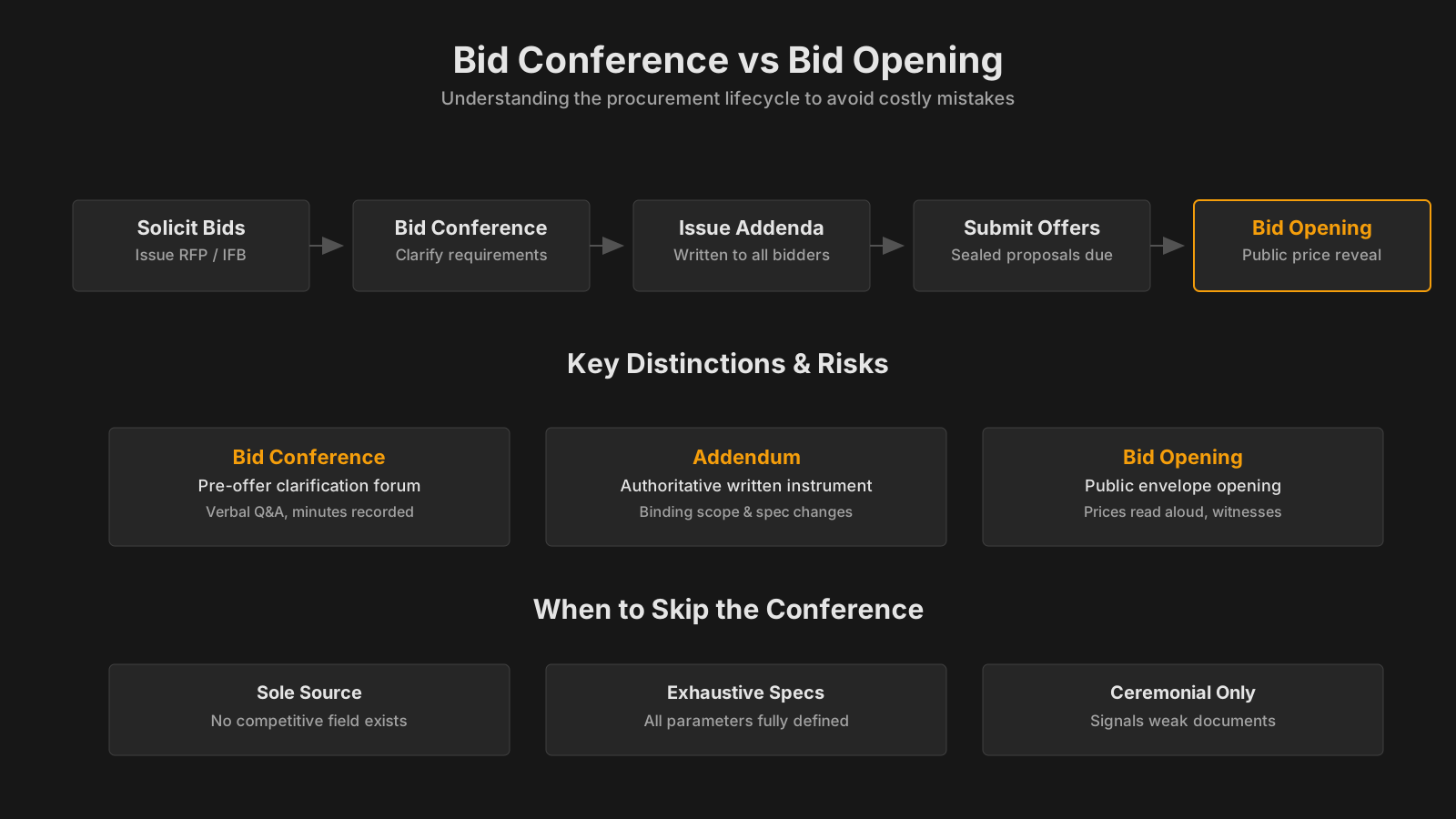
A bidder conference, also referred to as a contractor conference, vendor conference, or pre-bid meeting, is a formally structured session held by a buyer or project owner after the release of procurement documents but before bids or proposals are submitted. Within project management, it serves as the primary mechanism for ensuring that all prospective sellers receive identical, simultaneous access to clarifications, requirements interpretations, and contextual information that cannot be fully captured in a written request for proposal. The objective is not to negotiate or select a vendor but to build a common foundation of understanding that makes subsequent evaluations meaningful and comparable.
Bidder Conferences: Key Topics at a Glance
| Key Concept | Summary |
|---|---|
| Definition | A bidder conference is a structured forum where the buyer convenes all potential bidders after issuing procurement documents but before bid submission, ensuring uniform understanding of requirements and procurement procedures. It is often referred to as a contractor, vendor, or pre-bid meeting. |
| Core Purpose | It eliminates informational disparities by providing all prospective sellers with identical, real-time clarifications on ambiguous specifications, unwritten expectations, and operational context that a static request for proposal alone cannot fully convey. |
| Private Sector Use | While optional in many private sector procurements, holding a bidder conference becomes essential when the project entails emerging technology, multi-jurisdictional compliance, or integration with legacy systems, where unwritten assumptions can seriously distort cost estimates and delivery plans. |
| Addendum Process | An effective facilitator captures all substantive queries, prepares formal written responses, and circulates them as addenda to the entire bidder list. This transparency often necessitates sequenced amendments to solicitation documents and may extend the bidding timeline to preserve fairness. |
| PMBOK Framework | Aligned with the PMBOK Guide's Conduct Procurements process within Project Procurement Management, the bidder conference serves as a tool to establish a shared procurement baseline and proactively mitigate risks arising from divergent interpretations among bidders. |
| Scope Management | When clarifications reveal that the statement of work must be substantially revised, the project team must assess the impact on scope baselines and may need to formally re-baseline the procurement management plan to reflect the refined requirements and updated cost assumptions. |
| PRINCE2 Approach | Although PRINCE2 does not prescribe bidder conferences by name, its procurement guidance under the Managing Product Delivery process recommends structured supplier engagement activities that perform the same function of aligning expectations before contract award. |
| Core Value | The conference's fundamental worth lies in reducing information asymmetry, thereby preventing post-award disputes rooted in differing interpretations of ambiguous specifications. It locks in a shared technical and commercial understanding before irreversible commitments are made. |
What Is a Bidder Conference?
The definition of a bidder conference in project procurement management centres on its function as a two-way communication forum that supplements written solicitation materials. A buyer presents an overview of the project scope, contractual conditions, technical specifications, and evaluation criteria. Sellers then have the opportunity to ask questions, seek clarifications, and probe ambiguities in a setting where every competitor hears the same exchanges. This immediate, transparent airing of concerns distinguishes the conference from private correspondence that might inadvertently give one bidder an advantage over another.
Practitioners often describe the bidder conference as a levelling ritual. Procurement documents, no matter how meticulously drafted, contain gaps that only become apparent when an outside party tries to build a price around them. A conference forces those gaps into the open and, critically, ensures that every potential bidder hears the official interpretation at the same moment. In government-funded infrastructure projects, for instance, the conference is frequently a statutory requirement designed to demonstrate procedural fairness. In the private sector, it is sometimes optional but almost always advisable when the scope involves novel technology, cross-jurisdictional regulation, or interfaces with existing systems that bidders cannot easily inspect.
The phrase itself can be misleading. A bidder conference is rarely a single event that resolves every doubt. It often triggers a cascade of amendments to the solicitation package because a good facilitator writes down every substantive question, formulates a written answer, and distributes that answer as an addendum to all registered bidders. In that sense, the conference is a catalyst for a controlled documentation update, not a standalone event. The power lies in the record it generates, not merely in the discussion that takes place in the room.
Key Insights on Bidder Conferences
- Two-way communication forum
- This live, interactive setting allows buyers to detail the project scope, contractual terms, technical specifications, and evaluation criteria while sellers surface clarification questions, ensuring mutual understanding before proposals take shape.
- Transparent levelling ritual
- All competitors receive identical questions and official responses at the same time, eliminating the risk that private correspondence could grant any single bidder an unfair informational advantage.
- Mandatory in public projects
- Statutory requirements for government funded infrastructure often make bidder conferences compulsory to demonstrate procedural fairness; private organizations typically convene them voluntarily for initiatives involving novel technology or complex regulatory frameworks.
- Generates solicitation addenda
- A skilled facilitator captures every material inquiry and distributes official written answers as addenda to all registered bidders, a practice that frequently leads to a series of targeted amendments that refine the solicitation package into a definitive reference.
The Role of Bidder Conferences in Project Management Frameworks
Bidder conferences in the PMBOK framework are positioned inside the Conduct Procurements process, which is part of the Project Procurement Management knowledge area. The PMBOK Guide describes them as meetings between the buyer and prospective sellers held prior to submission of a proposal, with the intent of assuring that all bidders have a clear and common understanding of the procurement. The process emphasises that the buyer must treat every seller equally and that any clarification provided during the conference must be documented and shared with all participants. This is not just good practice; it is a defence against later protests, disputes, or allegations of unfair dealing.
The standard also flags a subtle danger. Conduct Procurements sits after Plan Procurement Management but before Control Procurements. When a conference shifts the underlying understanding of a requirement so dramatically that the statement of work itself must be rewritten, the project team may need to circle back and re-baseline parts of the procurement management plan. Failing to recognise this loop back is a common oversight. A project manager who treats the conference as a mere information session rather than a potential scope clarification event can end up with bids that reflect a requirement the project never intended, because the addendum process was not managed with sufficient rigour.
PRINCE2 does not contain an explicit term for bidder conferences, but its guidance on procurement within the Managing Product Delivery process and the Commercial Off-the-Shelf procurement pathway strongly implies the need for a comparable structured interchange. The PRINCE2 principle of focus on products demands that any external supplier understand not just what to build but the quality criteria against which delivery will be judged. In practice, PRINCE2 practitioners use supplier briefing events and clarification workshops that serve the same function. The key PRINCE2 twist is the presence of a senior user who can provide the voice of the customer during such sessions, reinforcing the link between procurement and anticipated benefits.
Agile environments rarely host traditional bidder conferences because the procurement model tends to be collaborative and iterative. When a buyer hires a team rather than orders a fixed deliverable, the selection process often involves work-sample evaluations and joint planning sessions instead of a single pre-bid meeting. That said, in scaled agile frameworks where an enterprise purchases a platform or a tool to support multiple teams, virtual vendor Q&A sessions fulfil a similar role. The format shifts towards recorded webinars, shared digital whiteboards, and an online repository where every vendor can see the same questions and answers, but the core principle of symmetrical information remains intact.
Key Characteristics and Components of a Bidder Conference
The key components of a bidder conference include a structured presentation, a moderated question-and-answer segment, and a formal mechanism for capturing and disseminating clarifications. The buyer typically opens with a walkthrough of the project background, the critical success factors, and the non-negotiable constraints embedded in the solicitation. This is not a sales pitch to entice bidders; it is a calibration exercise. The goal is to align all bidders’ mental models of what constitutes acceptable performance, an acceptable timeline, and an acceptable risk allocation.
Next comes the interactive portion, which needs to be facilitated with a discipline that inexperienced buyers sometimes underestimate. Questions must be logged verbatim. Answers must be reviewed by technical, legal, and procurement specialists before being spoken, because even a casual verbal response can become a binding commitment if it contradicts the written solicitation. Many seasoned buyers insist that no answer is final until it appears in an official addendum. The conference room itself is a recording environment, not a courtroom, and the material generated there feeds into subsequent contractual documentation.
An often overlooked component is the sign-in sheet and attendance record. Knowing who attended the conference later becomes critical if a losing bidder claims that it was excluded from material information. The record of who was present, combined with the distribution log for post-conference addenda, creates an audit trail that procurement auditors appreciate. This administrative detail does not feel strategic in the moment, but it is one of the elements that separates a professionally managed procurement from a sloppy one.
Every bidder conference also requires an explicit set of ground rules. Are recording devices permitted? Can bidders ask commercially sensitive questions about competitors? How will verbal exchanges that inadvertently reveal a competitor’s approach be handled? Without clear rules, a well-intentioned clarification can become a breach of confidentiality or even, in regulated sectors, a violation of anti-collusion statutes. The facilitator must be prepared to stop a question that drifts into proprietary territory, redact that portion from the public minutes, and handle the inquiry separately if the solicitation allows for confidential question submission channels.
Key Takeaways on Bidder Conference Components
- Calibration exercise, not sales pitch
- The buyer begins with a structured briefing on the project background, critical success factors, and non-negotiable constraints to establish a shared understanding of performance standards, delivery timelines, and risk allocation across all bidders.
- Answers vetted by specialists beforehand
- Because even an offhand reply can create a binding commitment if it conflicts with the written solicitation, every verbal response must be reviewed and cleared by technical, legal, and procurement experts before it reaches bidders.
- Finality reserved for official addenda
- Experienced buyers treat no clarification as final until it is formally issued in an official addendum, which ensures that all bidders receive identical, documented information and that no informal guidance carries contractual weight.
- Audit trail and proprietary safeguards
- Attendance logs and addenda distribution records create a defensible audit trail valued by procurement auditors, while facilitators must immediately interrupt and redact any proprietary question that arises, rerouting it through confidential communication channels when the solicitation permits.
Purpose and Importance of Bidder Conferences in Procurement Management
Understanding the purpose of bidder conferences in procurement management requires looking past the obvious function of answering questions. The deeper value lies in reducing information asymmetry and preventing the kind of downstream disputes that arise when a bidder discovers, after award, that its interpretation of a vague specification was different from the buyer’s. A well-executed conference compresses the range of possible misunderstandings before prices are locked in. This materially lowers the probability of costly change orders, claims, and relationship breakdowns later in the project lifecycle.
Bidder conferences also serve a screening function. Some bidders attend and, through the questions they ask, signal that they do not fully grasp the technical domain or the regulatory environment. The buyer cannot and should not use the conference to pre-judge specific bidders during the evaluation phase. However, observing the sophistication of the questions does give the buyer early intelligence about the strength of the pool and whether the procurement documents need supplementary education. In highly specialised procurements, the conference sometimes exposes that only one supplier truly understands the requirement, a warning sign that the buyer may need to re-scope the work to attract genuine competition.
Imagine a public utility procuring a control system upgrade that must interface with forty-year-old electromechanical equipment. Written specifications can describe the interface points, but a tour of the facility during the conference reveals the physical condition of the existing installation, the access constraints, and the site-specific hazards that no datasheet captures. Without that shared physical observation, every bidder would include an unstated risk premium in its price. The conference eliminates the information gap and allows bidders to price the observable risks rather than the imagined ones.
For the buyer, the conference is also a rare chance to correct procurement document errors before they become contract amendments. A bidder may point out that a referenced industry standard has been withdrawn, or that a required certification pathway no longer exists. The buyer who hears this early can issue a corrigendum and avoid a situation where all bids are technically non-compliant. This preventive aspect of the conference is arguably more valuable than the clarification function, yet it rarely gets mentioned in textbooks.
Distinguishing Bidder Conferences from Related Activities
It is easy to conflate a bidder conference with a pre-proposal meeting or a site visit, but the distinctions matter. A site visit is a physical inspection of the location where work will be performed. It may be combined with a bidder conference, but its primary purpose is observational, not discursive. A pre-proposal meeting can be a casual phone call with a single supplier, which would violate the equality principle if not replicated across all bidders. The bidder conference, by definition, is a collective, structured, recorded, and addendum-linked event open to all.
Another frequent point of confusion is the difference between a bidder conference and a negotiation. Negotiation happens after bids are received and evaluated, when the buyer engages one or more shortlisted bidders to refine terms. The bidder conference occurs before bids are submitted and strictly prohibits negotiation. If a buyer starts hinting at price ranges, adjusting scope, or making commitments in the conference, the procurement ceases to be a fair competition and enters legally hazardous territory. The boundary is absolute, and crossing it invites bid protests, litigation, and, in public procurement, personal liability for procurement officials.
Bidder conferences are also distinct from industry days, which some large government agencies use to gauge market interest before finalising the acquisition strategy. An industry day is a pre-solicitation engagement where the buyer explores what is available in the marketplace and shapes the requirement accordingly. A bidder conference takes place after the requirement is fixed and the solicitation is released. Confusing the two can lead bidders to believe the requirement is still negotiable, setting expectations the buyer cannot meet.
Differentiating Bidder Conferences from Similar Events
- Site visits are observational
- A site visit is a physical inspection of the work location with a purely observational purpose, contrasting with the interactive discussions of a bidder conference, though the two may be combined.
- Pre-proposal meetings risk inequality
- A casual pre-proposal conversation with a single supplier undermines the principle of equal access unless the same opportunity is systematically extended to all bidders.
- Bidder conference core definition
- The bidder conference is inherently a collective, structured, and recorded event that is formally tied to solicitation addenda and open to every bidder, ensuring a level playing field.
- Negotiation has strict boundaries
- Negotiation occurs exclusively after bids are received and evaluated; hinting at price ranges, adjusting scope, or making commitments during the conference exposes the procuring entity to bid protests and legal liability.
- Industry days precede solicitation
- An industry day is a pre-solicitation engagement that enables large agencies to assess market interest and refine requirements before finalizing the acquisition strategy.
Common Challenges and Misconceptions
One of the most persistent common pitfalls of bidder conferences is the illusion of complete information. Buyers sometimes come away believing that every ambiguity has been resolved, when in fact only the bidders who spoke up had their concerns addressed. Quieter attendees may have harboured doubts that never surfaced. Skilled facilitators actively draw out non-respondents, but even then, the conference cannot guarantee universal comprehension. It merely enhances the probability of it.
Another trap is the phenomenon of “bidder coaching.” When a seller asks a particularly insightful question, it inadvertently educates less experienced competitors about how to approach the work. This can compress the competitive field in ways the buyer did not intend. Some bidders avoid conferences for exactly this reason, calculating that their proprietary understanding is a competitive advantage they do not wish to share. The buyer who wants to encourage maximum participation may need to offer a confidential question submission process alongside the open forum, though this adds administrative complexity.
A widespread misconception is that a bidder conference is a sign of weak solicitation documents. In reality, the very act of convening one often improves document quality. The conference is not an admission of failure but a deliberate risk-mitigation practice. Organisations that skip conferences to project an image of rigour frequently pay for the omission later in the form of endless requests for information, bid withdrawals, and a weaker field of proposals.
Logistical challenges also bedevil bidder conferences, particularly international ones. Time zones, language barriers, and differing cultural norms about how openly one challenges a client can distort the flow of information. A North American buyer conducting a conference across Asia-Pacific time zones may find that very few verbal questions are asked, not because the solicitation is clear, but because suppliers from certain cultures are reluctant to appear confrontational in a public forum. In such cases, a written question-and-answer period after the conference becomes essential, and an initial virtual session may need to be followed by smaller, language-specific breakout discussions.
Evolution and Current Thinking
The modern best practices for bidder conferences have been reshaped by digital collaboration tools and a growing emphasis on fairness audits. The traditional in-person conference, often held in a hotel ballroom, is increasingly replaced or supplemented by a virtual format where bidders join via a web platform, questions are submitted through a chat panel, and the entire recordings are preserved and time-stamped. This shift has expanded participation, particularly among smaller firms that could not justify travel costs, and it has made the addendum process almost instantaneous.
A nuanced debate has also emerged about whether the conference should be mandatory or optional. Some organisations mandate attendance, reasoning that a bidder who skips the conference cannot claim ignorance of clarifications discussed. Others treat it as optional, arguing that mandatory attendance imposes a barrier and may deter innovative startups. The current thinking leans toward optional but strongly encouraged attendance, with a requirement that any bidder who opts out must formally acknowledge that it has received all post-conference addenda and bears full responsibility for incorporating them into its proposal.
The evolution has not entirely been positive. Virtual conferences have amplified the bidder coaching concern because competitors can record sessions and replay competitor questions indefinitely. They also make it harder for the buyer to read the room and sense which issues are creating genuine anxiety. The tactile intelligence of a physical gathering is lost, replaced by the sterile transparency of a chat log. Some procurement veterans still insist on an in-person conference for high-value, high-risk capital projects, precisely because they want to observe body language and the unspoken dynamics between competitors.
Current best practice therefore tends toward a hybrid model. A live-streamed session accommodates distant bidders, but key technical experts and the procurement lead are physically present in one location. Questions can be submitted both orally and in writing. The post-conference addendum is issued within 48 hours, and every bidder must acknowledge receipt before the submission deadline opens. This model balances the inclusivity of virtual tools with the relational depth of face-to-face interaction, and it is rapidly becoming the default for complex procurements across energy, transportation, and defence sectors.
Core Insights on Conference Evolution
- Virtual formats expand participation
- Digital platforms have largely replaced or enhanced in-person bidder conferences, enabling smaller firms to participate without travel expenses and accelerating addendum distribution to near-instant updates.
- Mandatory versus optional debate
- Procurement teams remain split between requiring attendance to forestall ignorance claims and keeping it optional to avoid discouraging innovative startups.
- Optional attendance with formal acknowledgment
- Current best practice favors optional but strongly encouraged attendance, coupled with a requirement that non-attendees formally acknowledge receipt of all post-conference addenda and accept full responsibility for integrating those updates into their proposals.
- Recording amplifies coaching concerns
- Because virtual conferences can be recorded and replayed indefinitely, the risk of bidder coaching intensifies, as competitors scrutinize every exchange for strategic advantage, distorting the intended competitive dynamics.
- Hybrid model for complex procurements
- A hybrid approach that combines virtual inclusivity with in-person relationship building is rapidly emerging as the standard for high-risk capital projects in energy, transportation, and defense, where trust and complex coordination are paramount.