Baseline performance is the expected level of project achievement defined by the approved plan, serving as a reference point against which actual progress and cost are measured. In disciplines that rely on earned value management, this concept is formalized through the Performance Measurement Baseline (PMB), an integrated set of scope, schedule, and cost baselines that provides the time-phased budget for all planned work. The term does not refer to a single metric but to the entire planned trajectory of performance, encompassing what should be delivered, when delivery is scheduled, and the resources authorized for that delivery. Without a clearly articulated baseline performance, project managers lack the yardstick to distinguish between normal execution variance and conditions that require intervention.
The utility of baseline performance lies in its role as the foundation of project control. Once the plan is approved and baselined, actual performance data can be compared against it to produce variances that trigger analysis and corrective actions. While the phrase might seem technical, the underlying idea is intuitive: any endeavor without a defined expectation of progress cannot be steered with confidence. In project management, baseline performance represents that expectation, codified and shared among stakeholders, creating a common language for discussing status, forecasting outcomes, and justifying scope, schedule, or budget trade-offs.
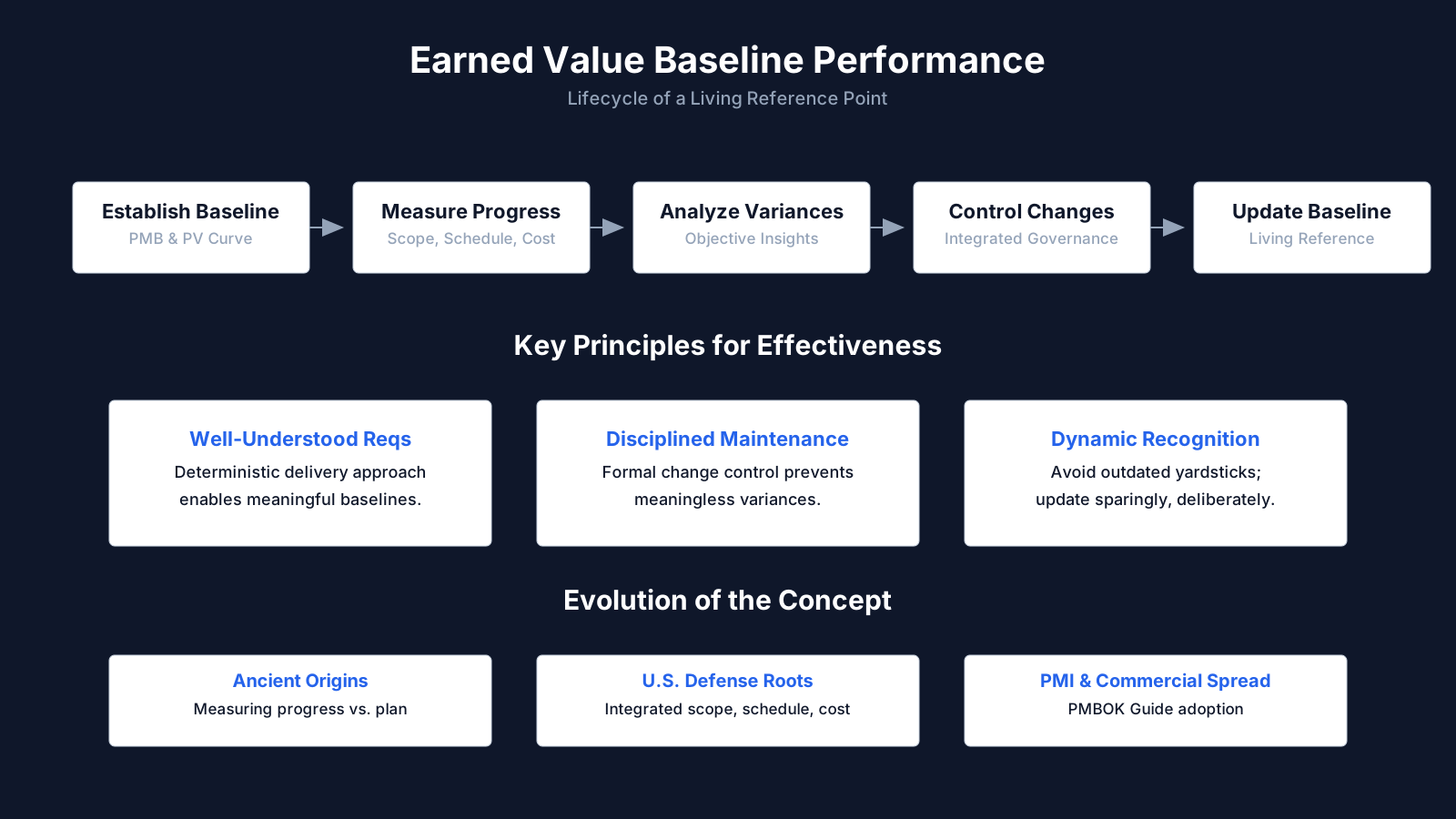
Baseline Performance: Key Topics Summary
| Key Concept | Summary |
|---|---|
| Baseline Performance | The approved plan establishes the expected level of project achievement, creating a consistent reference point for measuring actual progress and cost performance against original commitments. |
| PMB | The Performance Measurement Baseline integrates scope, schedule, and cost baselines into a unified framework, delivering the time-phased budget for all planned work and forming the foundation of earned value management. |
| Cost Baseline | This aggregation of authorized time-phased budgets for work packages and control accounts deliberately excludes management reserve, enabling precise tracking of cost variance and reliable expenditure forecasting. |
| Variance Analysis | Deviations between actual results and the baseline expose both schedule and cost variances, triggering root-cause investigation into factors such as underestimated complexity, overly optimistic assumptions, or resource constraints. |
| WBS Quality | A poorly constructed WBS embeds gaps into the baseline from inception, generating distorted variance reports that obscure actual project health and delay corrective action. |
| Schedule Optimism | An overly optimistic schedule baseline masks accumulating delays until the critical path is severely compromised, forcing drastic recovery measures such as fast-tracking or crashing that often introduce additional risk. |
| Cost Overruns | Although the cost baseline attracts the most organizational scrutiny, seasoned practitioners recognize that cost overruns nearly always trace back to unresolved scope or schedule root causes. |
| PMBOK Guidance | Both the sixth and seventh PMBOK editions position the performance measurement baseline as a core integration element; the seventh edition expands focus to performance domains while preserving baseline-driven measurement as a foundational practice. |
What is Baseline Performance?
The performance measurement baseline in project management is the approved integrated scope, schedule, and cost plan for a project, against which execution is measured and managed. It is not a static document but a formally controlled configuration that can be updated only through integrated change control processes. Within the PMBOK framework, the performance measurement baseline is central to the Monitor and Control Project Work and Control Scope, Schedule, and Costs processes. It is also the reference for earned value calculations, where planned value (PV) is derived directly from the baseline performance curve over time.
Practitioners often think of baseline performance as the sum of three interdependent commitments. The scope baseline includes the project scope statement, work breakdown structure (WBS), and WBS dictionary, capturing exactly what the project will deliver. The schedule baseline is the approved project schedule model, containing planned start and finish dates, milestones, and activity sequencing, against which schedule performance is measured. The cost baseline aggregates the authorized time-phased budgets for all work packages and control accounts, excluding management reserve, and is used to track cost variance and forecast expenditures.
When these three baselines are integrated, they form the performance measurement baseline, which essentially says: for each reporting period, this much scope is planned to be completed, within this much time, and at this much cost. Any deviation from this integrated picture constitutes a performance variance. That variance can be primarily scope-related, schedule-related, or cost-related, but in complex projects the three dimensions interact. A schedule slip often inflates costs, and a cost overrun can force descoping. Baseline performance serves as the equilibrium point from which these shifts are assessed.
The term baseline performance is sometimes used more loosely to describe the expected output rate or quality level, but in advanced project management it refers specifically to the quantified, time-phased performance expectation embedded in the measurement baseline. This distinction matters because without a stable, integrated baseline, claims about being “ahead” or “behind” become subjective and difficult to validate. It is the integration, not merely the existence of separate plans, that transforms a collection of plans into a management control instrument.
A car restoration project might illustrate how this works in a non-software context. The plan might state that by the end of week six, the engine rebuild and body sandblasting will be finished, consuming roughly $15,000. Baseline performance tells the project manager that, if reality matches the plan, those two deliverables should be complete and the actual costs should approximate the planned amount. If only the engine is complete and the team has already spent $18,000, the baseline performance flags both a schedule variance and a cost variance, prompting a search for root causes, whether they be underestimated complexity, resource inefficiency, or an optimistic original estimate.
Core Insights on Measurement Baselines
- Integrated triple baseline definition
- By fusing the approved scope, schedule, and cost baselines into a single time-phased framework, the performance measurement baseline provides the definitive benchmark against which all project execution is measured and governed.
- Earned value reference curve
- The planned value for each reporting period is drawn directly from the performance measurement baseline, serving as the critical yardstick for comparing actual progress and anticipating future cost performance.
- Controlled changes and variance detection
- Maintained as a formally controlled configuration under integrated change control, the baseline instantly flags deviations as schedule or cost variances, compelling systematic root cause analysis before they compound.
Key Components of Baseline Performance
A detailed understanding of the key components of baseline performance reveals why the concept is far more than a static plan. The three foundational baselines each carry structural characteristics that influence how the integrated baseline behaves under real-world stress. The scope baseline is inherently hierarchical, decomposing the project into manageable work packages and then into activities. This decomposition determines the granularity of performance measurement. If the WBS is poorly constructed or omits critical integrations, the baseline performance will contain blind spots from the start, producing misleading variance reports later.
The schedule baseline translates scope into a time-sequenced network of dependencies, incorporating resource availability, calendars, and logical constraints. Its validity rests on accurate activity duration estimates and dependency modeling. Schedule baseline performance is monitored through metrics such as schedule variance (SV) and schedule performance index (SPI), but these only have meaning if the baseline reflects a realistic execution path. A common frustration among project managers is that an overly optimistic schedule baseline can disguise real delays until the critical path is so compromised that recovery becomes impossible without drastic measures like fast-tracking or crashing.
The cost baseline aggregates the authorized budgets for each scheduled activity, typically distributed over time as a cumulative S-curve. This baseline does not include management reserve, which is held separately for unforeseen risks that fall outside the project’s risk register. Cost baseline performance is measured through cost variance (CV) and cost performance index (CPI). Because the cost baseline is a direct financial commitment, it often receives the most organizational scrutiny, but experienced practitioners know that a cost overrun nearly always has a scope or schedule root cause. Isolating cost without examining schedule and scope completeness leads to distorted interpretations of project health.
Integration of the three baselines means that a change in any one dimension must be evaluated for its impact on the others. If a stakeholder requests a new feature, the scope baseline change triggers analysis of schedule impact and additional budget requirements. Only after approved change control is the performance measurement baseline revised, and at that point the new baseline performance expectation replaces the old one for future measurement. Without strict integrated change control, the baseline quickly becomes a historical curiosity rather than a management tool.
In practice, many project teams also derive a planned value curve from the performance measurement baseline. This curve plots the cumulative planned budget against time and serves as the primary visual comparator for earned value analysis. Any deviation of the earned value line or actual cost line from this planned curve signals a potential performance issue. The shape of the planned value curve – often an elongated S – reflects the typical project life cycle where expenditures ramp up during execution and taper off during closure. Baseline performance thus includes the implied expenditure rhythm, helping stakeholders anticipate funding needs and identify periods of peak resource loading.
Baseline Performance in Project Management Frameworks
The treatment of baseline performance in PMBOK, PRINCE2, and Agile frameworks demonstrates how different methodologies adapt the same essential idea to their governance models. PMBOK’s sixth and seventh editions both emphasize the performance measurement baseline as a core element of project integration management, though the seventh edition shifts focus from process groups to performance domains while retaining baseline-driven measurement as a fundamental principle. Within PMBOK, baseline performance is not an optional artifact. It is the logical result of the Develop Project Management Plan process and is maintained throughout project execution via the Perform Integrated Change Control process.
PRINCE2 approaches the same concept through its emphasis on baselines for management stages and the project plan. The Project Plan in PRINCE2 serves as a baseline for measuring overall project achievement, while stage plans provide more detailed baselines for shorter-term control. Tolerances – the permissible deviations from these baselines – are set for time, cost, scope, risk, quality, and benefits. If a forecast exceeds a tolerance, the project board must be consulted, and an exception report is generated. Baseline performance in PRINCE2 therefore acts as the boundary line within which the project manager has authority to act without escalation. That connection between baseline and delegated authority is a distinguishing feature, emphasizing governance over mere measurement.
In Agile environments, the concept of a detailed, monolithic baseline performance that spans the entire project is often considered unrealistic and counterproductive. Instead, Agile teams use lightweight baselines at multiple levels. A release plan may establish an initial scope and delivery forecast against which overall progress is tracked, while iteration plans provide short-term baselines for each sprint. Velocity, calculated from historical performance, becomes a dynamic performance benchmark that replaces the static schedule baseline for forecasting future work. Burn charts and cumulative flow diagrams offer continuous visual comparison of actual progress against the remaining scope, effectively creating a rolling baseline that adjusts as understanding deepens.
Hybrid approaches frequently maintain a high-level integrated baseline for the whole project, while allowing for detailed rolling wave baselines in the near term. For example, a product development effort might baseline overall funding and a target release window, but execute using two-week sprints with sprint-level baselines. The aggregate baseline performance is then updated through formal change control only when major scope shifts occur, while tactical performance adjustments happen at the team level. This dual-layer baseline structure preserves the governance benefits of traditional baselining without imposing excessive rigidity on technical teams that need to adapt to emerging requirements.
Core Insights on Baseline Approaches
- PMBOK baseline-driven measurement
- The PMBOK Guide regards the performance measurement baseline as a cornerstone of project integration management in both editions, and the seventh edition’s shift from process groups to performance domains reinforces that baseline-driven measurement remains essential for identifying variances and guiding corrective actions.
- PRINCE2 tolerance governance
- PRINCE2 uses the Project Plan as the overall baseline and stage plans for nearer-term control, defining explicit tolerances for time, cost, scope, risk, quality, and benefits; breaching any tolerance triggers an exception report and escalates the decision to the project board for a deliberate response.
- Agile rolling baseline concept
- Instead of a single upfront baseline, Agile methodologies employ empirical tools like burn charts and cumulative flow diagrams to create a rolling baseline that continuously replots actual progress against the remaining scope, enabling frequent inspection and adaptation without losing sight of delivery commitments.
- Dual-layer baseline structure
- Agile projects often pair a high-level baseline for funding and release windows with detailed sprint-level baselines, which preserves governance transparency while allowing technical teams to incorporate emerging requirements and validated learning into each iteration.
BVOP Perspective on Baseline Performance
The BVOP approach to baseline performance challenges traditional assumptions about the stability and accuracy of baselines derived from work breakdown structures. BVOP explicitly warns that WBS-based scope baselines often become inaccurate beyond the first few levels of decomposition when the project involves significant uncertainty or discovery work. To address this, the methodology advocates for relational effort points rather than precise time and cost estimates for work that cannot be fully defined upfront. Baseline performance, in this view, is expressed less as a fixed quantity of deliverables and more as a flow of prioritized business value points, with the expectation that scope will be refined continuously as users provide feedback.
BVOP’s five-level scope classification, ranging from Definite to Unlikely, directly affects how baseline performance is established and maintained. Only work items classified as Definite or Highly Probable are baselined with detailed resource allocations. Items at lower probability levels are planned as provisional inclusions, with the understanding that they may be descoped or replaced without triggering formal rebaselining. This shifts the meaning of baseline performance from a contractual obligation to achieve everything initially planned to a dynamic target that maximizes value delivered within a given budget and timeline. In environments where requirements are volatile, this approach reduces the administrative burden of constant rebaselining while maintaining a transparent record of what was intended and what was ultimately delivered.
Purpose and Importance of Baseline Performance
The purpose of baseline performance extends well beyond variance calculation; it establishes the accountability framework that makes project management a disciplined profession. By formally approving a baseline, sponsors and project owners signal their endorsement of the planned cost, timeline, and scope, transferring to the project manager the authority to execute within those constraints. This delegation of authority is psychologically and contractually significant. Without a baseline, the project manager operates in a perpetual state of negotiation, unable to distinguish between necessary adaptation and simple failure to meet previous commitments.
Baseline performance also enables forecasting. Metrics like the estimate at completion (EAC) and the to-complete performance index (TCPI) use the cost baseline and actual cost performance to project final costs and to indicate the efficiency required for the remainder of the project to stay on budget. Without a reliable baseline, these forecasts are speculative at best. A contractor on a fixed-price project, for instance, watches the CPI trend against the baseline performance monthly, because a downward trend below 1.0 predicts a gross margin erosion that must be addressed before reserves are exhausted. In such contexts, baseline performance is not a theoretical tool but a financial survival mechanism.
Another essential function is the early warning it provides. A small negative schedule variance that recurs over several reporting periods, even if still within tolerance, can point to a systemic underestimation of task complexity or a productivity drag that will eventually cascade. Baseline performance, when updated with actual data and trended over time, surfaces patterns that single data points miss. Seasoned project managers learn to read these emerging patterns and intervene before the variance exceeds thresholds, using the baseline as a diagnostic instrument rather than a mere reporting requirement.
Organizations also use baseline performance for portfolio governance. When program managers aggregate the performance data of multiple projects, they compare each project’s actual consumption against its baseline to identify which initiatives are demanding a disproportionate share of resources relative to planned value. This portfolio-level view informs decisions about continuing, pausing, or accelerating projects. Without baseline performance, the portfolio manager has no objective basis to argue that Project A is drifting while Project B is executing tightly, making resource reallocation discussions vulnerable to political influence rather than data-driven reasoning.
Core Insights on Performance Baselines
- Accountability through formal approval
- Formal approval vests the project manager with authority and simultaneously establishes clear accountability for delivering within the agreed cost, schedule, and scope constraints.
- Enables cost forecasting metrics
- By comparing actual performance against the cost baseline, metrics such as estimate at completion and the to-complete performance index forecast final costs and signal the efficiency required to finish on budget.
- Diagnostic instrument for early intervention
- Persistent patterns like a CPI below 1.0 or recurring negative schedule variance act as diagnostic signals, enabling experienced managers to detect systemic issues and intervene before control limits are breached.
- Objective basis for portfolio decisions
- Aggregated baseline performance data across projects provides program managers with an objective, evidence-based foundation for reallocating resources, eliminating reliance on political influence or subjective judgment.
Applying Baseline Performance in Real-World Projects
The application of baseline performance takes concrete form during regularly scheduled performance reviews, typically conducted at the control account or work package level. Project teams collect actual start and finish dates, actual costs, and the percentage of physical work completed, then compare these data points to the baseline. The resulting variances are analyzed for root causes and, where necessary, accompanied by change requests to realign the baselines. In complex capital projects, this cycle might run weekly, with integrated baseline reviews occurring monthly in front of steering committees. The baseline becomes the narrative spine of the project’s status presentation, with every slide or dashboard tile ultimately referring back to a variance from that original commitment.
Rebaselining is a critical application concept often misunderstood. When a project experiences a significant and irreversible deviation from its original plan, decision-makers may authorize a new baseline so that future performance measurement remains meaningful. Rebaselining is not a remedy for poor execution; it is an administrative acknowledgment that the assumptions underpinning the original baseline no longer hold and that the remaining work plan requires a fresh foundation. Without careful governance, however, frequent rebaselining can erode the very accountability that the baseline is supposed to enforce. Project offices often impose strict rules: rebaselining may require sponsor approval, documentation of root causes, and a detailed explanation of how the new baseline will prevent recurrence of the conditions that triggered the rebaseline.
Another practical use of baseline performance is in incentive contracting. Many engineering, procurement, and construction contracts tie fee adjustments or bonuses to performance against an agreed baseline. If the contractor exceeds the baseline schedule performance index by a predetermined margin, they earn additional profit. If they underperform, penalties may apply. This aligns the contractor’s motivation with the owner’s expectation, but it also places immense pressure on the accuracy and fairness of the original baseline. A baseline that is too aggressive will penalize capable performers; one that is too lenient rewards mediocrity. Getting baseline performance right at contract signing is therefore a negotiation skill as much as a planning activity.
Organizations that thrive in project execution treat baseline performance as a living management tool, not as an artifact to file and forget. They train project managers to interpret variances as signals that drive root cause discussions and to resist the temptation to dismiss persistent negative trends as temporary aberrations. They invest in project management information systems that automatically calculate earned value metrics and highlight threshold breaches, freeing the project manager to focus on analysis and corrective action rather than manual calculation. In such environments, baseline performance becomes part of the organizational culture, a shared reference that everyone from team members to executives understands and respects.
Common Pitfalls and Misconceptions About Baseline Performance
One of the most persistent common misconceptions about baseline performance is the belief that it should never change once approved. While uncontrolled change is destructive, a baseline that no longer reflects project reality ceases to be useful as a benchmark. Projects operating in emerging technology or under evolving regulations often encounter forces that genuinely invalidate the original plan. In these cases, refusing to rebaseline turns the performance measurement into a game of pretending to fail until the end, at which point everyone acknowledges the plan was unrealistic. The disciplined approach is not immutability but controlled evolution, where baseline revisions are documented, justified, and approved through formal governance.
Another frequent pitfall is overemphasizing cost baseline performance at the expense of scope and schedule integration. A project that appears under budget may have simply deferred expensive scope to a later phase, artificially inflating the CPI while masking a growing scope debt. Similarly, a project that is ahead of schedule according to SPI may have accomplished progress by focusing on low-value activities, leaving critical path work untouched. Without the integrated view, single-dimension metrics can paint a dangerously rosy picture. Baseline performance, by definition, loses its diagnostic power when the dimensions are assessed in isolation.
Baseline erosion, where gradual informal adjustments are made to plans without proper change control, is another subtle destroyer of baseline integrity. A team lead extends a deadline by a few days without updating the schedule baseline; a project manager redirects contingency funds to cover a minor overrun without recording a cost baseline change. Over weeks and months, the baseline drifts away from the documented version, and the performance reports become fiction. This pattern is especially common in organizations with low project management maturity, where processes exist on paper but are not enforced. Restoring the baseline in such environments requires not just process reeducation but cultural reinforcement that small, undocumented changes collectively represent a serious governance failure.
Finally, confusion between baseline performance and actual performance expectations can lead to flawed decision-making. Baseline performance represents the original plan, not necessarily the current realistic forecast. A project that is performing poorly may still be viable if the original baseline was excessively ambitious, but executives can mistakenly conclude that the project is doomed when they see large negative variances. The conversation should shift from variance magnitude to whether the remaining work is achievable and whether the business case remains positive. Baseline performance anchors that conversation but should not be allowed to stifle honest reassessment of project feasibility.
Key Insights on Baseline Pitfalls
- Baselines need controlled evolution
- When a baseline no longer reflects the actual project, it ceases to function as a meaningful benchmark; revisions should therefore be governed by a formal process of documentation, justification, and approval rather than being treated as off-limits.
- Under-budget status can deceive
- An apparent cost under-run may simply reflect the deferral of expensive scope to later phases, artificially boosting the cost performance index while silently accumulating scope debt that will need to be settled.
- Schedule progress may mislead
- A favorable schedule performance index can be generated by concentrating on low-value activities while critical path work stalls; single-dimension metrics therefore demand cautious interpretation to avoid overlooking real delays.
- Small changes signal governance failure
- Undocumented adjustments such as deadline extensions without baseline updates or unrecorded contingency fund transfers betray a deeper governance breakdown that requires reinforcing control mechanisms and a culture of accountability to correct.
Relationship to Other Management Concepts
The interplay between baseline performance and earned value management is the most immediate and technical relationship. Earned value management translates the performance measurement baseline into planned value, then compares it with earned value and actual cost. Variance formulas such as SV, CV, SPI, and CPI all depend on the existence of a credible baseline. Moreover, the estimate at completion and the to-complete performance index derive their meaning from how they reframe the gap between current performance and the baseline’s forecast. Without baseline performance, EAC becomes a pure extrapolation without a comparative anchor, losing much of its managerial utility.
Beyond EVM, baseline performance is tightly linked to the concept of management reserve. The cost baseline deliberately excludes management reserve, which is held for unidentified risks. Performance measurement against the baseline reveals variances that, if they exceed the contingency reserve allocated for known risks, may trigger the use of management reserve. This requires change control, which effectively sets a new baseline inclusive of the reserve drawdown. The baseline performance boundary therefore defines the point at which routine response ends and executive-level risk management begins.
Change control and configuration management are process counterparts of baseline performance. The performance measurement baseline is a configuration item, meaning any modification to it must follow a formal change request path that includes impact analysis, approval, and documentation. This ensures that the baseline always reflects the latest authorized plan, and that unauthorized work – scope creep – cannot silently alter performance expectations. In high-reliability organizations such as aerospace and defense, this traceability is not optional, it is a regulatory requirement tied to contract compliance and safety certifications.
Rolling wave planning and progressive elaboration also shape how baseline performance is established over time. In projects where the full scope cannot be defined in detail at the start, only the immediately foreseeable work is baselined with precision, while future phases carry summary-level budgets and placeholder schedules. As more information becomes available, the baseline is elaborated and, if necessary, reapproved. This dynamic approach maintains baseline integrity while acknowledging that project uncertainty demands flexibility. The baseline performance, in such cases, evolves from a rough outline into a detailed map, always remaining the single source of truth for what is currently authorized.
Evolution and Current Thinking on Baseline Performance
The evolution of baseline performance reflects a broader shift from rigid, document-driven project management toward adaptive systems that still value accountability. In the mid-twentieth century, large government programs in defense and infrastructure pioneered the use of integrated baselines to control multibillion-dollar efforts. These early baselines were cumbersome to maintain, often distributed as printed reports that were out of date before they reached the desk of a decision-maker. The rise of project management software in the 1980s and 1990s made baseline capture and variance calculation vastly more efficient, enabling near-real-time performance dashboards that dramatically increased the speed of control cycles.
Agile and DevOps movements have introduced the strongest challenge to traditional baseline thinking. In domains where customer requirements shift monthly or even weekly, a twelve-month frozen baseline is seen as a relic of waterfall imagination. Thought leaders in Agile product development argue that baselines should be replaced by empirical data from actual team throughput, with plans and forecasts updated continuously based on observed velocity and lead time. Baseline performance, in this context, becomes a lightweight rolling forecast rather than a formal deliverable approved by a steering committee. However, many organizations that adopt Agile at the team level still require an aggregate baseline for funding governance and external reporting, creating tension between operational agility and strategic control.
Current best practice acknowledges both perspectives and supports a layered baseline model. The outer layer comprises a high-level, stable baseline that protects the business case and funding envelope. The inner layer consists of detailed, frequently adjusted baselines for near-term execution. Digital project management tools now enable this layered approach by maintaining multiple baseline snapshots and automatically flagging when inner-layer deviations accumulate to a point where they threaten the outer-layer commitments. The baseline performance concept thus endures, but its implementation has become more nuanced, recognizing that the right level of baseline detail depends on the project’s uncertainty profile and the organization’s tolerance for adaptation.
Debates continue about whether baseline performance, as traditionally measured by schedule and cost variance, should be supplemented with value-centric metrics such as net promoter score of delivered increments or business value achievement. Some modern methodologies advocate for a shift away from plan-centric performance measurement toward outcome-centric measurement, where baseline performance is defined by the anticipated benefits stream rather than the intermediate outputs. While this reframing has appeal for innovation projects where intermediate deliverables may change, practitioners in capital-intensive industries note that cost and schedule baselines remain indispensable for contracts and regulatory compliance. The most mature organizations blend both perspectives, using baseline performance to control execution efficiency while also tracking value realization to guide strategic pivots.
Key Insights on Baseline Evolution
- Shift from rigid to adaptive baselines
- Baseline management has evolved from static, document-heavy controls in mid-century government programs to adaptive digital frameworks that preserve rigorous accountability while accelerating decision cycles and enabling continuous performance monitoring.
- Agile tension over frozen baselines
- Agile thought leaders advocate replacing twelve-month frozen baselines with empirical throughput and cycle-time metrics, yet many organizations still mandate aggregate baselines for funding governance and external reporting, creating an enduring tension between iterative delivery and institutional oversight.
- Layered baselines and value metrics
- Modern project management platforms support layered baseline snapshots that reveal cumulative deviations across multiple dimensions, while the debate intensifies over supplementing cost and schedule variance with value-centric indicators such as business outcomes realized and strategic return on investment.