Delivery cadence in project management is defined as the recurring rhythm and frequency at which deliverables, increments, or value are completed, demonstrated, and handed over to stakeholders. It establishes a predictable pattern for when work results become available and how often the project produces verifiable outputs. The concept applies across predictive, hybrid, and adaptive environments, although its mechanics differ depending on the delivery approach. A well-defined delivery cadence reduces uncertainty and makes project progress tangible to sponsors and users.
Delivery Cadence: Key Topics at a Glance
| Key Concept | Summary |
|---|---|
| Delivery Cadence | Delivery cadence defines the predictable rhythm at which work is completed, validated, and transferred to stakeholders, creating reliable expectations and flow. |
| Cadence Interval Options | Cadence intervals may be weekly, biweekly, monthly, quarterly, or another frequency selected to match work complexity, team capacity, and stakeholder expectations. |
| Schedule Flexibility Within Cadence | A steady two-week delivery cycle offers a stable planning framework while preserving flexibility for task-level sequencing and day-to-day adjustments. |
| Components of Delivery Cadence | Delivery cadence encompasses releases, internal handoffs, demonstrations, formal acceptance events, and stage-gate transitions, ensuring alignment across the full value stream. |
| Development Rhythm vs Release Timing | Teams can sustain a consistent development rhythm while decoupling release timing to accommodate marketing, regulatory, or customer readiness constraints. |
| Sprint Completion vs Customer Delivery | Recognizing this distinction prevents the common mistake of assuming that a sprint conclusion automatically indicates customer-visible delivery or market release. |
| Takt Time as Demand-Driven Cadence | Lean manufacturing applies takt time to synchronize production pace with actual customer demand, treating cadence as a demand-driven operating rhythm. |
| Value of Short Delivery Cycles | Short value-focused delivery cycles surface waste such as overprocessing, perfectionism, and rework earlier than lengthy phase-based delivery, enabling faster correction and learning. |
What Is Delivery Cadence in Project Management?
A precise delivery cadence definition describes the scheduled rhythm of completed work rather than the tempo of individual tasks. It answers the question of how frequently a project team produces something that can be inspected, released, or used. In a predictive project, that might mean the interval between formal stage deliverables. In an Agile context, it usually refers to the length of a sprint or the frequency of a release. The common thread is that delivery cadence turns abstract progress into a visible, recurring event.
Practitioners often notice that teams can be very busy without actually delivering anything usable. Delivery cadence is not about activity volume. It is about the regularity with which completed work crosses the boundary from the team to the customer or sponsor. For example, a team might write code every day, but if that code only reaches production twice a year, the delivery cadence is two releases per year. The daily work rhythm is separate from the delivery rhythm. That distinction matters because stakeholders experience the delivery rhythm, not the internal effort.
In plain terms, delivery cadence works like a public transport timetable. Buses may move through traffic constantly, but passengers experience the schedule as buses arriving every ten minutes, every hour, or at irregular times. The timetable creates confidence and allows people to plan. A project team that delivers at a known cadence gives stakeholders the same kind of planning ability. Without a timetable, every arrival feels unpredictable even if the bus is always somewhere in motion.
Delivery Cadence Explained
The term combines two ideas. Delivery refers to the transfer of completed work products, capabilities, or value to a stakeholder who can use them. Cadence refers to a steady, rhythmic pattern. Together they describe a delivery system with a recognizable beat. In project management, that beat can be weekly, biweekly, monthly, quarterly, or any other interval that fits the work and the stakeholder environment. The rhythm may be formalized in a schedule, a sprint cycle, a release calendar, or a service-level expectation.
Delivery cadence is not exactly the same as project schedule. A schedule identifies specific dates for many activities. Cadence focuses on the recurring interval between comparable delivery events. A project can have a detailed schedule but an inconsistent delivery cadence, especially if milestones keep moving or work packages complete unevenly. Conversely, a project with a steady two-week delivery cycle can tolerate some flexibility in the detailed schedule because the cadence itself provides a stable container for planning and review.
Delivery Cadence vs Release Cadence and Iteration Cadence
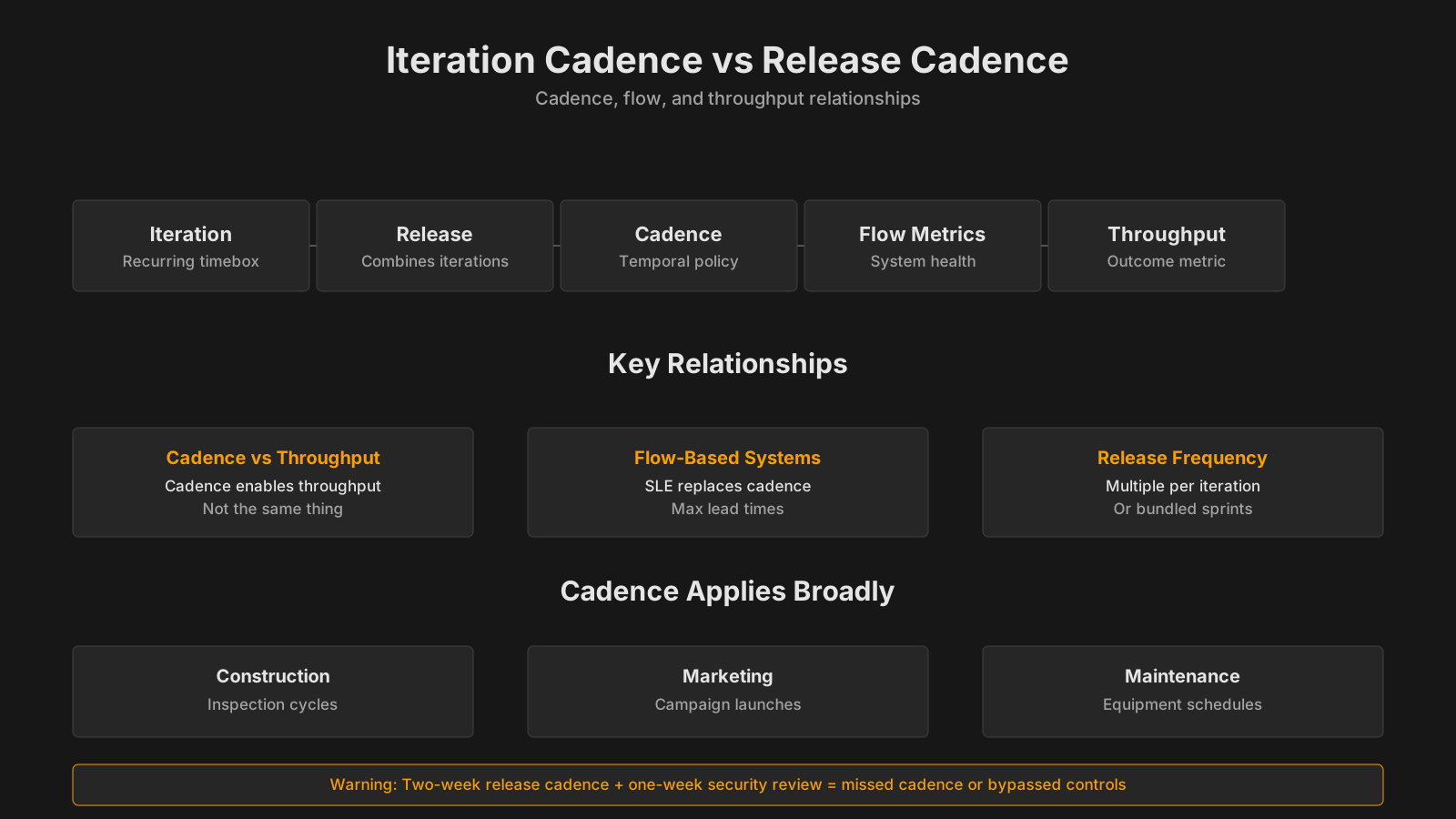
These terms are related but not interchangeable. Iteration cadence is the rhythm of timeboxed development cycles, such as a two-week sprint. Release cadence is the rhythm at which completed increments are actually deployed or made available to users. Delivery cadence encompasses both, but it also includes internal handoffs, demonstrations, formal acceptance events, and stage boundary deliveries. A team may have a two-week iteration cadence and a monthly release cadence. In that case, the delivery cadence for external stakeholders is monthly, while the internal delivery of working increments happens twice as often.
Some frameworks deliberately decouple release cadence from iteration cadence. This allows teams to maintain a stable development rhythm while releasing on a separate schedule that respects marketing, regulatory, or customer readiness. Understanding this distinction prevents a common error: assuming that the end of a sprint automatically means something reached the customer. Sprint completion is an internal iteration event. Release completion is an external delivery event.
Core Insights on Delivery Cadence
- Rhythm of completed work
- Delivery cadence refers to the predictable pattern of completed deliverables, distinguishing it from the pace at which individual tasks are executed.
- Frequency of usable output
- This metric captures how often a team produces outputs that stakeholders can inspect, release, or put to immediate use.
- Context shapes the definition
- In predictive projects, it represents the interval between formal stage deliverables, whereas in Agile it aligns with sprint length or release frequency.
- Visibility through recurring events
- A well-defined cadence turns abstract progress into a recurring checkpoint that is visible to customers, sponsors, and the broader organization.
- Stability for flexible planning
- A consistent delivery cycle, such as a two-week release, creates a stable planning framework that accommodates adjustments to the detailed schedule without disrupting overall flow.
Origins and Cross-Industry Context of Delivery Cadence
The origins of delivery cadence are not unique to project management. The word cadence comes from music and poetry, where it describes rhythm, flow, and the resolution of phrases. Business and engineering disciplines borrowed the term to describe regular production and delivery rhythms. Lean manufacturing, for example, uses takt time to align production speed with customer demand. Just-in-time supply chains rely on predictable replenishment intervals. These ideas migrated into software engineering and project management through Lean, Agile, and product development practices.
In publishing, a magazine follows a monthly or weekly publication cadence. In logistics, trucks may depart on a fixed schedule regardless of whether they are completely full. In medicine, clinical rounds happen at regular intervals so that care teams can inspect and adjust. The common purpose in all these settings is synchronization. A known cadence lets people coordinate without constant renegotiation. Project management adopted the same logic to coordinate development, testing, approval, and handover activities.
Cross-industry use also highlights that cadence is context dependent. An emergency room cannot deliver patient outcomes on a fixed monthly schedule. A construction project may deliver at stage completions rather than weekly installments. The concept transfers into project management not as a single universal interval, but as the principle that delivery should have a deliberate, communicable rhythm. What works in software may not work in aerospace, but the underlying question is the same: how often can stakeholders expect a meaningful result.
Key Components of Delivery Cadence
Several key components of delivery cadence determine whether the rhythm is effective. These components include frequency, reliability, synchronization, and batch size. Frequency is the interval between delivery events. Reliability is the degree to which the team meets that interval without repeated slippage. Synchronization describes how the delivery rhythm aligns with governance, testing, and stakeholder review cycles. Batch size is the amount of work included in each delivery. Together these components shape the experience of receiving project value.
Frequency and Interval
Frequency is the most visible component. It defines the elapsed time between comparable delivery points. Common frequencies in adaptive projects include weekly, biweekly, and monthly. In predictive projects, the frequency may align with phase boundaries, gate reviews, or contractual milestones. The appropriate frequency depends on the speed of feedback loops, the cost of deployment, and the stakeholder capacity to absorb new work. Too frequent delivery can overwhelm users. Too infrequent delivery can hide problems for long periods.
Reliability and Consistency
Reliability matters more than raw speed in most cases. Stakeholders can plan around a steady monthly release far more easily than around a theoretically faster but erratic schedule. A team that delivers every two weeks for six months builds a reputation for predictability. A team that delivers sometimes weekly and sometimes quarterly creates uncertainty even if the average interval looks similar. Consistency reduces coordination costs because reviews, approvals, and integration activities can be arranged around a known pattern.
Synchronization and Batch Size
Synchronization ensures that delivery events align with other important project rhythms. A delivery cadence that ignores a monthly steering committee or a quarterly regulatory cycle creates friction. Batch size interacts with frequency because smaller batches can move more often without overloading downstream consumers. Large batches delivered frequently create high review burden and integration risk. Project teams often adjust batch size and frequency together to achieve a sustainable and meaningful delivery rhythm.
Essentials of Delivery Cadence
- Four Core Components
- Delivery cadence effectiveness depends on four primary building blocks: frequency, reliability, synchronization, and batch size.
- Reliability Means No Slippage
- Reliability reflects how consistently the team meets each scheduled delivery interval without recurring delays, deferrals, or last-minute rescheduling.
- Synchronization with External Cycles
- Synchronization aligns the delivery rhythm with governance reviews, testing windows, and stakeholder approval cycles, reducing handoff friction and helping work flow smoothly across the organization.
- Frequency Adapts to Context
- Adaptive projects typically operate on weekly, biweekly, or monthly cycles, whereas predictive projects tie their delivery frequency to phase boundaries, gate reviews, and contractual milestones.
- Predictability Beats Speed
- A steady, predictable rhythm lowers coordination overhead and gives stakeholders a dependable basis for planning, while an erratic schedule undermines confidence even when its average pace appears acceptable.
Delivery Cadence in Project Management Frameworks
The concept of delivery cadence in PMBOK appears most explicitly in the seventh edition through the glossary definition of cadence as a rhythm of activities conducted throughout the project. PMBOK does not prescribe a single cadence for all projects. Instead, the delivery performance domain addresses how the project delivers scope and quality, and the development approach and life cycle domain shapes whether delivery happens in phases, iterations, or a continuous flow. Cadence becomes a tailoring decision based on product characteristics, stakeholder needs, and organizational constraints.
PMBOK and Predictive Environments
In a predictive or waterfall environment, delivery cadence often aligns with the project life cycle phases. Formal deliverables may be produced at the end of requirements, design, build, test, and deployment phases. The cadence is therefore relatively infrequent and heavily governed. Stage gate reviews act as delivery checkpoints. While predictive projects can produce intermediate deliverables, the external delivery of usable value often occurs late. This is one reason predictive approaches carry higher integration risk on complex or uncertain work.
Delivery Cadence in PRINCE2
PRINCE2 does not use the term delivery cadence directly, but the concept is embedded in management by stages. A PRINCE2 project is divided into management stages, and the project board authorizes one stage at a time. Each stage produces a defined set of products, and stage boundaries serve as controlled delivery points. Work packages within a stage are authorized and accepted by a team manager. The stage length and the frequency of checkpoint reports create a governance rhythm. Delivery cadence in PRINCE2 therefore emerges from the duration of management stages and the formal acceptance of stage products.
Delivery Cadence in Agile, Scrum, and SAFe
Agile methods make delivery cadence central to the operating model. Scrum defines a fixed-length sprint of one month or less during which a usable increment must be created. The sprint review is a recurring delivery event where stakeholders inspect the increment. SAFe structures delivery around iterations and program increments. A program increment is typically eight to twelve weeks, with iterations of two weeks inside it. Release on demand allows value to reach customers when the market is ready, while the development cadence remains stable. This separation prevents development rhythm from being dictated solely by release anxiety.
Delivery Cadence in Kanban and Continuous Delivery
Kanban does not require fixed iterations, but it uses cadence for specific events such as replenishment, delivery planning, and service delivery reviews. Work items flow continuously, and the rate of delivery is measured through throughput and cycle time. Continuous delivery takes this further by enabling small changes to be released to production as soon as they pass automated tests and deployment checks. The cadence in a continuous delivery environment may be measured in hours or days rather than weeks. However, even continuous flow systems benefit from regular review and planning rhythms to avoid drift.
The BVOP Perspective on Delivery Cadence
The delivery cadence in BVOPM is tied to the methodology's focus on business value and waste reduction. BVOPM treats delivery events as opportunities to confirm that work is producing value, not merely completing tasks. Short, value-oriented delivery cycles expose waste such as overwork, perfectionism, and rejected acceptable work more quickly than long phase-based delivery. The methodology encourages cross-functional teams and the use of employee-created tools as formal delivery mechanisms, which can directly affect how reliably a team sustains its cadence. When Business Value Points decline across multiple cycles, BVOPM sees that as evidence that the project may need adjustment or closure.
Key Insights on Value-Based Cadence
- Value-focused delivery cycles
- BVOPM anchors the delivery cadence to business value and waste reduction, requiring each delivery event to confirm that the work yields measurable value rather than simply completing assigned tasks.
- Rapid waste exposure
- Short, value-oriented cycles expose overwork, perfectionism, and the rejection of otherwise acceptable work significantly faster than traditional phase-based delivery approaches, enabling earlier course correction.
- Enabling reliable cadence
- Cross-functional teams and employee-created tools serve as formal delivery mechanisms that directly shape how reliably a team can sustain its delivery cadence.
- Value decline signals closure
- When Business Value Points decline across several consecutive cycles, BVOPM interprets this as evidence that the project may need significant adjustment or should be considered for closure.
Purpose and Importance of Delivery Cadence
The purpose and importance of delivery cadence lie in its ability to convert effort into evidence. A regular delivery rhythm gives stakeholders something concrete to evaluate. It reduces the gap between expectations and reality because progress is demonstrated rather than reported. It also creates natural checkpoints for feedback, quality verification, and course correction. Without a defined cadence, projects can drift through long periods of activity without a clear demonstration that value is accumulating.
Predictability and Stakeholder Confidence
Predictability is a direct benefit of a stable delivery cadence. Sponsors, customers, and governance bodies can prepare reviews, allocate resources, and plan adoption activities when they know when something will arrive. Predictable delivery also builds trust. Even when the content of each delivery varies, the recurring rhythm signals that the team has control over its work. That sense of control often matters as much as the specific features delivered in any single cycle.
Feedback Loops and Risk Reduction
Frequent delivery shortens the feedback loop between creation and evaluation. When a team delivers every two weeks, incorrect assumptions surface after two weeks rather than after six months. This reduces the cost of change and limits the accumulation of rework. A steady cadence also makes risk visible earlier. Integration problems, quality defects, and misunderstood requirements become apparent in small batches. The cadence itself becomes a risk management mechanism because it forces regular inspection.
Controlling Work in Progress
Delivery cadence also exerts pressure on work in progress. A team that commits to delivering at the end of each iteration must finish work rather than endlessly start new tasks. The cadence creates a boundary that prevents work from expanding indefinitely. It encourages teams to break down large items into pieces that can be completed within the rhythm. In this way, cadence supports decomposition and flow, not just reporting. It is a structural constraint that improves focus.
Types and Variations of Delivery Cadence
Several types of delivery cadence appear in practice, depending on the degree of predictability and the nature of the work. Fixed cadence, variable cadence, and hybrid patterns each have different advantages and risks. Fixed cadence is common in Agile and stage-based projects. Variable cadence may suit maintenance, support, or highly regulated environments. Hybrid patterns often emerge when different parts of a project or program require different delivery rhythms.
Fixed Cadence
A fixed cadence repeats on a stable interval, such as every two weeks or every quarter. It is easiest to communicate and coordinate around. Fixed cadence also simplifies planning because the team knows how many delivery events will occur in a given period. The main limitation is rigidity. Some work does not fit neatly into a fixed interval, and forcing it into one can create artificial deadlines or waste. Fixed cadence works best when work can be decomposed into similarly sized increments.
Variable or On-Demand Cadence
Variable cadence delivers when a meaningful unit of value is complete, without a predetermined interval. This approach is often seen in highly exploratory work, research, or environments where deployment is costly. The advantage is that teams do not ship incomplete or trivial work merely to satisfy a calendar. The disadvantage is that variable cadence can degrade into unpredictability. Stakeholders may lose confidence if deliveries become infrequent without clear explanation. Variable cadence still requires transparency and a shared definition of what counts as a delivery.
Hybrid Cadence Patterns
Hybrid patterns combine elements of fixed and variable cadence. A project may run regular sprint reviews every two weeks but release to production monthly or on demand. A program may hold fixed quarterly planning events while individual teams deliver at different internal rhythms. Hybrid cadence acknowledges that different stakeholders need different levels of delivery regularity. The key is to make the pattern explicit so that no one confuses an internal iteration with an external release.
Key Takeaways on Cadence Types
- Three delivery cadence patterns
- Fixed, variable, and hybrid cadences each create distinct trade-offs in planning reliability, delivery timing, and responsiveness to change.
- Fixed cadence benefits
- Fixed cadence reduces planning overhead and is most effective when teams can break work into increments of comparable size and scope.
- Variable cadence advantages
- Variable cadence ties releases to the completion of meaningful value, which helps avoid shipping incomplete or low-value work merely to satisfy a date on the calendar.
Practical Application and Use in Real Projects
Understanding delivery cadence in real projects requires attention to context, constraints, and stakeholder capacity. A project team does not simply choose a cadence in isolation. It must consider regulatory approval times, customer deployment windows, testing capacity, and the organization's tolerance for change. In a construction project, the delivery cadence may align with the completion of foundations, structural work, and finishes. In a digital product project, it may align with release windows that minimize business disruption. The cadence is then formalized in the project schedule, the release plan, or the team's working agreement.
Setting and Adjusting Delivery Cadence
Teams often start with a cadence based on historical capability or organizational precedent, then adjust as data emerges. If every delivery is heavily loaded with unresolved issues, the cadence may be too fast. If stakeholders lose engagement between deliveries, it may be too slow. Adjusting cadence should be a deliberate decision with clear reasoning, not a reaction to a single missed date. Frequent changes to cadence erode the predictability that the rhythm was meant to create. A stable cadence over several cycles usually provides more information than constant experimentation.
Ownership and Governance of Delivery Cadence
Delivery cadence is not owned by a single role. In Scrum, the team defines and commits to the sprint cadence, while the product owner owns the release content. In predictive projects, the project manager owns the schedule and milestone rhythm, subject to governance approvals. In SAFe, release train engineers facilitate the program cadence. The critical point is that someone must be accountable for protecting the cadence from arbitrary disruption. Without that accountability, the rhythm becomes vulnerable to ad hoc requests and scope changes that quietly destroy predictability.
Common Challenges, Pitfalls, and Misconceptions
One of the most persistent common misconceptions about delivery cadence is that faster is always better. Teams sometimes increase delivery frequency without improving the underlying ability to complete work in small, high-quality increments. The result is more frequent deliveries of poor quality or trivial value. Cadence is not a performance target in itself. It is a container for feedback and coordination. A slower but reliable cadence often outperforms a faster but chaotic one.
Confusing Activity with Delivery
Many projects report progress in terms of tasks started, hours burned, or meetings held. None of these is a delivery. Delivery requires a usable result that has crossed an acceptance threshold. When teams confuse activity with delivery, they may believe their cadence is healthy even though stakeholders have not received anything valuable in months. This pitfall is especially common in projects with heavy documentation and internal handoffs. A clear definition of done helps prevent the illusion of delivery.
Prioritizing Speed Over Sustainability
An overly aggressive cadence can lead to burnout, deferred quality, and mounting technical debt. Teams that deliver weekly but spend every weekend fixing defects from the previous release are not sustaining their rhythm. Delivery cadence should be matched to the team's actual capacity and the organization's ability to absorb change. Sustainability is a core consideration. A cadence that cannot be maintained without heroic effort will eventually collapse, and the resulting unpredictability is worse than a modest but steady pace.
Ignoring External Dependencies and Context
Delivery cadence does not exist in a vacuum. Legal review, security testing, customer data restrictions, and deployment freezes can all constrain the rhythm. A team that commits to a two-week release cadence without accounting for a one-week security review will either miss the cadence or bypass necessary controls. Context also includes stakeholder capacity. If users cannot review and adopt changes every week, a weekly delivery cadence may create more noise than value. Delivery cadence should be designed around the entire value stream, not just the development team's internal speed.
Key Takeaways on Delivery Cadence
- Faster is not always better
- Raising delivery frequency without improving the team's ability to complete small, high-quality increments tends to produce more frequent releases of poor quality or limited value rather than meaningful progress.
- Confusing activity with delivery
- Measuring progress by the number of tasks started, hours burned, or meetings held creates a false impression of cadence even when no valuable outcome has met an acceptance threshold.
- Speed over sustainability causes burnout
- Forcing an aggressive cadence beyond team limits leads to burnout, postponed quality assurance, and accumulating technical debt, which means delivery frequency should reflect actual capacity.
- Weekend defect fixing signals unsustainability
- A team that ships weekly but spends every weekend repairing defects from the previous release is not sustaining a healthy rhythm, even if the release schedule appears consistent.
- Cadence must match organizational absorption
- A sustainable delivery cadence should align with both the team's capacity and the organization's ability to absorb change without disrupting its operations.
Relationships to Other Project Management Concepts
The relationship between delivery cadence and project schedule is especially important to clarify. A schedule is a time-based plan for performing specific activities and reaching specific milestones. Delivery cadence is the repeating pattern of completed value transfers. A schedule can change frequently without destroying the delivery cadence, as long as the recurring delivery events remain stable. Conversely, a project can have a highly detailed schedule but no meaningful delivery cadence if work products do not reach stakeholders in a consistent rhythm. The two concepts reinforce each other but answer different questions.
Project Schedule and Milestones
Milestones mark significant points in a project, but they are not always delivery events. A milestone can be an internal approval, a contract signature, or the completion of a phase. Delivery cadence focuses specifically on the transfer of value. In mature project plans, milestones and delivery events often align, but the distinction remains useful. A project can hit many milestones and still deliver little value if the milestones measure activity rather than usable results.
Work Breakdown Structure and Decomposition
Delivery cadence depends on how work is decomposed. A work breakdown structure that produces large, infrequent work packages will naturally create a slower cadence. Smaller work packages enable more frequent delivery, but only if the downstream acceptance process can keep up. The WBS is therefore a design input to delivery cadence. Teams that want to increase delivery frequency usually need to decompose work into smaller, independently verifiable increments. This is a structural change, not simply a scheduling change.
Earned Value Management
Earned value management measures project performance against a cost and schedule baseline. Delivery cadence affects the timing of earned value because value is earned when work is completed, not when effort is expended. A project with frequent delivery events may show more granular earned value progress. However, EVM does not inherently require a specific cadence. Predictive projects with formal stage deliverables can calculate EVM effectively despite infrequent deliveries. The relationship is indirect, but cadence can influence how smoothly earned value accrues.
Risk Management and Quality
Regular delivery is a risk reduction practice because it exposes defects and misunderstandings early. Each delivery event provides an opportunity to verify quality against real stakeholder needs. A longer gap between deliveries increases the amount of unreviewed work and therefore the potential for large-scale rework. Quality assurance activities often need to be synchronized with delivery cadence. Testing, review, and acceptance cycles become part of the rhythm rather than a bottleneck appended to the end of a phase.
Evolution and Current Thinking on Delivery Cadence
The evolution of delivery cadence reflects a broader shift from phase-based delivery toward incremental and continuous value flow. Early project management traditions often treated delivery as a single terminal event at project completion. That approach made sense for physical construction or large infrastructure work, where intermediate deliverables had limited standalone value. Software and knowledge work changed the calculus because usable increments could be delivered early and often. The Agile movement accelerated this shift by making frequent delivery a core principle.
From Stage Gates to Continuous Flow
Stage gate models still dominate many industries, but even those models have evolved. Organizations now use lighter gates, rolling wave planning, and overlapping phases to shorten the interval between meaningful deliveries. In digital product environments, continuous integration and continuous deployment have pushed delivery cadence toward near real time. The underlying principle has not changed: delivery is more valuable when it is regular, inspectable, and tied to feedback. What has changed is the range of feasible cadences and the tools available to support them.
Debates and Different Schools of Thought
There is no universal agreement on the optimal delivery cadence. Some practitioners argue that fixed cadence is essential for team discipline and stakeholder trust. Others contend that cadence should emerge from flow and system capacity, as Kanban suggests, rather than from an arbitrary calendar. Another debate concerns whether release cadence should be separate from iteration cadence. Proponents of continuous delivery argue that any manual release rhythm is an artificial constraint. Others note that market, regulatory, and adoption constraints often make continuous release undesirable. These debates reflect genuine context differences rather than a single right answer.
Cadence Evolution Core Insights
- From terminal events to continuous flow
- Modern delivery cadence treats value delivery as a continuous stream rather than a terminal project event, reflecting the economics of software and knowledge work where usable increments can be released early and frequently.
- Agile and evolving stage gates
- Agile made frequent delivery a foundational principle, and traditional stage-gate models have since adopted lighter gates, rolling wave planning, and overlapping phases to compress the time between meaningful releases.
- Debate over optimal cadence
- There is no consensus on the optimal delivery cadence; some practitioners argue that fixed rhythms preserve team discipline and stakeholder trust, while digital environments push toward near real-time delivery through continuous integration and deployment.
Summary of Delivery Cadence in Modern Project Management
A concise summary of delivery cadence positions it as the deliberate rhythm of completed value transfer in a project. It is not a schedule, a meeting interval, or a productivity metric. It is the observable pattern of deliverables reaching stakeholders. Effective delivery cadence balances frequency, reliability, synchronization, and batch size against the project's context. Teams that manage cadence well gain predictability, shorter feedback loops, and reduced integration risk. Teams that ignore cadence may still complete tasks, but they often struggle to demonstrate value and maintain stakeholder confidence.
In modern practice, delivery cadence has become a key design parameter for projects of all types. Predictive projects use stage boundaries and formal acceptance events. Agile projects use sprints and releases. Kanban and continuous delivery environments use flow metrics and on-demand deployment. The right cadence is always situational. What matters is that the rhythm is explicit, sustainable, and aligned with how stakeholders can actually receive and use the work. When those conditions hold, delivery cadence does more than mark time. It becomes a structural advantage for the project.