Continuous improvement, in project management, is defined as the ongoing, deliberate effort to enhance processes, deliverables, and management practices through incremental adjustments or occasional breakthrough changes. The term refers to a systematic approach rather than ad hoc problem-solving, and it operates on the assumption that every project environment contains inefficiencies that can be identified, analyzed, and reduced over time. Within project management, continuous improvement usually appears in quality management, lessons learned activities, retrospectives, and feedback loops connected to delivery performance.
Continuous Improvement: Key Topics Summary
| Key Concept | Summary |
|---|---|
| Systematic Discipline | Continuous improvement is a structured methodology built on the premise that every project environment contains inefficiencies that can be systematically identified, analyzed, and reduced over time. |
| Behavioral Foundation | Sustained progress depends less on any individual tool than on repeated behaviors reinforced by visible leadership support, transparent reporting, and psychologically safe channels for surfacing concerns. |
| Manufacturing Lineage | Manufacturing contributed much of the operational vocabulary now common in project settings, including waste, cycle time, defect prevention, and root cause analysis. |
| Kaizen Philosophy | Japanese manufacturing, particularly the Toyota Production System, institutionalized kaizen as a practice in which workers at every level contribute small, incremental improvements to their immediate work processes. |
| Software Application | Test automation, deployment metrics, and post-incident reviews apply the same logic, demonstrating that small adjustments to coordination and communication reduce errors more effectively than large punitive corrections. |
| Cross-Industry Relevance | Continuous improvement creates value in any domain where complex work depends on process reliability and human judgment, extending well beyond manufacturing environments. |
| Standardization and Reflection | Standardization locks in performance gains to prevent drift, while structured reflection gives teams the space to review outcomes without the pressure of immediate delivery. |
| Breakthrough Change | Breakthrough improvement involves broader redesigns, such as replacing a manual estimation process with a dedicated tool or moving from stage-gate reviews to continuous delivery, and the PMBOK Guide positions these activities within Manage Quality and Control Quality. |
What Is Continuous Improvement?
A core feature of continuous improvement in project management is that the practice is not simply a reactive response to failure. It is a planned discipline that creates conditions for learning during and after project work. The emphasis rests on small, frequent adjustments that accumulate into material gains, but the term also accommodates redesigns that fundamentally alter how work gets done. A team that treats project work this way is less like a crew waiting for a breakdown and more like a mechanic tuning an engine before the problem becomes severe.
Different frameworks describe the same underlying idea with different vocabulary. PMBOK addresses it through quality management processes, lessons learned registers, and organizational process asset updates. PRINCE2 embeds improvement into the principle of learning from experience and the lessons log. Agile methods make improvement visible through retrospectives and inspect-and-adapt cycles. These formal differences do not change the core idea: project teams should capture what is working, correct what is not, and carry that knowledge forward.
Continuous improvement also depends on a cultural stance. Teams that treat every delivered increment as an artifact to examine, not just an output to ship, are more likely to detect defects early and reduce wasted effort. The concept is less about a single tool and more about a repeated behavior pattern that gets strengthened through leadership support, honest reporting, and safe mechanisms for raising concerns.
Core Insights on Continuous Improvement
- Planned discipline, not reactive
- Continuous improvement functions as a deliberate, proactive discipline that builds structured learning into project execution and retrospectives, rather than waiting for failures to trigger corrective action.
- Small changes, significant accumulated results
- Frequent, modest adjustments compound into measurable performance gains over time, while the approach also creates space for structural redesigns that fundamentally reshape workflows and delivery models.
- Common core across methodologies
- PMBOK, PRINCE2, and Agile embed improvement through distinct governance and iteration mechanisms, yet all converge on the same operating principle: teams must capture proven practices, correct ineffective ones, and carry validated learning into future work.
Origins and Cross-Industry Context
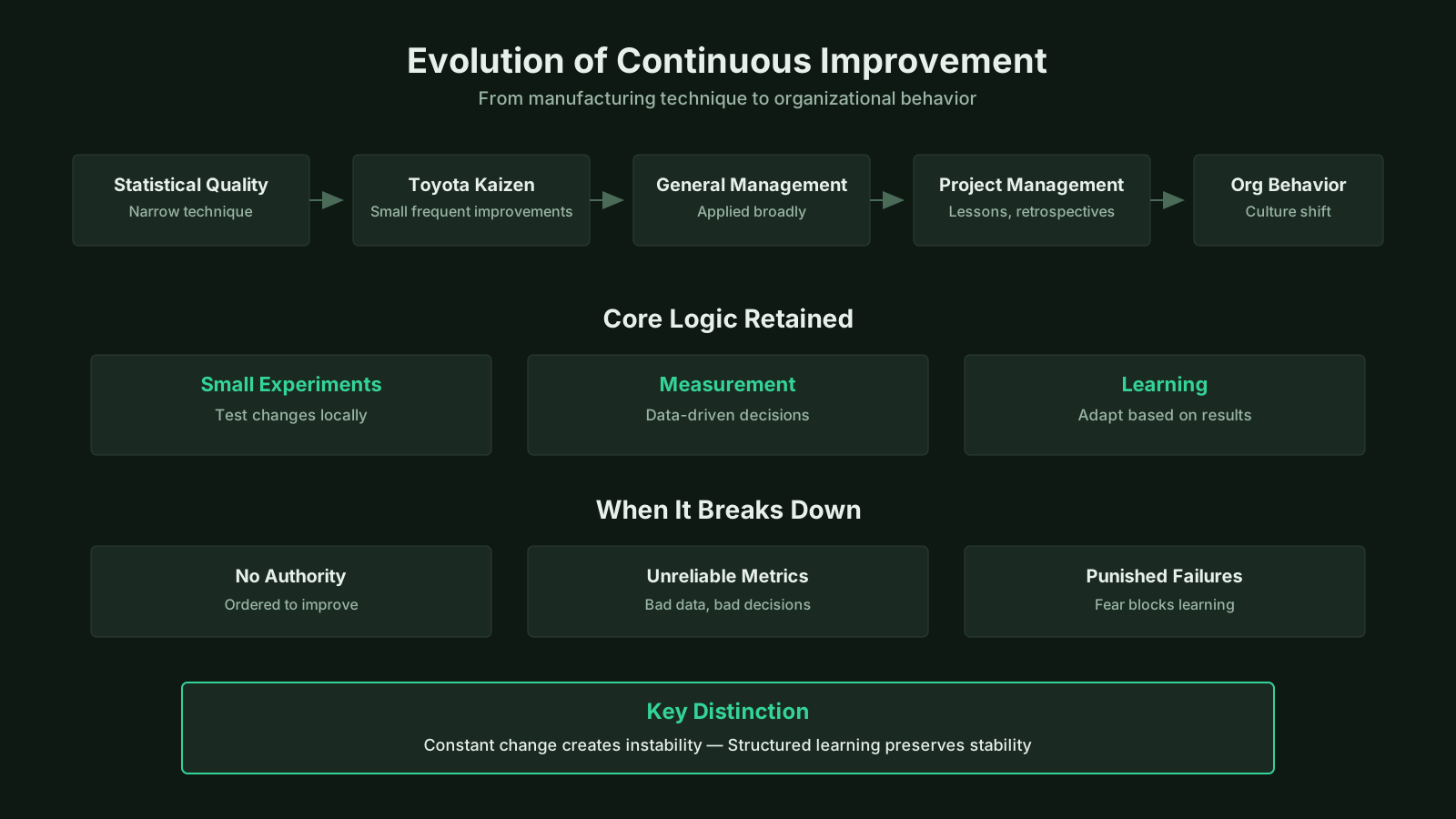
The origins of continuous improvement in management are most often traced to mid-twentieth-century quality movements in manufacturing. Continuous improvement in manufacturing produced much of the vocabulary now used in project environments, including terms like waste, cycle time, defect prevention, and root cause analysis. Walter Shewhart and W. Edwards Deming popularized the Plan-Do-Check-Act cycle, which became a foundational method for controlled experimentation and learning. Later, Japanese manufacturing, particularly the Toyota Production System, developed the concept of kaizen, in which workers at all levels contribute small improvements to their immediate work processes.
In aviation and medicine, continuous improvement appears in safety reporting systems, incident reviews, and structured debriefs that aim to prevent recurrence rather than assign blame. In software engineering, practices such as test automation, deployment metrics, and post-incident reviews apply the same underlying logic: small changes in how people coordinate and communicate can reduce errors more effectively than large punitive corrections. Cross-industry use matters because it demonstrates that continuous improvement is not a manufacturing-only practice; it operates wherever complex work depends on process reliability and human judgment.
Project management adopted these ideas gradually. Early project management standards focused heavily on planning and control, but the value of capturing operational knowledge became more explicit as organizations recognized that project failures often repeated similar patterns. Lessons learned systems, quality audits, and phase reviews became standard vehicles for improvement. The cross-industry background also explains why continuous improvement in projects often blends quality tools with team-level reflection practices.
Key Components of Continuous Improvement
The key components of continuous improvement can be grouped into measurement, experimentation, standardization, and reflection. Measurement supplies the baseline and the signal that a change has actually helped. Experimentation involves testing potential improvements on a limited scale before committing resources to a broader rollout. Standardization locks in gains so that performance does not drift backward, and reflection creates the space for teams to review outcomes without distraction from immediate delivery pressure.
Incremental and Breakthrough Improvement
Incremental improvement refers to small, low-risk changes that refine an existing process. A team might adjust how it labels requirements, shorten a meeting, or reorder a review step to remove handoff delays. Breakthrough improvement refers to larger redesigns, such as replacing a manual estimation process with a new tool or shifting from stage-gate reviews to continuous delivery. Most project contexts benefit from both, but incremental improvement is generally easier to sustain because it requires less political capital and creates fewer disruptions.
Practitioners often observe that breakthrough changes are appealing because they produce visible gains quickly, yet they also carry more risk of unintended consequences. Incremental changes accumulate quietly and may be harder to perceive in the short term. That is why measurement becomes important: without baseline data, a team may not recognize that dozens of minor refinements have reduced cycle time or improved first-pass quality.
Feedback Loops and Measurement
Continuous improvement depends on feedback loops that connect outcomes back to decisions. In project environments, these loops include quality control measurements, stakeholder satisfaction checks, velocity trends, defect rates, cycle times, and team morale signals. A feedback loop only becomes useful when the data is relevant enough to trigger action. Collecting extensive metrics that nobody reviews creates an illusion of improvement while adding administrative burden.
A project team without feedback loops is like a driver who never looks at fuel, speed, or road signs; the vehicle may keep moving, but the driver is reacting late to avoidable problems. Continuous improvement installs the equivalent of dashboard signals for project health, which allows smaller corrections earlier.
Standardization and Culture
Standardization is often misunderstood as an enemy of creativity. In continuous improvement, standardization means documenting the current best known way of performing a task so that improvements can be applied consistently. Once a team discovers a better sequence for code reviews or a more reliable method for validating requirements, that method becomes the new baseline. Without standardization, gains remain locked in individual habits and can disappear when a team member leaves or shifts roles.
Culture is the invisible component that determines whether continuous improvement becomes a routine or a forced exercise. If leaders respond to reported defects with blame, team members will hide problems. If they reward early detection, improvement becomes self-reinforcing. The most rigorously designed improvement process will fail in a culture that treats every deviation as a personal failure rather than a system signal.
Key Insights on Improvement Practices
- Experimentation, standardization, and reflection
- Collectively, these practices create a disciplined improvement cycle: experimentation validates changes on a limited scale, standardization converts successful trials into consistent routines, and reflection gives teams protected time to assess outcomes without the urgency of active delivery.
- Incremental versus breakthrough improvement
- Incremental improvement applies small, low-risk refinements that preserve operational stability, whereas breakthrough improvement pursues more substantial redesigns with higher potential returns. Both approaches play a role, but incremental change typically requires less political capital, causes fewer disruptions, and is easier to sustain over time.
- Baseline data reveals hidden progress
- Without baseline data, teams often miss evidence that numerous small refinements have collectively reduced cycle time, raised first-pass quality, or removed recurring delays. Establishing clear metrics before changes begin is therefore critical for validating whether improvement efforts actually deliver measurable value.
- Feedback loops guide project teams
- Feedback loops, including quality control checks, velocity trends, defect rates, cycle times, stakeholder satisfaction, and morale signals, function as a management dashboard that reveals emerging issues before they escalate. By monitoring these indicators regularly, teams can correct course early instead of reacting after avoidable problems have already affected delivery.
Continuous Improvement in PMBOK and Predictive Project Management
Within the PMBOK framework, continuous improvement in PMBOK is not presented as a single standalone process; rather, it runs through quality management, lessons learned, and organizational process asset updates. The PMBOK Guide's process groups and knowledge areas embed improvement activities in Manage Quality and Control Quality, where audits and process analysis look for nonconformities and opportunities to refine project execution. It also appears at project closure, when final lessons are documented and passed into the organization's knowledge base. The Seventh Edition's value delivery system and systems thinking perspective reinforce that improvement is a systems-level concern rather than an isolated task.
Quality Management and Process Audits
Manage Quality uses tools such as process analysis, root cause analysis, and quality audits to identify process inefficiencies. An audit might reveal that repeated requirement ambiguities stem from a poorly structured intake form rather than individual error. That is process-level thinking, not just deliverable inspection. Control Quality then measures whether changes have actually improved the output. The cycle of planning for quality, performing quality work, verifying results, and updating the quality approach mirrors the basic continuous improvement loop.
In predictive projects, quality activities are often scheduled at phase gates or as part of formal reviews. This can create a rhythm where improvement happens periodically rather than continuously. A common adaptation is to add smaller technical reviews and inspection points within phases so that teams do not wait until a milestone to discover accumulated defects.
Lessons Learned and Organizational Process Assets
Lessons learned registers and organizational process asset updates are the PMBOK mechanisms for carrying improvement from one project to the next. A project team may identify a repeated coordination failure during status meetings, document it, and recommend a change to the project management plan or to a standard operating procedure. That recommendation becomes an external contribution when it updates templates, policies, or risk checklists used by future projects.
This transfer is not automatic. Many organizations collect lessons but rarely apply them. PMBOK-oriented improvement therefore depends on a governance function that reviews and acts on lessons, not just on documentation. Without that follow-through, the lessons learned register becomes a database of good intentions rather than a source of measurable improvement.
Continuous Improvement in PRINCE2
According to PRINCE2, learning from experience is a principle applied from pre-project through closure. Continuous improvement in PRINCE2 is embedded in that principle, supported by the lessons log and lessons report as formal management products. Project managers, teams, and the project board are expected to seek out lessons at the start of the project, document them as the project proceeds, and pass useful insights to the organization at closure.
The continued business justification principle also reinforces improvement in an indirect way. As the project proceeds, the project board must confirm that the project remains viable and aligned with its expected benefits. If new knowledge reveals that a process is inefficient or that a product design should change, that insight can trigger a formal issue or change request. Improvement is not treated as an optional side activity; it becomes part of governance when a better path to the project's objectives is identified.
Lessons Log, Lessons Report, and Quality Controls
The lessons log in PRINCE2 records both positive and negative experiences during the project. The lessons report is prepared at closure and passes those experiences to the organization. Quality controls, including the quality register and quality review technique, support the detection of defects and the identification of process weaknesses. PRINCE2 does not prescribe a specific improvement cycle like PDCA, but its management products give improvement activities a home within project governance.
Because PRINCE2 projects are often managed by stages, learning can be integrated at stage boundaries. A stage end review may reveal that a certain work package overran because of unrealistic assumptions, and that lesson can adjust planning for the next stage. This creates a phased version of continuous improvement, closer to periodic learning than the frequent retrospectives common in Agile delivery.
Key Insights on PRINCE2 Improvement
- Learning from experience principle
- PRINCE2 operationalizes the learning from experience principle across the entire project lifecycle, using the lessons log for ongoing capture and the lessons report to transfer validated insights to future initiatives.
- Improvement embedded in governance
- Continuous improvement is structurally embedded in PRINCE2 governance, as emerging knowledge that exposes inefficiencies or required design adjustments is converted into formal issue or change requests rather than handled informally.
- Quality controls detect weaknesses
- The quality register and quality review technique provide structured detection of defects and process weaknesses, creating an evidence base that feeds directly into formal improvement actions.
- Phased improvement at stage reviews
- PRINCE2 institutionalizes improvement through stage end reviews, using lessons captured in completed work packages to adjust planning and controls for the next stage, which provides a structured alternative to frequent Agile retrospectives.
Continuous Improvement in Agile and Hybrid Environments
In Agile delivery, continuous improvement in Agile is not a single ceremony but a recurring expectation embedded in retrospectives, reviews, and workflow metrics. The Agile principle concerning reflection at regular intervals directs teams to inspect their behavior and adjust to become more effective. In Scrum, the sprint retrospective exists specifically for this purpose. In Kanban, metrics such as lead time, throughput, and cumulative flow provide continuous signals for improving workflow. Extreme Programming embeds improvement in practices like pair programming, test-driven development, and refactoring, where small structural adjustments occur as part of daily work.
Sprint Retrospectives and Inspect-and-Adapt
The sprint retrospective in Scrum is a focused meeting where the team reviews the previous iteration and selects one or a few small improvements to try next. The inspect-and-adapt concept extends beyond the retrospective to sprint reviews, where stakeholders inspect the increment and adjust the product backlog accordingly. Improvement in this context is empirical: the team runs a short experiment, observes the effect, and decides whether to keep, adapt, or abandon the change.
A common misconception is that retrospectives are complaint sessions or morale exercises. They are not, at least not when practiced well. A retrospective should generate actionable adjustments that can be tested in the next iteration. Teams that produce long lists of emotional feedback but no concrete experiment often experience retrospective fatigue without realizing measurable improvement.
Hybrid Environments
Hybrid projects combine predictive planning with adaptive delivery cycles. Continuous improvement in hybrid work often appears in two places: formal lessons learned at phase gates and recurring team retrospectives inside iterative components. A hybrid team might maintain a predictive schedule while using Kanban boards for execution, reviewing flow metrics weekly to remove bottlenecks. The challenge is coherence; lessons from retrospectives should inform stage decisions, and formal stage findings should feed back into team working agreements.
In hybrid governance, continuous improvement can stall if the two approaches operate in separate silos. For example, a project board may only care about milestone reports, while the delivery team only reviews agile metrics. Without a bridge between these views, the organization misses process issues that are visible to one group but not the other.
BVOP Perspective on Continuous Improvement
Business Value-Oriented Project Management links continuous improvement and waste reduction by identifying invisible organizational harm that traditional quality reports may miss. It treats certain forms of waste as process damage, including overwork, perfectionism, and the rejection of acceptable work. These categories push improvement efforts beyond typical defect counting and toward visible patterns of behavior that erode value delivery without always appearing as formal failures.
BVOP also uses Business Value Points as a project health indicator. A persistent decline in those points can signal that the project or program should be examined for closure or major correction. Continuous improvement in this context is not only about making small workflow adjustments; it can also support a decision to stop work that no longer produces sufficient value. Defect analysis uses predefined root-cause categories, which makes improvement efforts more repeatable and less dependent on unstructured brainstorming.
The BVOP view connects continuous improvement to both product risk management and team dynamics. Risk management with quantified loss size units and dynamic filtering gives improvement a prioritization mechanism. In practice this means a team can distinguish between a minor defect that should simply be logged and a recurring issue that merits deeper process analysis. That distinction prevents improvement activities from becoming overwhelming or purely reactive.
BVOP Improvement Core Insights
- Invisible organizational harm detection
- BVOP continuous improvement identifies and addresses hidden waste that conventional quality reports overlook, such as overwork, perfectionism, and the rejection of acceptable work, all of which constitute forms of process damage.
- Business Value Points health signal
- A sustained decline in Business Value Points signals that a project or program requires review for significant corrective action or closure, because the value it delivers no longer justifies continued investment.
- Predefined root-cause categories
- Defect analysis relies on predefined root-cause categories to make improvement efforts systematic and reproducible, reducing dependence on unstructured brainstorming and subjective judgment.
- Risk management integration
- BVOP integrates continuous improvement with product risk management and team dynamics, applying quantified loss size units and dynamic filtering to rank improvement actions according to actual business impact.
- Defect versus issue distinction
- This prioritization mechanism enables teams to distinguish between minor defects that require only logging and recurring issues that warrant deeper process analysis and corrective action.
Purpose and Importance of Continuous Improvement
The importance of continuous improvement in project management comes from the fact that projects are temporary, but organizations accumulate habits, templates, and expectations over time. A single project that ends on schedule but leaves behind no reusable learning may deliver its immediate scope while preserving the conditions for future failure. Continuous improvement is the bridge between project outputs and organizational capability.
Improvement reduces hidden costs that are rarely captured in a project budget, such as rework, duplicated communication, waiting caused by ambiguous handoffs, and the cognitive load of constantly resolving the same issue in different ways. It also builds stakeholder confidence. Sponsors and clients notice when a team does not repeat known mistakes and when delivery quality becomes more predictable across iterations or phases.
There is a workforce dimension too. Teams that see their feedback change how work is performed tend to report higher engagement and lower frustration with bureaucratic processes. However, improvement should not be framed as a motivational slogan; its value comes from measurable reductions in waste and more reliable delivery, not from making people feel good in isolation.
Continuous improvement also supports risk management indirectly. Early detection of weak signals through retrospectives and quality audits lets teams address vulnerabilities before they become full-blown issues. A process weakness left unexamined in one project can become a systemic risk across a program or portfolio.
Practical Application Across the Project Lifecycle
Continuous improvement examples in project work appear in every lifecycle stage, though the specific tools differ. At initiation, historical lessons and organizational process assets shape project charters, risk registers, and team structures. At planning, quality management plans and communication plans may be tailored based on feedback from previous projects. At execution, daily standups, technical reviews, and quality audits generate real-time signals for adjustment. At monitoring and controlling, variance analysis and control charts distinguish normal variation from signals that require intervention. At closing, lessons learned sessions and final retrospectives transfer knowledge back to the organization.
Initiation and Planning
During initiation, a project manager may review lessons from similar past projects to anticipate risks. A prior project might have struggled with unclear service-level expectations, so the new charter includes a more explicit stakeholder statement and a formal review point. Planning incorporates these lessons into the quality management plan by identifying which processes need frequent checks and which can tolerate lighter control. This is not about always adding more controls; it can also mean removing unnecessary approvals that past projects showed were adding delay without improving quality.
In planning, baseline expectations matter. A baseline that is treated as untouchable can discourage improvement, while a baseline that is updated with no discipline becomes meaningless. Continuous improvement helps by defining when a variance is a one-off anomaly and when it signals a pattern worth addressing through a change request.
Execution, Monitoring, and Controlling
During execution, continuous improvement appears in shorter feedback loops. A software team might hold a brief daily standup and notice that a particular integration task is blocked for the third day. Instead of simply escalating, the team examines why the blocker keeps recurring and changes its environment configuration process. In a construction project, a daily safety walk might reveal that material staging creates repeated handling delays, prompting a rearrangement of the site layout at low cost.
Monitoring and controlling activities supply the evidence that distinguishes real improvement from noise. Control charts can show whether a process is stable or shifting. Trend analysis can reveal whether defect rates are declining after a change. The key is that improvement is tested against baseline performance, not against anecdotal impressions. Without that comparison, teams often believe they have improved because they feel busy or because a recent deliverable happened to go smoothly.
Closing and Transition
At closing, continuous improvement aims to preserve usable knowledge for future projects. Facilitated lessons learned sessions look at what should be repeated, what should be avoided, and what advice should be given to future teams. The output should not be a generic list; it should include enough context about the situation, the action taken, and the observed effect for someone else to use it later. Final retrospectives in Agile projects serve the same function at the team level, while the project closure report captures decisions for the sponsoring organization.
Transition to operations is another point where improvement matters. A new product or service may move into a support model that has its own workflows. Continuous improvement during transition includes validating that the operational team understands known failure modes, monitoring thresholds, and the reasoning behind certain design choices. That handoff often reveals gaps that were invisible during project delivery.
Lifecycle-Wide Improvement Insights
- Tools vary by stage
- Each project phase applies continuous improvement through tailored techniques and tools that address the distinct risks and deliverables of that stage.
- Lessons shape initiation
- Historical lessons and organizational process assets directly shape the project charter, risk register, and team design during initiation, helping teams avoid repeated mistakes and align early decisions with proven practices.
- Real-time execution signals
- Execution-phase feedback loops such as daily standups, technical reviews, and quality audits deliver real-time signals that allow teams to correct course before small issues become costly deviations.
- Closing transfers knowledge
- Structured lessons learned sessions and retrospectives at project close transform project-specific experience into reusable organizational knowledge that strengthens future planning and execution.
Common Challenges, Pitfalls, and Misconceptions
Several misconceptions about continuous improvement cause organizations to pursue the practice superficially. One common misconception is that holding retrospectives or conducting quality audits automatically produces improvement. These are only mechanisms; they create opportunity, not outcome. Another misconception is that continuous improvement means constant change. Healthy improvement includes standardization and stability, because changing too many variables at once makes it impossible to know what worked. Continuous improvement also gets confused with cost cutting, blame assignment, or anonymous suggestion boxes that rarely lead to real process adjustments.
A serious pitfall is measurement misuse. Teams may track too many metrics and drown in dashboards, or they may select metrics that are easy to collect instead of metrics that reveal process health. In some environments, metrics become targets, and people optimize the number instead of the underlying behavior. This is a well-known dynamic in performance management and applies directly to continuous improvement when cycle time, defect count, or velocity becomes a reward criterion.
Another challenge is psychological safety. Improvement requires people to admit uncertainty, surface defects, and sometimes challenge the decisions of leaders. If the environment punishes these behaviors, the formal improvement events will produce polite, low-risk observations while real problems remain hidden. This is not a soft skill issue; it is a structural condition for accurate learning.
There are also situations where continuous improvement should not be aggressively applied. Early in a project, when scope and methods are still unstable, too much process tinkering can add noise. During a genuine crisis, the priority is containment and recovery, not refinement. A short project with a highly experienced team may benefit more from a good initial plan and a structured closeout than from frequent process interventions. Continuous improvement is context-dependent, not a universal requirement at every moment.
Continuous Improvement vs Other Management Concepts
The distinction between continuous improvement vs lessons learned is important because lessons learned often happens at the end, while continuous improvement is meant to operate throughout the project. Lessons learned is a documentation and review activity that supports improvement. Quality assurance focuses on evaluating whether processes are being followed and whether they are effective. Change management concerns how changes to scope, schedule, or resources are approved and integrated. Continuous improvement can use all of these, but it is broader than any one of them.
Corrective action is another related term. A corrective action addresses a specific deviation after it has occurred. Continuous improvement may include corrective actions, but it also includes preventive adjustments and exploratory experiments that are not triggered by an immediate failure. Benchmarking compares project performance against external or internal references; it can reveal gaps, but benchmarking alone does not produce changes. Root cause analysis is an analytical technique used within improvement, not the improvement program itself.
A common point of confusion is the relationship between quality control and continuous improvement. Quality control inspects specific outputs and identifies defects. Continuous improvement asks why defects are occurring and what can be changed to reduce their frequency. A team might fix a single defect through corrective action, but unless the underlying process changes, the defect class may return in the next iteration or the next project.
In the broader PM ecosystem, continuous improvement sits close to knowledge management and organizational learning. It supports the maturation of project management practices by turning individual project outcomes into reusable process knowledge. This is why portfolios and programs often sponsor improvement initiatives across multiple projects rather than leaving improvement entirely to individual teams.
Core Insights on Improvement Concepts
- Continuous improvement operates throughout
- Unlike lessons learned exercises, which typically capture insights after project completion, continuous improvement is embedded across the entire project lifecycle, so teams can apply new knowledge while it is still actionable.
- Distinct from related management practices
- Quality assurance focuses on verifying that established processes are followed, change management regulates the formal approval of scope and resource adjustments, and benchmarking uncovers performance gaps without directly implementing improvements, each serving a distinct role that continuous improvement complements rather than replaces.
- Goes beyond corrective actions
- Continuous improvement extends beyond simple correction by also embedding preventive adjustments and exploratory experiments, allowing organizations to strengthen processes proactively instead of waiting for failures to trigger action.
- Fuels organizational learning
- By transforming isolated project outcomes into reusable process knowledge, continuous improvement enables portfolios and programs to scale learning across multiple projects, making it a strategic enabler of organizational capability rather than a single project activity.
Evolution and Current Thinking
The evolution of continuous improvement in project management has moved from periodic, document-heavy lessons learned toward frequent, data-informed feedback loops. In predictive environments, improvement was historically tied to phase gates, post-project reviews, and formal audits. Agile and DevOps practices accelerated this tempo by embedding reflection into every iteration and using real-time operational data to guide changes. Lean thinking contributed a focus on flow, waste, and value stream mapping, which has influenced portfolio and program management as much as individual project delivery.
Current thinking recognizes that continuous improvement is both a technical discipline and a social one. Metrics and structured methods matter, but they only work if teams feel able to report problems and if leaders are willing to adjust their own assumptions. Psychological safety, systems thinking, and local decision-making have become part of the improvement conversation, not just add-ons. This reflects the influence of Lean, Agile, and safety science on project management.
There is still debate about how formal continuous improvement should be. Some practitioners argue that improvement should be embedded into daily work and should not require a separate governance layer. Others argue that without formal process ownership and scheduled reviews, improvement gets lost under delivery pressure. The most credible position is context-dependent: teams with strong feedback habits may need minimal formal structure, while large programs or regulated environments may need defined improvement roles and audit cycles.
Technology has also changed what is possible. Project management information systems, workflow tools, and process mining can surface inefficiencies at a scale that manual spot checks cannot. But the risk remains that organizations confuse dashboards with insight. A tool can show that a process has slowed down, but humans still need to interpret why, test a change, and assess the result. Continuous improvement has not become automatic simply because more data is available.
If the project management field has learned one thing, it is that improvement cannot be reduced to a template. The discipline persists because every project reveals something about how the organization plans, communicates, estimates, and delivers. Capturing that something and acting on it before it fades is the practical heart of continuous improvement.