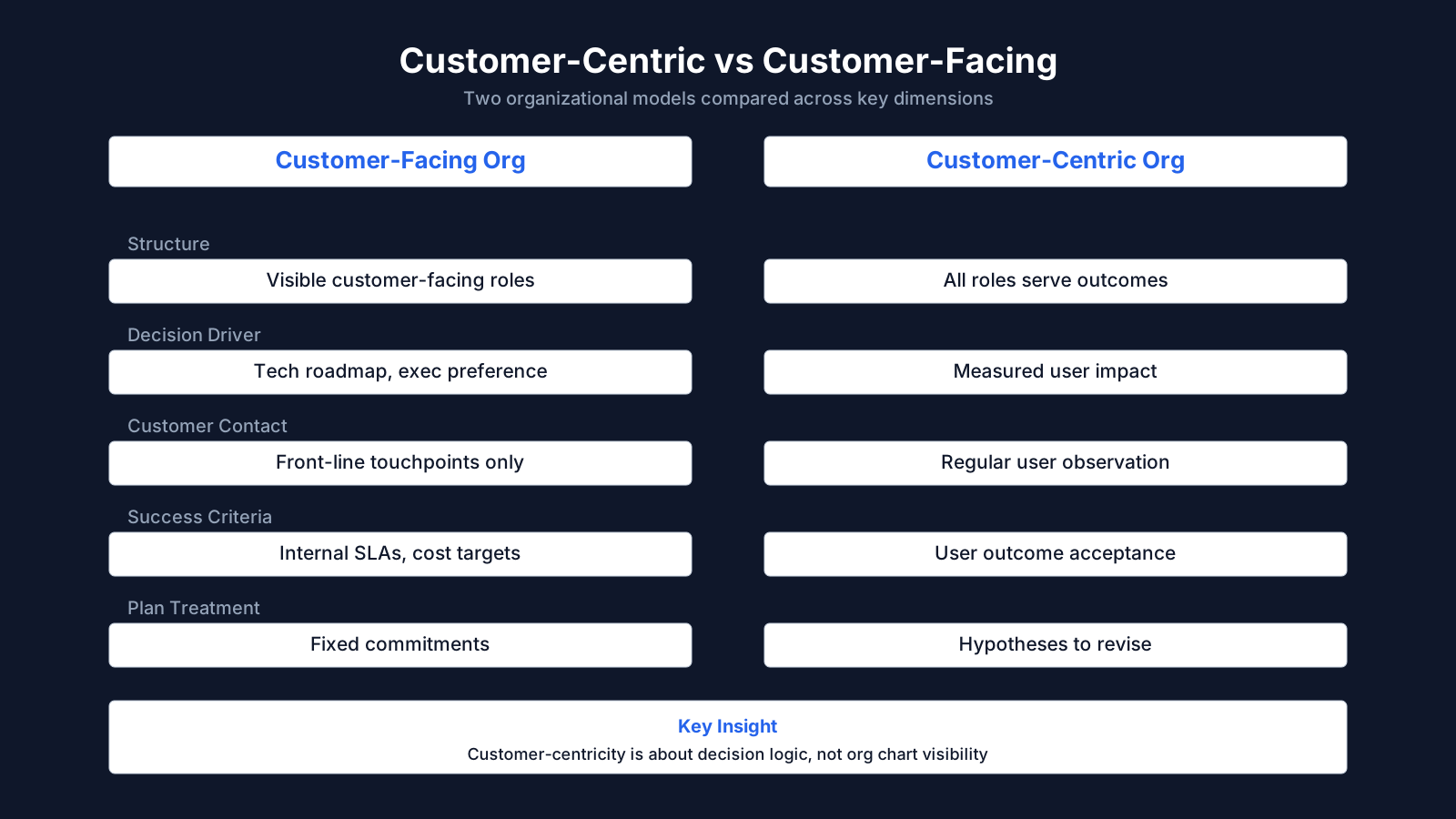
Customer-centric organizations are defined as entities that structure their governance, portfolio selection, program benefits, and project delivery around the needs, value expectations, and feedback of the people who use or receive the project’s outputs. In project management, customer-centricity is not a marketing posture or a customer service slogan. It is an operating orientation that uses customer-defined value as the primary test for what gets funded, how work is sequenced, what quality means, and when a project can be declared successful.
This orientation cuts across predictive, Agile, and hybrid delivery models, although each model expresses it differently. Some project teams mistake customer-centricity for simply being friendly to stakeholders. The deeper practice involves restructuring decision rights, feedback loops, and success measures so that the customer’s actual outcome sits at the center of project work.
Key Topics in Customer-Centric Organizations
| Key Concept | Summary |
|---|---|
| Customer-centric definition | A customer-centric organization aligns governance, portfolio selection, program benefits realization, and project delivery with the needs, value expectations, and feedback of the people who use or receive project outputs. |
| Value test | This operating orientation treats customer-defined value as the primary test for funding decisions, work sequencing, quality standards, and the criteria for project success. |
| Outcome focus | The deeper practice restructures decision rights, feedback loops, and success measures so the customer’s realized outcome remains the central reference point for project work. |
| Success example | A software release delivered on time and within budget but failing to reduce claim processing time would still fall short of success under a customer-centric standard. |
| Decision rights | Ambiguity about which customer holds decision rights often causes scope instability and rework; customer-centric governance surfaces those conflicts early, well before acceptance testing. |
| Historical origins | The approach traces to the quality movement, service management, and design disciplines in manufacturing and consumer industries, later shaping software engineering, healthcare, and public administration. |
| Cross-industry context | Early work in airline operations, retail banking, and hospitality showed that customer experience extends across multiple touchpoints, leading Agile product management to adopt journeys, personas, and feedback loops. |
| Key components | Core components include a clear definition of customer value, formal voice-of-customer mechanisms, cross-functional ownership of outcomes, and feedback loops that run throughout delivery rather than only after project closure. |
What Is a Customer-Centric Organization in Project Management?
The customer-centric organization definition in a project environment centers on the principle that project outputs only have value when they generate a positive change for a defined customer. That customer may be an external buyer, an internal business unit, a citizen receiving a public service, or an end user who never pays a bill. The organization treats that customer not as a distant recipient of handoffs but as an active participant in shaping scope, validating increments, and defining acceptance criteria.
A traditional project organization often optimizes for schedule, budget, and specification conformance. A customer-centric project organization keeps those constraints but interprets them through the customer’s outcome. For example, a software release that ships on time and on budget but fails to reduce the time a claims processor needs to complete a task would not be considered successful. The customer’s workflow, satisfaction, and ability to realize a business benefit become the reference point.
This does not mean every customer request becomes a requirement. Customer-centricity includes structured methods for understanding needs, separating wants from underlying problems, and making tradeoffs transparent. It also recognizes that customers can be wrong about solutions even when they are right about their problems.
Internal and External Customers
Customer-centric project organizations often manage two or more customer types at once. An internal customer might be a finance department requesting a new reporting tool. An external customer might be the eventual user of a mobile application. In many public sector projects, the customer is a citizen or regulated entity, while the paying sponsor is a government agency. The distinctions matter because the person who funds the project, the person who specifies requirements, and the person who actually uses the output may have different definitions of value.
Mature organizations name these groups explicitly in the project charter and benefits management plan. Confusion about which customer has decision rights is one of the most common sources of scope instability and rework, and customer-centric governance is designed to surface those conflicts early rather than during acceptance testing.
Core Insights on Customer-Centric Project Management
- Value defined by customer change
- Project outputs earn the label of success only when they produce a measurable improvement for a defined customer, rather than simply satisfying internal milestones.
- Outcomes over schedule and budget
- In a customer-centric organization, schedule and budget remain important guardrails, yet success is ultimately judged by improvements in customer workflows and the business benefits those changes deliver.
- Clear decision rights prevent rework
- When it is unclear which customer holds decision authority, scope instability typically follows, and customer-centric governance mitigates this risk by surfacing and resolving authority conflicts early.
Origins and Cross-Industry Context
The origin of customer-centric organizations lies less in project management literature and more in the quality movement, service management, and design disciplines that emerged across manufacturing and consumer industries. Total quality management shifted attention from internal inspection to customer-defined fitness for use. That same logic later influenced software engineering, healthcare, and public administration, where patient-centered care and user-centered design became recognized models for reducing waste and improving outcomes.
In manufacturing, the idea that the customer, not the production line, defines quality challenged long-standing assumptions about efficiency. A factory could produce thousands of units without defects according to its own specifications and still fail if customers found the product difficult to use. Project management absorbed this lesson gradually. Early project methodologies emphasized technical deliverables and internal baselines. Customer satisfaction was often treated as a lagging indicator rather than a design constraint.
Cross-industry exposure to customer-centricity also came through service design and experience management. Airline operations, retail banking, and hospitality firms learned that customer experience spans multiple touchpoints, many of which are enabled by internal projects. Those industries influenced the idea that projects do not just deliver assets; they change the way a customer experiences a service. By the time Agile and product management practices became widespread, customer-centricity had already developed a vocabulary of journeys, personas, feedback loops, and value hypotheses that project teams could borrow.
Key Components of Customer-Centric Organizations
The key components of customer-centric organizations in a project setting include a clear definition of customer value, formal voice-of-customer mechanisms, cross-functional ownership of outcomes, and feedback loops that operate during delivery rather than only after closure. These components distinguish genuine customer-centricity from a general willingness to listen to stakeholders.
Customer Value as the Decision Filter
Customer-centric organizations use customer value to prioritize portfolio investments, approve scope changes, and resolve tradeoffs. In practice, this means a proposed feature or work package is evaluated against the expected change in the customer’s ability to achieve an outcome, not only against its technical complexity or cost. The business case, benefits management plan, and product backlog all carry traces of this value logic.
Voice of the Customer and Feedback Loops
Voice of the customer encompasses interviews, observation, surveys, usage data, and direct participation in reviews. The customer-centric organization treats this voice as an input to planning and as a control mechanism. Feedback loops are built into iteration reviews, user acceptance checkpoints, and post-release monitoring. The key is that feedback arrives early enough to change direction, which is why Agile delivery models align naturally with customer-centric practices.
Cross-Functional Ownership and Product Orientation
Customer-centric organizations often organize project work around customer journeys or products rather than around functional specialties. A cross-functional team owns an end-to-end customer problem, such as onboarding, billing, or claims processing. That ownership reduces the handoff delays and fragmented accountability that often erode customer value in functionally siloed organizations. Product managers or product owners act as the customer’s representative, but they are supported by business analysts, UX specialists, and delivery teams who all understand the customer outcome.
Core Insights on Customer Centricity
- Customer value as decision filter
- Customer-centric organizations use the expected shift in the customer's ability to achieve a desired outcome as the primary filter for prioritizing features, elevating that outcome above technical complexity, implementation cost, or internal convenience.
- Formal voice-of-customer mechanisms
- These organizations embed customer input collection across interviews, direct observation, surveys, product usage analytics, and structured review participation, transforming listening from an ad hoc gesture into a repeatable and governed practice.
- Feedback loops during delivery
- Customer feedback is captured early enough to alter direction through iteration reviews, user acceptance checkpoints, and post-release monitoring, which explains why Agile delivery models align so naturally with customer-centric ways of working.
- Cross-functional ownership of outcomes
- Work is structured around customer journeys or end-to-end products rather than functional silos, so that cross-functional teams share a single accountability for measurable customer outcomes instead of narrow departmental outputs.
- Product managers as customer advocates
- Product managers or product owners act as the primary voice of the customer, and are backed by business analysts, UX specialists, and delivery teams who collectively internalize the target customer outcome rather than treating it as a handoff requirement.
Purpose and Importance of Customer-Centric Organizations
The purpose of customer-centric organizations in project management is to reduce the risk of delivering outputs that nobody values. Projects have historically been measured by whether they met time, cost, and scope baselines. Customer-centricity adds a fourth test: whether the result changed the customer’s condition in a way that was worth the investment. This matters because many failed projects are technically successful but operationally irrelevant.
Customer-centricity also improves requirements quality. When teams understand the customer’s actual workflow, they are less likely to build unnecessary features or miss implicit expectations. It strengthens stakeholder engagement by giving customers a real role in shaping the solution, which reduces resistance during rollout. And it creates a natural feedback mechanism for benefits realization, because the customer’s behavior and satisfaction become measurable indicators of value.
The importance extends to portfolio management. A portfolio that selects projects based on internal politics or technological appeal may deliver many outputs and little change. Customer-centric portfolio governance forces a conversation about who benefits, how much, and whether that benefit aligns with organizational strategy. This does not guarantee perfect decisions, but it makes the value logic visible and reviewable.
Customer-Centric Organizations in PMBOK and PRINCE2
Customer-centric organizations in PMBOK are not named as a formal process or knowledge area, but the concept appears throughout the standard’s treatment of quality, scope, stakeholder engagement, and benefits management. The PMBOK Guide’s quality management knowledge area defines quality as the degree to which a set of inherent characteristics fulfills requirements, and it links customer satisfaction to conformance to requirements and fitness for use. Scope validation also requires formal acceptance from the customer or sponsor, making customer judgment an explicit control point.
PMBOK’s Seventh Edition strengthens the customer-centric thread by organizing guidance around principles and performance domains. The value delivery system and stakeholder engagement domains make customer outcomes a recurring reference point. While the Sixth Edition focused on process mechanics, the Seventh Edition treats tailoring, value, and stakeholder relationships as foundational principles. That shift reflects a broader recognition that project success cannot be reduced to a baseline triangle.
PMBOK Process Groups and Knowledge Areas
Within the process groups, customer-centricity appears at initiation through the project charter and business case, where customer needs and expected benefits are documented. During planning, requirements collection and scope definition are supposed to capture the customer’s voice. Execution and monitoring involve continuous communication with customer representatives, and closing requires customer acceptance and final benefit handover. Each of these points is a governance gate where customer value can be tested.
PRINCE2 Customer and Quality Themes
PRINCE2 addresses customer-centricity through its principle of continued business justification and its focus on products. The Senior User role represents the interests of those who will use the project’s outputs and is responsible for specifying expected benefits and acceptance criteria. PRINCE2’s quality theme requires the team to understand customer quality expectations and translate them into measurable quality criteria. The customer and supplier environment is explicitly acknowledged in the organization theme, which clarifies that projects operate within a relationship structure, not a single isolated organization.
Core Customer-Centric Insights
- Customer focus woven throughout PMBOK
- Customer-centricity operates as a cross-cutting theme in PMBOK, surfacing within quality management, scope validation, stakeholder engagement, and benefits management rather than as a distinct process or knowledge area.
- Seventh Edition elevates customer outcomes
- The Seventh Edition elevates customer outcomes by structuring guidance around principles and performance domains, making value delivery and stakeholder engagement recurring anchors for customer results.
- Customer acceptance drives process groups
- Customer expectations shape the project lifecycle: they are captured in the charter during initiation, sustained through customer representative engagement in execution and monitoring, and confirmed through formal acceptance and benefit handover at closure.
- PRINCE2 Senior User role
- The Senior User role provides output users with formal representation, specifies expected benefits and acceptance criteria, and functions within the customer-supplier relationship structure recognized in the organization theme.
Customer-Centric Organizations in Agile, Hybrid, and Predictive Delivery
Customer-centric organizations in Agile settings express the concept through the product owner role, user stories, acceptance criteria, sprint reviews, and the inspect-and-adapt cycle. The Agile Manifesto’s principle of customer collaboration over contract negotiation is not a rejection of discipline. It is a recognition that customer needs evolve and that teams need direct, frequent customer contact to build the right product.
Agile does not automatically produce customer-centricity. A team can deliver increments every sprint and still ignore the customer’s broader outcome if the product owner is weak or if the organization treats velocity as the primary goal. Customer-centric Agile teams use user research, prototypes, and release metrics to validate that each increment actually moves the customer closer to a useful result. Sprint reviews become a live feedback loop rather than a demonstration for praise.
Hybrid models blend predictive planning with iterative customer feedback. A project may have a fixed regulatory deadline and a waterfall-style requirements phase, but still use prototypes or pilot releases to validate customer assumptions before full rollout. Predictive environments rely more on formal requirements documentation, customer acceptance criteria, and change control. In those settings, customer-centricity shows up through strong business analysis, early customer involvement in requirements workshops, and rigorous benefits tracking after handover.
The BVOP Perspective on Customer-Centricity
Business Value-Oriented Project Management treats customer-centricity in BVOP as a stakeholder management and communication problem as much as a value problem. It assumes that customer value cannot be delivered if planning documents are so dense that new team members and customer representatives cannot quickly grasp what is being proposed. BVOP mandates that brief planning documents remain readable by everyone, including people who join the project later. It also emphasizes formal stakeholder input validation and a Transparent Board of Project Issues where customer concerns can be raised before authorization.
BVOP also uses hiring-and-training-based dependency analysis, which connects customer-facing capability to the organization’s ability to staff and prepare teams. A customer-centric project that depends on specialized customer support skills may be delayed not by a code release but by the time required to hire and train the people who will serve the customer. That practical insight is often missing from traditional dependency logs that focus only on technical interfaces. BVOP’s approach keeps customer impact visible in the resource and communication planning process without claiming to replace PMBOK or PRINCE2.
Core Insights on Customer-Centricity
- Customer-centricity as communication problem
- BVOP frames customer-centricity not only as a question of delivered value but equally as a discipline of stakeholder communication and expectation management.
- Readable brief planning documents
- Planning documents need to be concise enough for new team members and customer representatives to understand the proposed scope within minutes.
- Transparent Board of Project Issues
- BVOP requires that stakeholder concerns be formally validated and surfaced on a transparent issues board before any project receives authorization, ensuring customer input shapes the decision.
- Hiring-and-training dependency analysis
- BVOP's dependency analysis explicitly connects the organization's readiness to deliver customer-facing outcomes with its capacity to recruit, onboard, and prepare the necessary teams.
- Customer impact beyond technical dependencies
- In practice, a customer-centric initiative is often delayed more by hiring and training lead times than by technical release cycles, a distinction that conventional dependency tracking rarely captures.
Practical Application Across the Project Lifecycle
Customer-centric project management practices appear in every phase, though their intensity and form vary by delivery model. At the portfolio level, senior leaders use customer impact as a scoring criterion for competing business cases. In project initiation, customer representatives help define the problem statement and the benefits expected. During planning, journey maps, personas, and service blueprints may supplement traditional requirement documents.
Portfolio Selection and Initiation
Portfolio governance in customer-centric organizations asks how each proposed project changes a customer’s ability to perform a task, make a decision, or avoid a loss. Project charters identify the primary customer group and the decision rights of customer representatives. That early clarity prevents later arguments about whose feedback counts.
Planning and Requirements
Requirements work starts with customer outcomes before moving to features. A customer-centric business analyst might observe a day in the life of a user, identify pain points, and then translate those observations into measurable acceptance criteria. The work breakdown structure may be organized around customer journey stages rather than technical subsystems, which keeps the plan anchored to value.
Execution and Feedback
During execution, customer representatives participate in demos, pilots, and user acceptance testing. Iterative teams use fast feedback to correct course. Predictive teams often use a customer advisory group or a senior user committee to review deliverables at stage gates. The common principle is that customer judgment is not postponed until the end.
Monitoring, Controlling, and Benefits Realization
Monitoring in customer-centric organizations includes customer satisfaction, adoption, task completion, and support request patterns, not just schedule variance. Benefits realization plans define who will measure the customer outcome and when. Those measures may include process cycle time, error rates, user effort scores, or repeat purchase behavior, depending on the project. The monitoring process also detects when customer value assumptions have changed and triggers a formal change request if needed.
Common Misconceptions and Pitfalls
One of the most persistent misconceptions about customer-centric organizations is that they do whatever the customer asks. In reality, customer-centric project management is about solving customer problems, not obeying customer instructions. Customers often describe a solution that would not work, or they ask for a feature that masks a deeper workflow issue. A skilled team pushes back with evidence and proposes alternatives.
Another misconception is that customer-centricity belongs only in commercial software or service design. Internal infrastructure projects, compliance projects, and operational improvements also have customers, even if those customers are employees, auditors, or downstream systems. Ignoring the internal customer leads to tools that are technically compliant but unusable in daily operations.
Common pitfalls include mistaking the buyer for the user, overvaluing loud voices, and treating satisfaction scores as the only measure of value. A project can earn high satisfaction from a buyer who never uses the product while the actual users remain frustrated. Another pitfall is feedback theater, where teams collect customer input, file it, and change nothing. That erodes trust and produces passive resistance during rollout. Customer-centricity also fails when governance prohibits the team from acting on feedback, leaving the customer with participation but no influence.
Customer-centric approaches are not a cure for weak strategy. A project can be deeply customer-focused and still conflict with regulatory obligations or long-term organizational goals. In those cases, customer input is balanced against formal constraints and strategic intent. The goal is informed tradeoff, not unconditional deference.
Correcting Customer-Centric Misconceptions
- Solve problems, not instructions
- Customer-centric project management centers on resolving the underlying customer problem, so teams should challenge requests with evidence and offer viable alternatives whenever a proposed solution would fail to deliver value.
- Internal customers matter too
- Customer-centricity is equally relevant to internal infrastructure, compliance, and operational work, where employees, auditors, and downstream systems are the customers whose needs define success.
- Recognizing who truly uses output
- Teams often confuse the buyer with the actual user and give disproportionate weight to the loudest voices, producing high satisfaction scores from buyers who never use the product while genuine users remain frustrated.
- Beware of feedback theater
- Customer-centricity collapses into feedback theater when teams gather input but make no changes, or when governance stalls action, leaving customers with participation rights but no actual influence over outcomes.
Relationship to Other Project Management Concepts
The relationship between customer-centric and stakeholder-centric project management is a common source of confusion. Customer-centricity is a subset of stakeholder-centricity. Stakeholders include regulators, suppliers, employees, investors, and communities, many of whom are not customers in any direct sense. A customer-centric organization prioritizes the customer for certain value decisions but still manages other stakeholder obligations. It is possible to be customer-centric and still anger a regulator through noncompliance, which is why the two concepts must coexist.
Customer-Centric vs Product-Centric and User-Centric
Product-centric organizations optimize for product capability, performance, and internal technical excellence. They may produce impressive features that customers do not need. Customer-centric organizations start with the customer outcome and derive product requirements from it. User-centric design focuses specifically on the experience of the end user, often at the interface level. Customer-centric project management includes user-centric insights but also covers business model fit, pricing, support, and benefits realization for the paying customer or sponsor.
Connections to Benefits and Value Management
Customer-centricity is closely tied to benefits realization management because customer outcomes are the most direct evidence that benefits have been achieved. A benefits dependency map may link project outputs to customer behavior changes, then to operational metrics, and finally to financial outcomes. In value management, customer value is quantified and prioritized against cost, risk, and urgency. Without these formal connections, customer-centric rhetoric can become a vague cultural claim rather than a disciplined management practice.
Evolution and Current Thinking on Customer-Centric Organizations
The future of customer-centric project management is increasingly tied to product management operating models, continuous discovery practices, and outcome-based governance. Many organizations are moving away from one-off project teams that disband after go-live and toward stable product teams that own a customer journey over time. That shift changes how programs are funded, how benefits are measured, and how customer feedback is incorporated into ongoing work.
Current thinking also reflects a more honest view of customer knowledge. The older idea that customers always know what they want has been replaced by a distinction between expressed needs and latent needs. Teams use observation, prototyping, and experimentation to uncover needs that customers may not articulate. This is not manipulation; it is a recognition that people are often poor at predicting their own future behavior.
Debates persist about how much authority customers should have in project governance. Some practitioners argue that customer representatives should hold formal decision rights in scope and acceptance. Others warn that customer-dominated governance can produce scope creep and short-term thinking. The balanced practice treats customer input as a decisive voice in value questions but not as a replacement for technical feasibility analysis, risk management, or strategic alignment.
Key Insights on Customer Centricity
- Stable product teams replace projects
- Leading organizations increasingly favor enduring product teams that own a customer journey over its full lifecycle, rather than temporary project teams that dissolve immediately after launch.
- Funding and metrics transform
- This transition reshapes funding models, benefit measurement, and the way customer feedback is embedded into continuous delivery cycles.
- Expressed versus latent needs
- Effective practice now separates articulated needs from latent needs, with the latter surfacing through structured observation, rapid prototyping, and disciplined experimentation.
- Debate over customer decision rights
- Some practitioners advocate giving customer representatives formal authority over scope and acceptance, while others caution that customer-dominated governance invites scope creep and short-term prioritization.
- Balanced governance approach
- A balanced governance model treats customer input as decisive on value questions while preserving independent judgment on technical feasibility, risk exposure, and strategic alignment.
