Conflict management in project management refers to the systematic process of identifying, addressing, and resolving disagreements among project stakeholders in ways that preserve working relationships and support project objectives. It encompasses prevention, de-escalation, negotiation, and the constructive use of differing views. Conflict management operates at multiple levels: between individuals, within teams, across functional boundaries, and between the project team and external stakeholders. In project work, the term also includes the interpersonal skills, structured techniques, and governance mechanisms used to keep disputes from harming schedule, quality, scope, or team cohesion.
Conflict Management: Summary of Key Topics
| Definition | Summary |
|---|---|
| Core Definition | Conflict management is the structured process of identifying, addressing, and resolving disagreements among project stakeholders while preserving working relationships and safeguarding project objectives. |
| Scope of Application | Its scope extends beyond interpersonal skill to include structured techniques and governance mechanisms that protect schedule, quality, scope, and team cohesion. |
| Lifecycle Coverage | Conflict management covers the full lifecycle of a disagreement, from recognizing early signals and assessing intervention needs to selecting a response and repairing relationships afterward. |
| Theoretical Foundations | The field draws on social psychology, organizational behavior, and labor relations research. Early models such as the Thomas-Kilmann Conflict Mode Instrument categorize responses by assertiveness and cooperativeness. |
| Healthcare Application | Hospitals adopt structured communication protocols, including graded assertiveness and SBAR, enabling junior clinicians to safely challenge senior physicians because unresolved conflict can directly affect patient safety. |
| Industrial Application | Manufacturing and construction rely on grievance procedures, labor management committees, and site-level dispute resolution to maintain production continuity and reduce costly work stoppages. |
| Software Engineering | Software engineering embeds conflict management into daily practice through code reviews, architecture decision records, and Agile retrospectives, using structured feedback to resolve technical disagreements early. |
| Key Components | Key components include early identification, interest analysis, disciplined communication, strategy selection, and follow-through, giving project managers a practical toolkit even without formal authority. |
What Is Conflict Management in Project Management?
A conflict management definition in project management emphasizes constructive engagement rather than suppression or elimination. Conflict itself is not inherently negative; it becomes a problem when it diverts energy from deliverables, reduces trust, or blocks decision-making. Project conflict management therefore focuses on recognizing when disagreement has crossed from productive tension into destructive territory and applying appropriate strategies to restore collaboration. The practice recognizes that projects are temporary organizations with diverse stakeholders, competing priorities, and constrained resources, all of which make conflict likely.
Conflict management is broader than conflict resolution. Resolution implies reaching a final settlement of a specific dispute. Management includes the ongoing process of handling friction, choosing not to escalate some issues, and using disagreements to improve decisions. A project manager may decide that a particular conflict should be monitored rather than resolved immediately because the team needs more information or because the issue is not yet ripe for decision. This distinction matters because project environments rarely allow every disagreement to be fully resolved. Some disputes settle themselves, some need structured intervention, and some should be deliberately contained to protect higher-priority work.
Conflict Management vs Conflict Resolution
Conflict resolution is a subset of conflict management. It refers to the direct efforts to eliminate a specific disagreement, often through negotiation, mediation, or a formal decision. Conflict management, by contrast, covers the full lifecycle of a disagreement: recognizing early signals, assessing whether intervention is needed, choosing an appropriate response, and repairing relationships after the conflict subsides. In practice, a project team may manage a conflict by postponing discussion until tempers cool, even though no resolution occurs at that moment. That is still conflict management.
Productive and Destructive Conflict
Conflict becomes productive when it challenges weak assumptions, exposes overlooked risks, or forces stakeholders to clarify ambiguous requirements. A technical argument about integration architecture, for example, can reveal defects in the design that would otherwise surface late in testing. Conflict becomes destructive when it turns personal, when participants withhold information, or when the same disagreement repeats without progress. Experienced project managers learn to distinguish the tone and pattern of conflict, not just its topic. The same subject can produce useful debate in one team and toxic standoffs in another depending on trust, facilitation, and power balance.
Key Takeaways on Conflict Management
- Constructive engagement is essential
- Effective conflict management in projects depends on engaging disagreements as opportunities to surface underlying concerns, rather than suppressing or eliminating them.
- Not all conflict is harmful
- Conflict damages project outcomes only when it drains energy from deliverables, erodes trust, or blocks decision-making, so project managers must identify the point at which productive tension becomes destructive.
- Resolution differs from management
- Resolution means achieving a final settlement for a particular dispute, whereas management involves continuously handling friction, choosing not to escalate certain issues, and leveraging disagreements to strengthen decisions.
- Full lifecycle approach required
- Effective conflict management spans the entire lifecycle of a disagreement, requiring early recognition of signals, careful assessment of intervention needs, selection of appropriate responses, and deliberate repair of relationships after tensions subside.
Origins and Cross-Industry Context
The origins of conflict management lie in social psychology, organizational behavior, and labor relations research that gained influence in the mid-twentieth century. Early frameworks from management theorists such as Kenneth Thomas and Ralph Kilmann adapted earlier work on leadership and managerial styles to categorize how people balance assertiveness and cooperativeness during disagreements. Their conflict mode model became widely used in corporate training and eventually influenced project management guidance. The underlying idea was that no single style works in every situation.
Outside project management, conflict management has deep roots in healthcare, aviation, manufacturing, and software engineering. Hospitals use structured communication protocols to let nurses and junior clinicians challenge senior physicians without fear of retaliation, because unresolved conflict can cause patient harm. Aviation applies crew resource management to encourage first officers to raise safety concerns. Manufacturing and construction have long used grievance procedures, labor-management committees, and site-level dispute resolution to keep production moving. Software engineering brought conflict management into daily team practice through code reviews, architecture discussions, and Agile retrospectives. These cross-industry applications reinforced a central principle: conflict is an expected condition in complex work, not a failure of leadership.
For project management, the transfer of these ideas was natural. Projects compress time, mix disciplines, and create temporary authority structures. People who do not normally work together must make interdependent decisions. That creates exactly the conditions in which conflict emerges. The discipline borrowed from mediation, negotiation, and organizational psychology to form a practical toolkit for project managers who often lack formal authority over all the people involved.
Key Components of Conflict Management
The key components of conflict management include early identification, interest analysis, communication discipline, strategy selection, and follow-through. Early identification means noticing behavioral signals before a dispute becomes formal. Interest analysis separates what people say they want from the underlying needs that shape their positions. Communication discipline includes active listening, reframing, and de-escalation. Strategy selection involves choosing among different conflict modes depending on context. Follow-through means verifying that agreements stick and that working relationships recover.
Positions, Interests, and Needs
One of the most useful distinctions in conflict management is between positions and interests. A position is a stated demand, such as insisting on a particular vendor or a specific deadline. An interest is the underlying reason for that demand, such as a fear of integration risk or pressure from a functional manager. Two stakeholders may have irreconcilable positions but compatible interests. A project manager who explores interests can often find options that satisfy both sides without either party needing to lose face. This approach is drawn directly from principled negotiation practice and is widely applied in project settings.
Communication and Emotional Intelligence
Conflict management depends heavily on communication quality. Active listening, paraphrasing, asking open questions, and separating behavior from identity all reduce defensiveness. Emotional intelligence supports this work by helping project managers notice their own reactions and read the emotional states of others. A project manager who becomes defensive during a stakeholder disagreement may escalate the conflict unintentionally. Self-regulation is not a soft skill in this context; it is a practical control mechanism that prevents a technical dispute from becoming a relationship rupture.
Power Dynamics and Escalation
Power shapes how conflict appears and how it can be managed. A conflict between two team members may look very different from a conflict between a project manager and an executive sponsor. The project manager may hold less formal authority than a functional manager who controls resources, which complicates direct confrontation. Effective conflict management therefore includes awareness of escalation paths. Some conflicts are best resolved at the team level, others need a project board or steering committee decision, and still others must be managed through influence rather than authority.
Core Insights on Conflict Management
- Early identification of warning signs
- Effective managers track early behavioral signals such as withdrawal, sarcasm, or repeated friction and intervene before tensions harden into a formal complaint or grievance.
- Interests versus stated positions
- Interest analysis moves beyond stated demands to surface the underlying needs, including fear of integration risk or pressure from a functional manager, and in doing so reveals options that satisfy both parties without forcing either side to lose face.
- Communication discipline reduces defensiveness
- When used consistently, active listening, paraphrasing, open questions, and the discipline of separating problematic behavior from personal identity keep technical disagreements focused on the issue rather than allowing them to escalate into personal conflict.
- Self-regulation as a control mechanism
- Managing one's own reactions is not a soft skill but a practical safeguard that prevents a disagreement over work issues from eroding a productive working relationship.
- Context-driven strategy selection
- Conflict resolution depends on selecting the appropriate level and mode of intervention, such as resolving routine issues within the team, escalating structural or high-stakes disputes to a project board, and using influence rather than authority in situations where direct control is absent.
Types and Sources of Conflict in Projects
Project teams commonly experience types of conflict in project management that can be sorted into task conflict, relationship conflict, and process conflict. Task conflict concerns the substance of the work, such as technical approach, design choices, or requirement interpretations. Relationship conflict concerns interpersonal friction, values, or communication styles. Process conflict concerns roles, responsibilities, decision authority, and administrative procedures. Each type has different consequences and requires different handling.
Task Conflict
Task conflict can be productive when it remains evidence-based and focused on outcomes. A disagreement about whether to use a modular or monolithic architecture, for example, can force the team to examine assumptions about scalability, deployment, and maintenance. Task conflict becomes destructive when participants stop evaluating evidence and start defending positions for status reasons. The project manager or facilitator can keep task conflict healthy by insisting on decision criteria and keeping the discussion linked to project objectives.
Relationship Conflict
Relationship conflict is generally more damaging. It consumes attention, reduces psychological safety, and leaks into unrelated decisions. Two team members who distrust each other may oppose a reasonable schedule adjustment simply because of who proposed it. Relationship conflict often has no clean technical solution. It requires coaching, clear behavioral expectations, and sometimes team composition changes. Ignoring relationship conflict in the hope that it will disappear is a common and expensive mistake.
Process Conflict
Process conflict arises from unclear roles, competing governance requirements, or disagreement about how decisions should be made. A team may argue about whether a change request needs sponsor approval or only product owner approval. In predictive projects, process conflict often appears around change control and reporting. In Agile projects, it appears around definition of done, sprint boundaries, and backlog authority. Clarifying decision rights early prevents many process conflicts from escalating.
Task conflict and relationship conflict often feed each other. A team disagreeing about architecture choices can slowly harden into personal distrust if the discussion is not facilitated. What starts as a technical disagreement becomes an interpersonal standoff, and then every future decision is interpreted through that standoff. That drift is one reason project managers need to intervene early, before positions become identities.
Purpose and Importance of Conflict Management in Projects
The importance of conflict management in projects is evident in its effect on decision quality, delivery speed, and team stability. Unmanaged conflict produces delays, hidden agendas, reduced information sharing, and unresolved risks. When people avoid raising concerns because conflict feels unsafe, the project loses the early warning signals that prevent expensive failures. Well-managed conflict, by contrast, surfaces risks before they become issues and allows diverse expertise to improve decisions.
Conflict management also protects stakeholder relationships beyond the current project. A sponsor who feels unheard during scope negotiations may be less willing to support future phases. A functional manager who perceives that the project ignored resource constraints may deprioritize cooperation later. Project managers rarely have long-term authority, so their ability to manage conflict constructively is a major determinant of sustained stakeholder support.
Organizational research generally supports the view that moderate task conflict can improve decision quality, while relationship conflict tends to harm performance. The practical implication is not to eliminate conflict but to steer it toward substantive issues and away from personal attacks. This is context-dependent. In a highly regulated environment or during a crisis, even task conflict may need to be contained to preserve speed and compliance.
Core Takeaways on Project Conflict
- Unmanaged conflict erodes project outcomes
- Project conflict that is left unresolved creates delays, suppresses critical information, and allows hidden agendas to fester until they become expensive failures.
- Constructive conflict improves decision quality
- Skillfully managed conflict brings emerging risks to the surface early and channels diverse expertise into sharper analysis, so that moderate task conflict becomes a performance asset rather than a threat.
- Conflict management sustains stakeholder support
- Because project managers usually operate without lasting formal authority, their ability to focus conflict on substantive issues is what preserves cooperation from sponsors, functional managers, and other key stakeholders.
Conflict Management in PMBOK
Conflict management PMBOK guidance places the topic among the interpersonal and team skills used in several project management processes. The PMBOK Guide includes conflict management within the tools and techniques for managing and developing the project team and for managing stakeholder engagement. It is not treated as a separate knowledge area, but as a transversal skill that project managers apply whenever team performance, stakeholder expectations, or resource coordination are at stake. The framework recognizes that project managers spend considerable time handling disagreements that may never appear in a formal issue log.
Five General Conflict Management Techniques
The PMBOK Guide describes five general techniques for handling conflict. Withdrawing or avoiding means postponing the issue or stepping back from the disagreement. Smoothing or accommodating emphasizes areas of agreement and downplays differences. Compromising or reconciling seeks a middle ground in which both sides give up something. Forcing or directing pushes one viewpoint through, often by using authority. Collaborating or problem solving works through the differences to find a solution that satisfies the underlying concerns of both parties. Older editions sometimes use the term confronting for this final approach.
Each technique has appropriate uses. Withdrawing works when the issue is minor, when tempers are too high, or when others can resolve the matter more effectively. Smoothing helps preserve relationships when the technical stakes are low. Compromising is useful under time pressure or when parties have equal power and no need for full consensus. Forcing suits safety decisions, compliance mandates, or situations requiring immediate action. Collaborating requires time and trust but produces stronger commitment and better solutions for complex problems.
Selecting a Conflict Management Approach in PMBOK Context
PMBOK does not prescribe a single best technique. The appropriate approach depends on time available, importance of the issue, relative power of the parties, and the need to preserve long-term relationships. A project manager may use forcing for a regulatory compliance issue, compromising for a minor schedule adjustment, and collaborating for a major scope change. Skilled practitioners shift among these modes as a conflict evolves rather than applying one style mechanically.
Conflict Management in PRINCE2
PRINCE2 conflict management relies more on governance structure than on interpersonal technique. PRINCE2 defines distinct roles for the project board, project manager, and team manager, each with clear accountability and decision authority. This role clarity reduces many conflicts caused by ambiguity about who can decide what. When disagreements do arise, PRINCE2 provides escalation paths through management by exception. Issues and exceptions are raised to the project board when tolerances are forecast to be exceeded, which gives conflicts a formal route to resolution.
PRINCE2 does not offer a detailed model of conflict resolution styles in the way that PMBOK does. Its contribution to conflict management lies in preventing disputes through defined accountabilities, stage boundaries, and controlled change procedures. A scope disagreement between a user and a supplier, for example, enters change control rather than becoming an unstructured argument. The project board then decides based on business justification. This does not remove interpersonal tension, but it gives the project manager a defensible process for handling contested decisions.
Escalation and Tolerance
Tolerance is a key PRINCE2 concept that supports conflict management. By setting tolerances for time, cost, scope, risk, quality, and benefits, the project board defines the boundaries within which the project manager can act without escalation. This reduces conflict over minor variances. When a threshold is threatened, the project manager raises an exception report. The conflict is then managed at the appropriate governance level rather than being left to fester in the project team.
Change Control as Conflict Prevention
PRINCE2 change control also serves a conflict management function. Many project conflicts stem from uncontrolled scope adjustments or competing stakeholder requests. The change theme requires that proposed changes be documented, assessed for impact, and decided by the appropriate authority. This converts stakeholder pressure into a structured decision. It does not make stakeholders happy by default, but it ensures that conflict over scope is visible, evaluated, and resolved against project justification.
Key Takeaways on Governance-Based Conflict Management
- Structural approach to conflict
- PRINCE2 addresses conflict primarily through its governance architecture, using defined roles and accountabilities to channel disagreements into structured decision-making instead of relying on interpersonal resolution techniques.
- Role clarity prevents disputes
- Explicit decision authority across the project board, project manager, and team manager levels removes a common source of friction by eliminating ambiguity about who holds the right to make specific decisions.
- Formal escalation paths
- Because tolerances are monitored continuously, any forecast breach triggers escalation to the project board, which converts potential disagreements into a disciplined review and resolution process.
- Tolerances set boundaries
- By defining acceptable ranges for time, cost, scope, risk, quality, and benefits, tolerances establish the precise limits of delegated authority and indicate when a decision must move to a higher governance level.
Conflict Management in Agile and Hybrid Environments
Conflict management in Agile environments operates through transparency, facilitation, and team ownership rather than hierarchical direction. Agile teams are expected to self-organize, which means conflict is not automatically escalated to a manager. Instead, the Scrum Master or team coach facilitates discussions and helps the team create working agreements. Daily standups, sprint reviews, and retrospectives surface disagreements early, often before they harden into formal disputes. Agile values individuals and interactions over processes, which means conflict itself is treated as a normal part of collaboration.
Facilitation and Servant Leadership
The Scrum Master plays a central role in Agile conflict management by acting as a servant leader. This does not mean the Scrum Master resolves every conflict. Rather, the Scrum Master creates conditions in which the team can resolve its own differences, intervening only when necessary. Facilitation techniques include clarifying the decision rule, separating facts from assumptions, and ensuring quieter team members are heard. The goal is not consensus for every issue but a transparent process that produces a clear decision and preserves trust.
Product Owner and Stakeholder Conflict
The product owner frequently sits at the center of stakeholder conflict. Different customers, business units, and executives may compete for backlog priority. The product owner must manage these tensions while maintaining a clear product vision. Conflict management here involves expectation setting, evidence-based prioritization, and sometimes saying no to powerful stakeholders. Agile does not remove this pressure; it makes the product owner explicitly responsible for managing it.
Hybrid and Distributed Team Tensions
Hybrid projects combine predictive governance with adaptive delivery. This often creates conflict between teams operating under different assumptions. A stage gate board may expect detailed upfront estimates while the delivery team wants iterative discovery. Conflict management in hybrid environments requires translating between these two mindsets. The project manager or delivery lead must keep governance requirements from crushing team autonomy while ensuring that delivery work remains accountable. Distributed and remote teams add another layer, because written communication easily amplifies conflict through missing tone and delayed responses.
BVOP Perspective on Conflict Management
The BVOP perspective on conflict management links project conflict to unclear roles, unvalidated stakeholder input, and team composition problems. Business Value-Oriented Project Management emphasizes cross-functional teams and transparent boards where issues can be raised early, which reduces conflicts that would otherwise stay hidden until they damage delivery. In this view, conflict is best managed by making assumptions visible and by ensuring that team skills and dependencies are analyzed before work is committed.
Core Insights on BVOP Conflict Management
- Conflict roots identified
- BVOP attributes project conflict primarily to ambiguous role definitions, unvalidated stakeholder input, and team composition that lacks the necessary skills or authority.
- Cross-functional team emphasis
- The approach promotes cross-functional teams and visual management boards that expose emerging issues early, reducing the chance they will disrupt delivery.
- Early issue visibility
- Transparent governance boards create a consistent forum for raising conflicts while they are still manageable, preventing them from becoming hidden threats to project success.
- Pre-commitment analysis
- Effective conflict management requires explicitly surfacing assumptions and assessing team skills and dependencies before work is committed, so that foreseeable friction is addressed before execution begins.
Practical Application and Use
Conflict management in practice appears throughout the project life cycle. During initiation, stakeholders often disagree about objectives, success criteria, and priority. During planning, functional managers and project managers argue over resource allocation and estimates. During execution, technical teams disagree about design and quality. During monitoring and controlling, schedule and cost variances trigger blame and competing explanations. During closing, acceptance disputes and lessons learned discussions can reopen old tensions. Project managers, Scrum Masters, team leads, PMO staff, sponsors, and functional managers all engage in conflict management, though with different scopes of authority.
Early Project Phases
In early phases, conflict management focuses on stakeholder alignment. A project charter may look clear on paper while sponsors hold different assumptions about scope or cost. Facilitating a requirements workshop that surfaces these differences is conflict management. The project manager may use active listening and interest analysis to help stakeholders understand that their priorities are not identical. If these conflicts are ignored during initiation, they reappear later as change requests, rework, or sponsorship withdrawal.
During Execution and Delivery
During execution, conflict management often involves balancing quality, schedule, and scope pressures. A developer may push back on an unrealistic deadline. A business analyst may challenge a requirement that conflicts with another. The project manager applies conflict techniques to keep these disagreements focused on data and impact rather than personality. In Agile teams, the daily standup and sprint retrospective become natural venues for conflict management, provided the team has enough psychological safety to speak openly.
During Monitoring, Control, and Closing
During monitoring and controlling, conflict often emerges around accountability for variance. Is the delay caused by poor estimation, late deliverables, or changing requirements? A project manager who rushes to assign blame may win the argument and lose the team. Conflict management here means separating cause analysis from personal judgment and keeping the discussion focused on corrective action. During closing, conflicts over acceptance criteria, final payments, and knowledge transfer require clear documentation and sometimes formal escalation. Managing these disputes fairly protects the organization from lingering legal or reputational damage.
Common Challenges, Pitfalls, and Misconceptions
One of the most persistent common misconceptions about conflict management is that a good project manager eliminates conflict. In reality, conflict often signals that people care about the work and that important trade-offs are becoming visible. A team with no visible conflict may be disengaged or afraid to speak. The goal is not a conflict-free project but a project where conflict is handled early, directly, and constructively.
Another misconception is that compromise is always a failure. Some practitioners view compromise as a weak middle point that leaves both sides dissatisfied. That view misses the practical value of a temporary settlement when time is short or when the issue is not critical enough to justify extended collaboration. Compromise can be the right call. Similarly, avoiding conflict is sometimes mislabeled as cowardice. There are situations where stepping back is strategically wise, especially when emotions are high or when another party has better information.
Pitfalls in Practice
A common pitfall is misdiagnosing relationship conflict as task conflict. The project manager keeps offering technical solutions to a problem that is actually about trust, respect, or status. The team remains stuck because the intervention targets the wrong layer. Another pitfall is escalating too early, which can signal that the project manager lacks confidence or cannot manage team dynamics. Forcing decisions too often can produce compliance without commitment. On the other hand, avoiding every conflict can let a toxic atmosphere grow until it affects deliverables and retention.
When Conflict Management Should Be Constrained
Conflict management is not a substitute for clear governance. Some decisions must not be left to collaborative discussion, such as safety violations, legal noncompliance, or confidential personnel issues. In those cases, directing and escalating are appropriate. Conflict management should also be constrained when a dispute is destructive enough to require formal mediation or disciplinary action. Project managers should recognize the limits of their role and not attempt to resolve deep interpersonal issues that require human resources or professional intervention.
Core Insights on Conflict Management Pitfalls
- Conflict elimination is not the goal
- Conflict should be interpreted as a sign of engagement rather than a problem to eliminate; the project manager's primary responsibility is to surface disagreements early and address them directly and constructively.
- Compromise holds practical value
- Compromise is not a weak outcome; it serves as a pragmatic, temporary settlement when time is limited or when the issue does not warrant the effort of a fully collaborative resolution.
- Know the limits of your role
- Project managers must understand the limits of their role and avoid supplying technical remedies for trust or status problems, escalating conflicts prematurely, or attempting to resolve deep-rooted interpersonal issues that require human resources or professional intervention.
Relationship to Other Project Management Concepts
The boundary between conflict management and issue management is a frequent source of confusion in project work. An issue is a formal event or condition that affects project objectives and is typically logged and tracked. A conflict is a disagreement or tension among people. An issue may arise from a conflict, and a conflict may be triggered by an issue, but they are not the same. Issue management focuses on documented problems and their resolution. Conflict management focuses on the interpersonal and group dynamics that can exist even when no formal issue has been logged.
Conflict management also connects to stakeholder management because many conflicts stem from competing stakeholder expectations. Stakeholder analysis helps identify which groups may resist the project or disagree with its direction. Communication management supports conflict management by defining how sensitive information is shared and how difficult messages are delivered. Risk management overlaps with conflict management when unresolved conflict creates risks such as reduced collaboration, delayed decisions, or team attrition. Negotiation is a related skill, but negotiation is one tool within the broader conflict management toolkit.
Team development models, such as Tuckman's forming-storming-norming-performing sequence, frame conflict as a normal stage in team evolution. The storming stage is explicitly associated with conflict over roles, approaches, and control. Conflict management helps teams move through storming without reverting to dysfunction. Leadership style also matters. A project manager who relies too heavily on authority may force conflicts underground, while a facilitative leader may struggle to make hard calls when needed. Effective conflict management thus sits at the intersection of leadership, communication, stakeholder engagement, and governance.
Evolution and Current Thinking
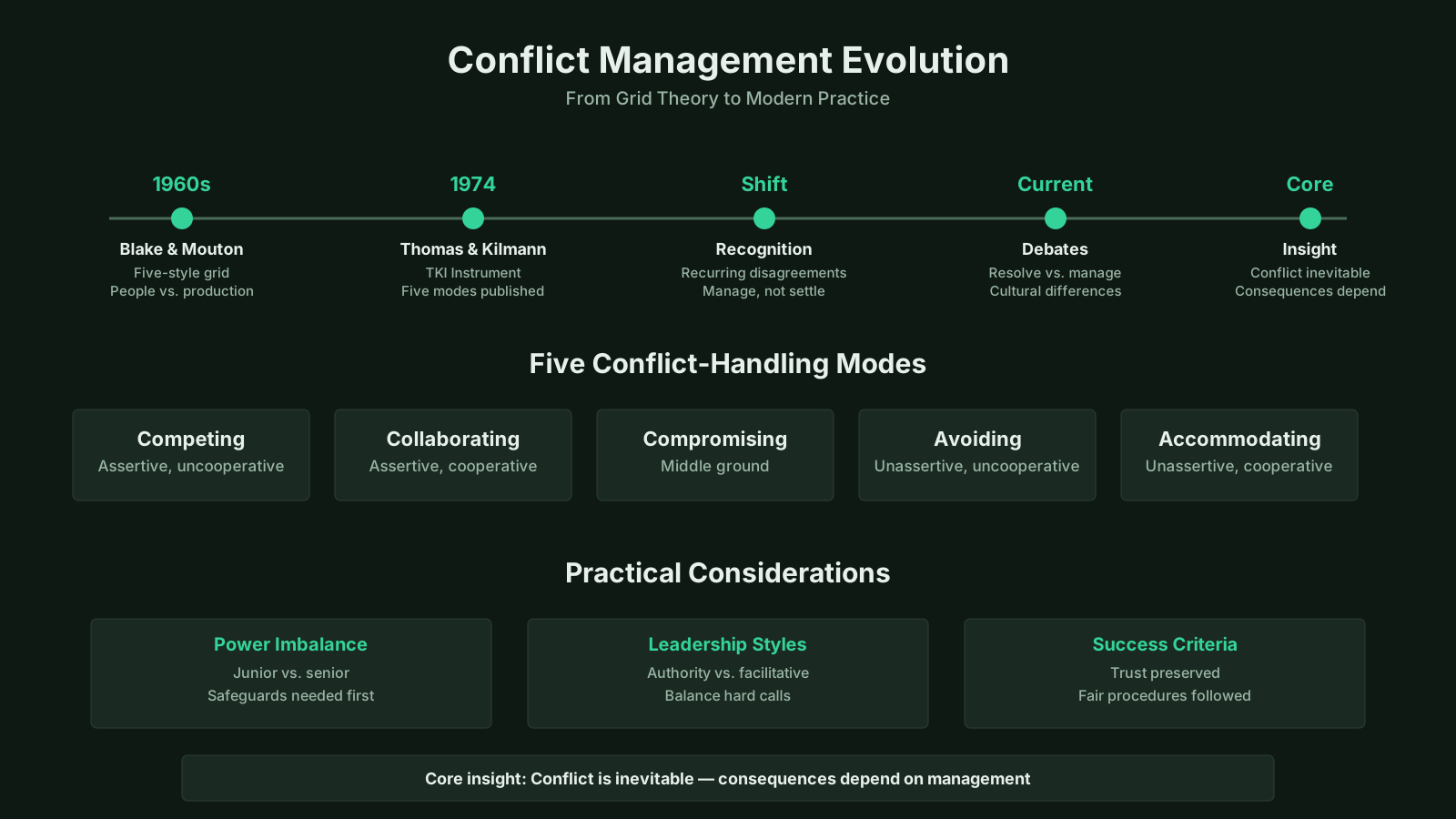
The evolution of conflict management in project management reflects a shift from viewing conflict as a problem to viewing it as a potential source of better decisions. Early management thinking often treated conflict as a sign of weak leadership or poor discipline. The human relations school later argued that conflict was natural and should be accepted. More recent thinking emphasizes that conflict can be beneficial when focused on tasks and carefully facilitated, while relationship conflict remains largely harmful. Modern guidance therefore stresses context, emotional intelligence, and psychological safety.
Current debates include whether all conflict should be resolved or just managed, how much conflict is desirable in high-performing teams, and whether cultural differences in communication style require different conflict approaches. In global and virtual teams, conflict often manifests through written channels where sarcasm, brevity, or delayed responses can inflame disputes. The rise of hybrid work has made explicit team agreements more important because informal resolution in hallways is less available.
Contemporary practice also questions the older notion that the project manager should always be the central resolver. In Agile and self-managing teams, conflict management is distributed. The emphasis shifts from authority to facilitation and from individual heroics to team capability. This does not mean project managers abdicate responsibility. It means they build conditions in which conflict can surface safely and then use the least intrusive intervention that restores constructive work. The field continues to evolve, but the core insight remains stable: conflict in projects is inevitable, and its consequences depend largely on how it is managed.
Core Insights on Conflict Evolution
- Conflict as decision catalyst
- The field has moved beyond viewing conflict as a symptom of weak leadership and now recognizes that well-managed disagreement often yields sharper decisions and stronger project outcomes.
- Task versus relationship conflict
- Current research distinguishes task-focused conflict, which can improve decision quality when facilitated with care, from relationship conflict, which continues to undermine team cohesion and performance.
- Emotional intelligence and safety
- Contemporary guidance underscores that context, emotional intelligence, and psychological safety together determine whether conflict becomes a productive force or a destructive one.
- Virtual communication hazards
- Across global and hybrid teams, written communication can escalate disputes through sarcasm, brief messages, or delayed responses, so explicit team norms for digital interaction have become essential.
- Inevitability and management focus
- Conflict is an inevitable feature of project work, yet its impact hinges on management approach, and project managers are not required to personally resolve every dispute.