In project management, communication channels refers to the total number of potential pathways through which information can flow between stakeholders. A channel exists between any two people or groups that may need to exchange project information, whether through formal reports, casual conversation, or digital tools. The standard formula for calculating the number of communication channels is n(n-1)/2, where n represents the number of stakeholders or distinct parties involved. This formula is commonly used in project management training and literature as a quick way to show how project complexity grows as more people join. The concept sits at the center of project communications management because it quantifies the coordination burden that every additional stakeholder introduces.
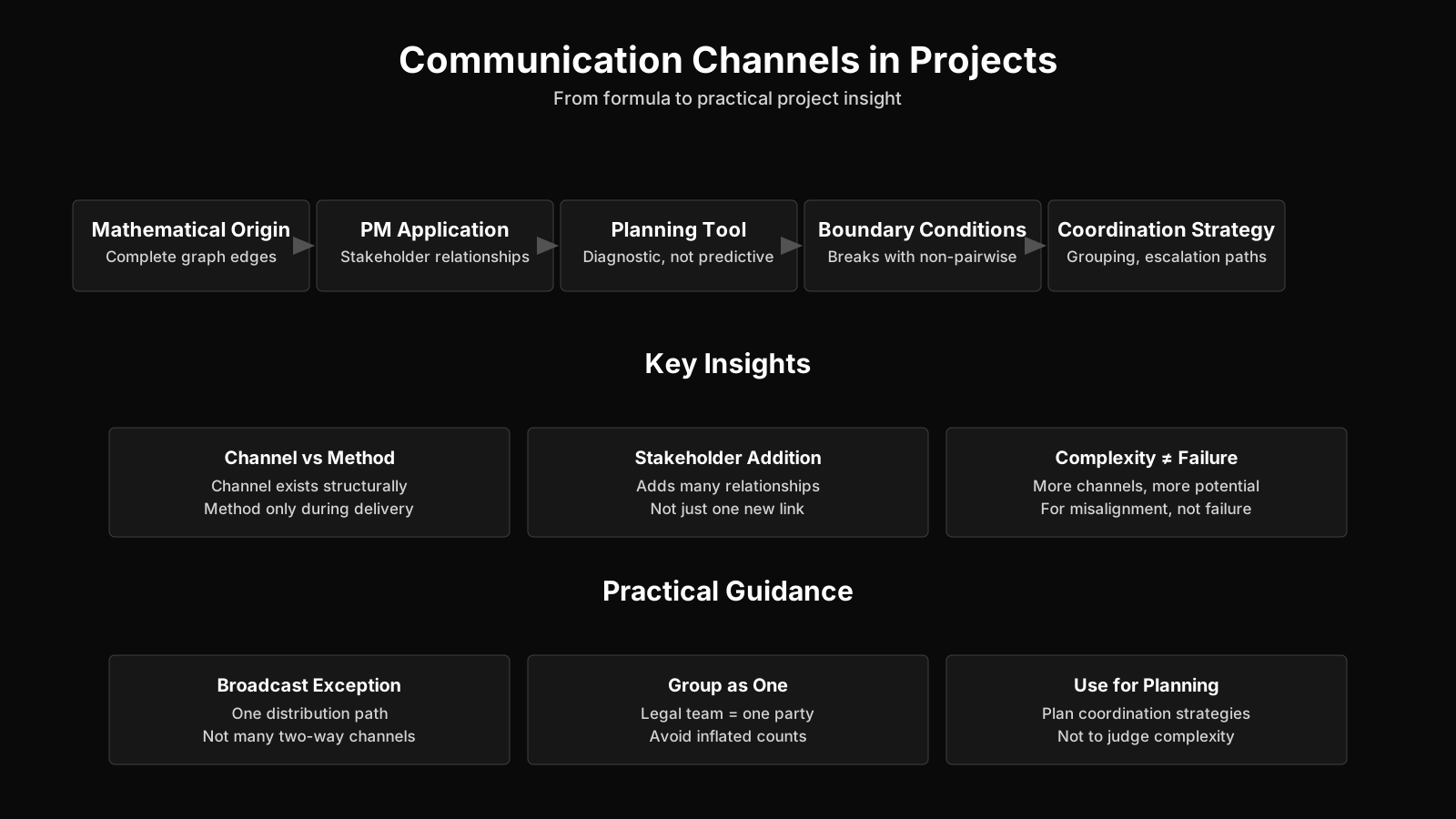
Communication Channels: Key Topics at a Glance
| Key Concept | Summary |
|---|---|
| Channel Definition | A communication channel is any potential bidirectional information pathway connecting two individuals or groups that need to exchange project information, whether through formal reports, informal conversations, or digital collaboration tools. |
| Channel Formula | The number of unique communication channels is one half of n times n minus one, where n represents the number of stakeholders. Dividing by two corrects for double counting because each bidirectional link is counted once from each endpoint. |
| Informal Pathways | Beyond formal reporting lines, the formula accounts for informal pathways such as peer-to-peer exchanges, project manager to functional manager discussions, and vendor to subject matter expert coordination. |
| Content Categories | Each channel may transmit multiple content categories, including schedule updates, risk assessments, budget revisions, and technical decisions, depending on stakeholder information needs. |
| Power and Role Dynamics | While every channel represents a potential two-way path, actual information flow is shaped by organizational hierarchy, role authority, and expectations about who initiates, escalates, or approves communication. |
| Channel Formality | Formal channels derive from governance structures, reporting relationships, and documented communication plans, while informal channels emerge through personal networks, trust relationships, and unplanned interactions. |
| Coordination Workload | The channel count helps project managers estimate coordination effort, but it becomes meaningful only when assessed alongside stakeholder engagement, organizational culture, geographic distribution, and available collaboration technology. |
| BVOP Perspective | In the BVOP approach, planning documents remain concise enough for every stakeholder to read quickly, because each additional reader represents a channel that must absorb the plan with minimal friction. |
What Is Communication Channels in Project Management?
The communication channels definition most often used in project management describes the total number of possible two-way information paths among all parties involved in a project. A channel exists between any two individuals or groups that may need to exchange project information. The count is based on the formula n(n-1)/2, where n equals the number of stakeholders. For example, a project with seven stakeholders has twenty-one channels. That number reflects potential links, not the number of messages sent or reports produced.
This definition matters because it separates the concept of a channel from the content that flows through it. A channel is not a meeting, an email thread, or a dashboard. It is the underlying sender-receiver relationship that could carry those messages. Understanding that distinction prevents project teams from confusing communication activity with communication capacity. In mature project environments, the channel count is used as a diagnostic lens rather than a performance target.
The Underlying Logic of the Formula
The formula n(n-1)/2 comes from basic combinatorics. Every person or group can potentially communicate with every other person or group except itself. If there are n stakeholders, each one has n minus one possible counterparts. Multiplying n by n minus one counts every connection twice, once from each direction, so dividing by two produces the number of unique channels. When a sixth person joins an existing five-person team, five new potential pathways appear because the newcomer can connect to each existing member.
For a project with twelve stakeholders, the practical effect is that there are sixty-six distinct sender-receiver pairs. That does not mean all sixty-six pairs will actually exchange information. It means the project manager has sixty-six potential points of coordination where messages could be delayed, distorted, or dropped. This is why many experienced project managers become cautious when stakeholder lists grow quickly. The formula exposes hidden complexity that a simple headcount does not reveal.
What Communication Channels Are Not
Communication channels are not the same as communication methods. Email, videoconferencing, face-to-face meetings, and instant messaging are methods or media that use a channel. A single channel can carry multiple methods over time. Likewise, communication channels are not the same as communication frequency. The formula counts possible relationships, not how often those relationships are used. A project with few channels can still suffer from communication overload if every channel is used constantly with poor discipline.
Another common misunderstanding is that communication channels describe only formal reporting relationships. In reality, informal channels between peers, between a project manager and a functional manager, or between a vendor and a subject matter expert are also captured by the formula. The potential for unplanned information exchange is exactly what makes the channel count a useful proxy for complexity.
Key Takeaways on Communication Channels
- Channel definition in project management
- A communication channel represents a potential two-way information pathway between any two project stakeholders, and the total channel count maps the complete set of possible stakeholder connections.
- The counting formula n(n-1)/2
- The formula n(n-1)/2 calculates the total number of potential communication links by taking the number of stakeholders as n, and because each channel is bidirectional the division by two eliminates double counting.
- Channels versus communication content
- A channel should be understood as separate from the messages, meetings, emails, and reports that move through it, meaning the count identifies possible connection points instead of measuring actual communication traffic.
- Diagnostic use of channel count
- In mature project environments, the channel count functions as a diagnostic indicator for assessing communication complexity, not as a metric to minimize or maximize.
- Adding a new team member
- Adding a sixth person to an existing five-person team introduces exactly five new potential communication pathways, since the newcomer can form a direct link with each current member.
Key Components of Communication Channels
The key components of communication channels include directionality, formality, content type, frequency, and the medium through which information travels. Directionality describes whether information flows one way or two ways. Formality distinguishes governed reporting lines from informal social connections. Content type refers to whether the channel carries schedule updates, risk information, budget changes, or technical decisions. Frequency and medium define how often the channel is used and what tools support it.
Each of these components affects how a channel behaves in real project work. A weekly steering committee report is a formal, one-way channel with structured content. A daily conversation between two developers is an informal, two-way channel with highly variable content. Both count as channels in the formula, but they demand very different management attention. This is one reason the raw channel count cannot stand alone as a communication strategy.
Directionality and Symmetry
Many communication channels are assumed to be two-way, but actual information flow is often asymmetrical. A project sponsor may send direction downward while receiving only summarized status upward. A vendor may receive requirements but have limited opportunity to negotiate them. The channel exists in both directions as a potential path, but organizational power and role expectations shape how information actually moves. Practitioners often observe that the most important breakdowns happen in channels that appear symmetrical on paper but are functionally one-way.
Formality and Organizational Context
Formal channels are those defined by governance structures, reporting relationships, and documented communication plans. They include status reports, change control boards, stage gate reviews, and procurement communications. Informal channels emerge through personal relationships, shared workspaces, and social networks. Both types carry project-relevant information. Formal channels provide traceability and accountability, while informal channels often carry early signals about risk, resistance, or emerging issues before they appear in official reports.
Content and Frequency
The content a channel carries can shift during the project lifecycle. A channel that initially handles scope clarification may later carry acceptance testing results or operational handover details. Frequency also changes. During project initiation, sponsor communication may be frequent and bidirectional. During steady-state execution, that same channel may settle into a monthly rhythm. Project managers who think of channels as fixed structures often miss the need to revisit communication assumptions as the project moves through phases.
Communication Channels in PMBOK and PRINCE2
The communication channels PMBOK concept appears within Project Communications Management, where the number of channels informs planning and management. In the PMBOK framework, Plan Communications Management uses stakeholder analysis and communication requirements to identify the information needs of each stakeholder. The channel count is one input among several for understanding communication complexity. Manage Communications then focuses on generating, collecting, and distributing information, while Monitor Communications focuses on ensuring stakeholder information needs are met. The formula itself is a simple combinatorics tool, but PMBOK embeds it in a broader set of communication planning activities.
PMBOK does not treat communication channels as a standalone technique. The number of potential paths helps project managers anticipate how much coordination work lies ahead, but it must be combined with stakeholder engagement assessment, organizational culture, geographic distribution, and available technology. The communications management plan remains the primary artifact for documenting how selected channels will be used.
PMBOK Process Groups and the Communications Knowledge Area
In the PMBOK Sixth Edition, Project Communications Management belongs to the planning, executing, and monitoring and controlling process groups. Plan Communications Management occurs during planning and produces the communications management plan. Manage Communications is an executing process that implements that plan. Monitor Communications occurs throughout the project and evaluates whether information is reaching the right stakeholders at the right time. The channel formula is most directly relevant during planning, when stakeholder lists are first assembled and the communication burden becomes visible.
PRINCE2 and the Communication Management Approach
PRINCE2 does not place the same numerical emphasis on counting channels, but the underlying logic appears in its communication management approach. This management product defines the stakeholders, information needs, timing, format, and method of communication for a project. PRINCE2 treats communication as a controlled process tied to the project board, project manager, and team managers. While PRINCE2 may not explicitly require the n(n-1)/2 calculation, the communication management approach addresses the same practical question: who needs to hear from whom, and through what route.
Key Insights on Communication Planning
- Formula embedded in broader framework
- PMBOK positions the channel count as one of several inputs for understanding communication complexity, and it must be evaluated alongside stakeholder engagement intensity, organizational culture, geographic distribution, and the technology available to support information flow.
- Three communication management processes
- PMBOK's three communication processes form a sequential control loop: Plan Communications Management identifies what each stakeholder needs to know, Manage Communications generates and distributes that information through appropriate channels, and Monitor Communications verifies that delivery remains timely and effective for the project's duration.
- PRINCE2 takes a practical approach
- Although PRINCE2 does not mandate the n(n-1)/2 calculation, its communication management approach answers the same practical question of who must communicate with whom, through which channel, and how often to keep the project on track.
Communication Channels in Agile, Hybrid, and Predictive Environments
The way communication channels in Agile environments are managed differs from predictive projects. Agile teams deliberately keep the number of participants small to limit the channel count. A core Agile principle is that face-to-face conversation is the most efficient and effective method of conveying information. When a team grows beyond roughly seven to nine people, the number of channels becomes large enough that informal communication starts to break down. That is one reason scaling frameworks introduce structures that preserve small team communication while coordinating across teams.
This emphasis on small teams is not accidental. A five-person Agile team has ten channels, which is manageable for daily coordination. A fifteen-person team has one hundred five channels, which overwhelms informal conversation and forces the team toward more formal coordination. Agile frameworks therefore favor small, cross-functional teams and suggest splitting or scaling structures when team size grows too large.
Agile and Osmotic Communication
Agile teams rely heavily on osmotic communication, where team members absorb information by overhearing conversations in a shared workspace. This works when the physical or virtual environment supports low-friction interaction. The daily standup is a structured mechanism that reduces the need for many one-off channels by creating a recurring shared moment. Information radiators such as task boards and burndown charts also transform what could be dozens of individual status requests into a single visible channel.
When Agile teams become distributed, osmotic communication weakens. Video calls, chat tools, and documentation become more necessary, and the effective channel count can feel larger even if the team size stays the same. This is why many Agile practitioners argue that co-location or a strong remote collaboration culture is essential for maintaining low communication friction.
Predictive and Hybrid Contexts
Predictive projects often have more formal hierarchical channels. Reporting lines follow the project charter, governance structure, and work breakdown structure. Communication tends to flow upward through status reports and downward through directives, with lateral channels between workstreams managed explicitly. Hybrid projects blend these approaches, using Agile ceremonies within delivery teams while preserving formal governance channels for sponsors and external stakeholders. In both cases, the channel count helps identify where coordination effort will concentrate.
BVOP Perspective on Communication Channels
In the BVOP communication channels approach, planning documents are kept brief enough to be read by everyone, including new joiners, because every new reader represents a potential communication channel that must absorb the plan quickly. BVOPM also connects dependency analysis to hiring and training, recognizing that when new people join a project, new communication channels form and existing channels may need temporary renegotiation. This is not about counting every channel but reducing the load that channel growth places on shared understanding.
Core Takeaways on Channel Management
- Brief planning documents
- BVOP intentionally keeps planning documents concise so that every reader, especially new joiners, can absorb them quickly, since each new reader represents a communication channel that must be onboarded efficiently.
- New readers as new channels
- Every new project participant functions as an additional communication channel, which means documentation and processes must be designed to support rapid comprehension from day one.
- Dependency analysis linked to hiring
- BVOPM links dependency analysis directly to hiring and training, because adding team members creates new communication channels while existing channels may need to be temporarily renegotiated to maintain flow.
- Focus on shared understanding
- The objective is not to enumerate every communication channel but to minimize the strain that channel growth places on preserving a shared understanding throughout the team.
Purpose and Importance of Communication Channels
The importance of communication channels lies in their ability to reveal coordination complexity before it becomes a problem. A project manager who understands that a twelve-person team has sixty-six potential channels can anticipate where messages may be delayed, misinterpreted, or lost. The channel count does not predict project failure by itself, but it highlights where communication overhead is likely to grow. This perspective matters most during stakeholder identification, team formation, and organizational change, when adding a single senior sponsor can create many new reporting relationships.
Communication channels also influence decision speed. As the number of channels rises, reaching consensus often takes longer because more people need to be consulted, informed, or aligned. This does not mean the project should avoid necessary stakeholders. It means the project should plan communication deliberately rather than assuming that adding people is cost-free from a coordination standpoint.
Why Channel Count Matters for Complexity
The formula n(n-1)/2 grows quadratically, not linearly. A project that doubles its stakeholder count from ten to twenty does not double its channels from forty-five to ninety. It more than quadruples them to one hundred ninety. This nonlinear growth is a key insight for project managers who underestimate the impact of adding a new team, vendor, or governance body. Even a modest increase in headcount can create a disproportionate increase in coordination effort.
Impact on Risk and Decision Speed
More channels create more opportunities for information loss, distortion, and delay. The risk is not simply that a message gets lost, but that it arrives in different versions to different stakeholders. Decision speed can also suffer because more channels often mean more people expect to be included. This does not mean fewer channels are always better. Excluding critical stakeholders can lead to poor decisions and resistance. The purpose of channel analysis is not to reduce the count at all costs, but to make the coordination load visible.
Practical Application and Use in Project Work
In communication channels in practice, project managers use the count during project initiation and planning to assess how many stakeholder relationships need active management. A project with eight stakeholders has twenty-eight channels; a project with fifteen stakeholders has one hundred five. That difference often justifies a more structured communications management plan, dedicated collaboration tooling, or additional coordination roles. The formula is not used continuously throughout the project. It is typically revisited when the stakeholder register changes, when a team merges with another, or when a governance committee expands.
The calculation is quick and inexpensive, which makes it attractive during early project conversations. A project manager can run the numbers in a planning workshop and immediately show the group why a growing stakeholder list has coordination consequences. This can lead to more realistic timelines, more careful governance design, and clearer escalation paths.
When the Calculation Is Most Useful
The channel count is most useful at three moments: during initial stakeholder identification, during major team changes, and during project recovery. At initiation, it helps set expectations for communication effort. During team expansion or workstream consolidation, it reveals hidden coordination costs. During recovery, it can explain why communication broke down despite individual competence. In each case, the calculation is a diagnostic starting point rather than a solution by itself.
Who Uses Communication Channel Analysis
Project managers use channel analysis most directly, but program managers and portfolio managers also consider it when coordinating multiple related initiatives. A program with several project teams may face communication needs that span project boundaries. Product owners and scrum masters in Agile settings use the same logic informally when they resist growing a team too large. PMOs may incorporate communication channel counts into project intake reviews or governance design to anticipate management overhead.
Key Takeaways on Channel Counting
- Planning phase stakeholder assessment
- Project managers calculate the communication channel count during project initiation and planning to quantify how many stakeholder relationships will demand active engagement and coordination.
- Justifies added management structure
- A high channel count often justifies a more structured communications management plan, dedicated collaboration tools, or additional coordination roles to prevent information overload and missed messages.
- Recalculation triggered by changes
- The calculation is revisited whenever the stakeholder register changes, teams merge, or a governance committee expands, so the coordination burden remains visible.
- Quick and inexpensive workshop tool
- Because the math is fast and cost-free, a project manager can run the numbers during a planning workshop and immediately show the group how each additional stakeholder multiplies coordination demands.
- Most valuable at three moments
- The channel count proves most useful during initial stakeholder identification, major team changes, and project recovery, while Agile teams and PMOs apply the same logic informally to constrain team growth and anticipate coordination overhead.
Common Challenges, Pitfalls, and Misconceptions
One of the most persistent communication channels pitfalls is treating the formula as a goal instead of a diagnostic. Some project managers try to reduce the number of channels by excluding stakeholders from the count, which simply hides risk. Others assume every channel must be actively managed, which can lead to excessive meetings and reporting. The formula describes potential paths, not actual communication demands. Another pitfall is ignoring informal channels that carry as much project-relevant information as formal ones. The channel count also says nothing about message quality, trust, or power distance.
Projects sometimes fall into the trap of overengineering communication because the channel count looks alarming. A large count does not automatically mean every pair needs a standing meeting. Many channels can be handled through shared artifacts, self-service dashboards, or scheduled group forums. Conversely, a small channel count does not guarantee good communication. Trust, clarity, and accountability matter more than the raw number of paths.
Misconceptions About the Formula
A common misconception is that the formula counts only people who talk to each other regularly. In fact, it counts every potential sender-receiver pair. Another misconception is that reducing the number of stakeholders always improves communication. Removing a difficult stakeholder from the count may reduce the number but increase project risk if that stakeholder still has influence. The formula is also sometimes applied to teams where some members are purely passive recipients, which can overstate active communication load.
Ignoring Informal and Shadow Channels
Formal communication plans capture only a fraction of real information flow. Shadow channels exist when team members escalate issues through personal relationships, when vendors share information outside the approved procurement path, or when functional managers exchange concerns without the project manager present. These channels are real and can carry decision-relevant information. Project managers who focus only on formal channels often miss early warning signs because the official reporting lines look clean while the actual communication network is far messier.
Overengineering the Channel Count
There is a risk of turning communication channel analysis into a bureaucratic exercise. Large projects with hundreds of stakeholders can produce channel counts in the tens of thousands, which is neither useful nor actionable. In those settings, practitioners usually aggregate stakeholders into groups or focus on key communication interfaces. The formula is most meaningful at the team and project level. At the program or portfolio level, channel counts need to be paired with relationship mapping and governance design to remain practical.
Relationship to Other Project Management Concepts
The concept of communication channels vs stakeholder engagement is often framed as a distinction between counting paths and managing relationships. Stakeholder engagement focuses on understanding influence, interest, expectations, and attitudes. Communication channels focus on the number of possible information flows among those stakeholders. They are complementary: the stakeholder register tells you who matters and why, while the channel count tells you how complex the communication environment has become. A communication management plan then specifies how selected channels will be used, how often, and with what format.
This distinction helps avoid a common mistake: producing a detailed stakeholder register but failing to plan how those stakeholders will actually communicate. The channel count bridges the gap between stakeholder identification and communication execution. It forces the project manager to move from who is involved to how they connect.
Stakeholder Register and Communication Management Plan
The stakeholder register is a project document that lists stakeholders, their roles, interests, influence, and expectations. The communication management plan is a component of the project management plan that describes communication requirements, methods, frequency, and responsibilities. Communication channel analysis sits between the two. It takes the stakeholder register as an input and helps determine how robust the communication management plan needs to be.
RACI and Reporting Structures
A RACI chart clarifies who is responsible, accountable, consulted, and informed for specific activities. Communication channels map who can talk to whom, but they do not define decision rights or consultation expectations. RACI and channel analysis are often used together. RACI tells the project manager which relationships require communication for decision-making, while the channel count shows how many such relationships exist. Organizational breakdown structures and reporting lines add another layer by showing formal authority through which many formal channels flow.
Virtual Teams and Collaboration Tools
Virtual teams complicate communication channel analysis because digital tools can create new pathways while also making them more traceable. A shared document repository may reduce the need for many one-to-one status updates, effectively consolidating channels. A poorly configured chat platform can do the opposite, fragmenting information across many private threads. Project managers need to consider the channel count alongside tool governance, information architecture, and team norms.
Essential Summary of Communication Links
- Channels and engagement are complementary
- Stakeholder engagement captures influence, interest, and attitudes, while channel count quantifies the number of possible information flows, so the two metrics jointly describe relational depth and communication complexity.
- Stakeholder register versus communication plan
- The stakeholder register defines which individuals and groups require attention and why, whereas the communication management plan specifies how selected channels are used, at what frequency, and in which formats.
- RACI charts define activity accountability
- A RACI chart clarifies which roles are responsible, accountable, consulted, and informed for each activity, providing a clear framework for defining reporting structures and assigning communication duties.
- Channel count needs governance context
- The number of channels alone offers limited value because designing communication systems requires additional attention to tool governance, information architecture, and team norms.
Evolution and Current Thinking on Communication Channels
The current thinking on communication channels has moved beyond the simple formula toward a more nuanced view of network quality and information flow. Modern project management still uses n(n-1)/2 as a teaching tool, but practitioners also consider the reliability, psychological safety, and digital traceability of each connection. A team with fewer channels but low trust may communicate worse than a larger team with well-maintained formal and informal channels. The formula remains useful, but it is now understood as a starting point rather than a complete model.
This evolution reflects broader changes in project management. Teams are more distributed, tools generate more communication data, and stakeholders expect more transparency. The question is no longer only how many channels exist, but which channels carry decision-critical information, which are overloaded, and which are silently broken. Communication channel analysis has become part of a wider interest in project network health.
From Simple Count to Network Perspective
Social network analysis and collaboration analytics have given project managers new ways to look at communication patterns. Instead of only counting possible paths, teams can now examine actual message flow, response times, and decision bottlenecks. This does not replace the simple formula. It adds depth. A project manager can still use n(n-1)/2 to explain why a growing team feels harder to coordinate, then use network data to find specific overloaded or underused channels.
Debates and Limitations
There is ongoing debate about how much weight to give the channel count. Some practitioners argue the formula overestimates communication complexity because not every stakeholder pair will ever interact. Others say that potential interaction is exactly the risk being measured. The truth depends on the project context. In a highly regulated environment with strict reporting lines, many potential channels may never be used. In a loosely structured environment, they may all become active. The formula is a proxy, not a precise measurement. It works best when combined with judgment about organizational culture, team maturity, and project phase.