A Communications Management Plan is a subsidiary plan within the project management plan that defines how project information will be created, distributed, stored, retrieved, monitored, and ultimately disposed of or archived. It serves as the formal record of communication requirements, methods, frequencies, owners, and escalation paths for a specific project or program. Unlike a generic organizational communication policy, the plan is tailored to the project context, stakeholder needs, governance structures, and delivery approach.
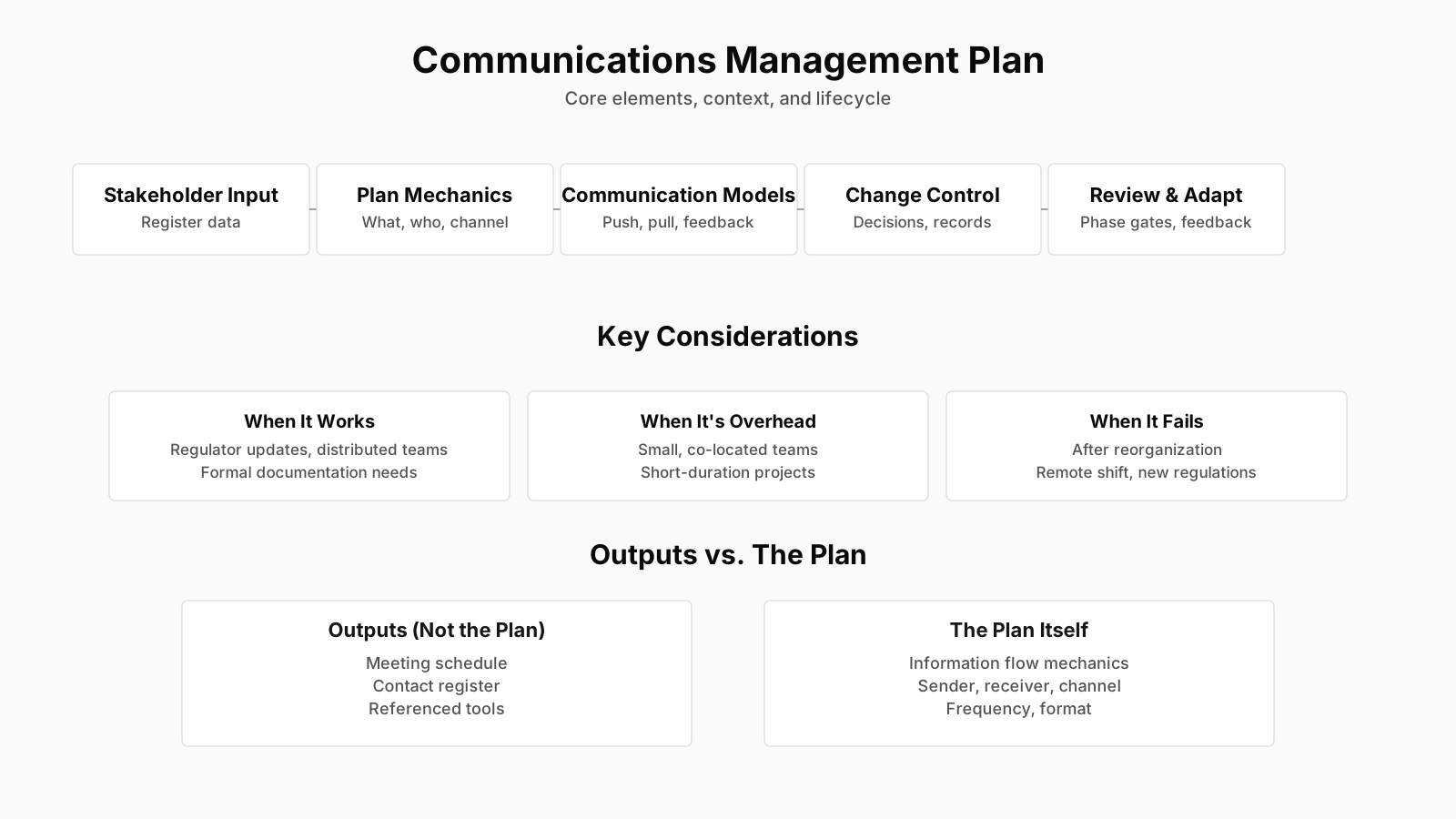
Communications Management Plan: Key Topics Summary
| Key Concept | Summary |
|---|---|
| Definition | A Communications Management Plan is a formal subsidiary document of the project management plan that defines how project information is created, distributed, stored, retrieved, monitored, archived, and ultimately disposed of. |
| Purpose | The plan sets clear rules, assigns responsibilities, and defines mechanisms for controlling information flow, tailored to the project context, stakeholder needs, governance structures, and the selected delivery approach. |
| Lifecycle | It governs the full communication lifecycle, from identifying stakeholder information needs to defining verification, storage, retrieval, and final archiving or destruction. |
| Integration | As an integrated component of the project management plan, it aligns with scope, schedule, cost, risk, quality, procurement, and stakeholder engagement baselines and methodologies. |
| Historical Roots | Communication planning predates formal project management and draws on proven practices from military operations, aviation coordination, emergency response, and corporate public relations. |
| Agile Approach | Agile environments favor working agreements and face-to-face interaction over heavy documentation, while still establishing lightweight communication expectations for distributed teams, external dependencies, or regulatory clarity. |
| Key Components | Essential components include stakeholder communication requirements, information content, delivery method and format, sender and receiver roles, frequency, ownership, escalation paths, and the plan's own update procedure. |
| Governance | A comprehensive plan also addresses access permissions, storage locations, retention schedules, legal and regulatory constraints, and confidentiality requirements, while setting cadence from daily standups to monthly steering committee reviews. |
What Is a Communications Management Plan?
A precise Communications Management Plan definition describes it as a formal document that establishes the rules, responsibilities, and mechanisms for managing information flow across a project. In project management, the term refers to more than a list of meetings or a contact directory. It covers the entire lifecycle of project communication, from identifying who needs what information to determining how that information will be verified, stored, and eventually archived or destroyed. The plan is a component of the broader project management plan, meaning it must remain consistent with scope, schedule, cost, risk, quality, procurement, and stakeholder engagement approaches.
The core meaning of the term sits inside a larger discipline known as project communications management. That discipline includes planning communications, managing the execution of communications, and monitoring communications to ensure they are effective. A Communications Management Plan is the primary output of the planning activity. Without it, communication becomes reactive, fragmented, and dependent on individual preferences rather than agreed project standards. In practice this means a project manager does not decide communication rules on the fly, they are defined early and reviewed as the project evolves.
Communication planning concepts predate formal project management and have been shaped by military operations, aviation coordination, emergency response, and corporate public relations. In those fields, the absence of defined message flow creates operational risk, delays, and sometimes safety failures. Project management adopted the same logic, applying it to stakeholder expectations, executive reporting, and team coordination. The purpose is not to bureaucratize conversation but to reduce uncertainty about who should know what, when, and through which channel.
Different frameworks treat the artifact in slightly different ways. PMBOK recognizes it as a formal subsidiary plan. PRINCE2 uses a related product called the Communication Management Strategy. Agile environments often reject heavy communication documentation in favor of working agreements and frequent face-to-face interaction, but even Agile teams commonly create lightweight communication expectations when distributed work or external dependencies demand clarity. The underlying principle is consistent: information must flow deliberately, not accidentally.
Core Insights on Communication Plans
- Formal document for information flow
- A Communications Management Plan is a formal document that codifies the rules, assigns accountability, and establishes the mechanisms for managing information flow among project stakeholders.
- Covers full communication lifecycle
- The plan spans the entire communication lifecycle, from identifying stakeholder information needs to establishing verification, storage, archival, and disposal protocols.
- Aligned with overall project plan
- Because it is integrated into the broader project management plan, the communications approach must remain consistent with scope, schedule, cost, risk, quality, procurement, and stakeholder engagement strategies to avoid conflicting guidance.
- Prevents reactive communication habits
- Without a defined plan, communication often becomes reactive and fragmented, so project managers establish communication rules early, review them regularly, and avoid making ad hoc decisions about communication standards.
Key Components of a Communications Management Plan
The key components of a Communications Management Plan include the stakeholder communication requirements, the information to be communicated, the method and format, the sender and receiver, the frequency, the owner, escalation routes, and the process for updating the plan itself. A complete plan also addresses access permissions, storage locations, retention rules, and any legal, regulatory, or confidentiality constraints that apply to project information. These components are often captured in a communication matrix, but the matrix alone is not the plan. The narrative guidance around it matters just as much.
Stakeholder Communication Requirements
Every stakeholder group does not need the same information, at the same time, or in the same format. An executive sponsor may need summary-level status and escalated decisions. A workstream lead may need detailed technical updates. A regulatory body may need formal compliance reports. The plan captures these requirements based on stakeholder analysis, engagement needs, and the project’s governance structure. It also distinguishes between mandatory communication, such as contractually required reports, and discretionary communication, such as informal progress notes.
Information, Methods, and Frequency
The plan specifies what information will be communicated, including status, risks, issues, changes, milestones, decisions, and performance data. It defines the method, whether push, pull, or interactive. Push communication sends information directly to recipients through email, reports, or instant messages. Pull communication stores information in a shared repository where stakeholders retrieve it as needed. Interactive communication occurs in meetings, calls, or workshops where participants exchange information in real time. Frequency is also defined, from daily standups and weekly status reports to monthly steering committee reviews and phase-end summaries.
Roles, Ownership, and Escalation
Each communication item needs an owner responsible for producing, reviewing, and distributing it. The plan may also identify an approver, particularly for sponsor-level or externally facing communication. Escalation paths clarify what happens when a risk or issue exceeds a threshold, who receives the escalation, and how quickly a response is expected. These definitions prevent situations where critical information reaches the right audience too late because nobody owned the channel or the decision point.
Communications Management Plan in PMBOK
Within the PMBOK framework, the Communications Management Plan PMBOK artifact emerges from the Plan Communications Management process. In the Sixth Edition, this process belongs to the Communications Management Knowledge Area and the Planning Process Group. It requires analyzing stakeholder information needs, organizational process assets, enterprise environmental factors, and the project management plan. The output includes the Communications Management Plan itself, along with project document updates. In the Seventh Edition, the knowledge areas are replaced by performance domains, and communication effectiveness appears across stakeholder and team domains, but planning remains a core project management activity.
Plan Communications Management Process
The Plan Communications Management process considers communication requirements, communication technology, communication models, and communication methods. Communication requirements analysis examines what information each stakeholder needs and why. Technology selection considers urgency, availability, ease of use, project environment, and confidentiality. Communication models address how messages are encoded, transmitted, decoded, and acknowledged, including the role of noise or interference. Communication methods classify exchanges as interactive, push, or pull. Together these inputs shape a plan that is realistic for the project’s complexity and constraints.
Outputs and Related Documents
The Communications Management Plan in the PMBOK sense is not isolated. It connects to the stakeholder register, stakeholder engagement plan, project schedule, risk register, and lessons learned register. For example, the stakeholder register identifies individuals and groups, while the Communications Management Plan defines how each will receive and provide information. The schedule determines when project reporting occurs, and the risk register may require specific communication thresholds. This interconnectivity is why the plan must be reviewed whenever stakeholder needs change, governance changes, or the project delivery approach shifts.
Core Takeaways on Communication Planning
- Plan arises from planning process
- The Communications Management Plan is developed through the Plan Communications Management process, which belongs to the Communications Management Knowledge Area and the Planning Process Group in the Sixth Edition.
- Inputs shape the plan
- Effective planning depends on a structured review of stakeholder information requirements, organizational process assets, enterprise environmental factors, and the current project management plan to align communication with project context.
- Seventh Edition shifts domains
- The Seventh Edition replaces knowledge areas with performance domains, placing communication effectiveness within the stakeholder and team domains while retaining planning as a core discipline.
- Technology and methods matter
- Selecting communication technology requires balancing urgency, availability, ease of use, project environment, and confidentiality, while also applying appropriate communication models and methods.
- Plan requires regular review
- The plan should be reevaluated whenever stakeholder needs, governance arrangements, or the project delivery approach change, since it depends on related tools such as the stakeholder register.
Communications Management Plan in PRINCE2
A Communications Management Plan in PRINCE2 is more accurately called a Communication Management Strategy. PRINCE2 uses the term strategy for several management products that define how the project will handle risk, quality, change control, and communication. The Communication Management Strategy is created during the Initiating a Project process and forms part of the Project Initiation Documentation. It is reviewed and potentially updated at each stage boundary to remain aligned with current stakeholder needs and project circumstances.
Communication Management Strategy in Practice
According to PRINCE2, the Communication Management Strategy describes the communication procedures, tools, and records required for the project. It identifies who needs what information, why, when, in what format, and through which channel. It also defines the method for reviewing communication effectiveness and any specific constraints related to confidentiality, security, or regulatory reporting. The Project Board approves the strategy as part of initial authorization, and the Project Manager ensures day-to-day adherence. This is a more centralized governance approach than many Agile settings, but it remains relevant for projects with formal stage gates and external accountability.
Communications Management Plan in Agile and Hybrid Environments
A Communications Management Plan in Agile environments is often implicit rather than a standalone formal document. Agile teams rely on daily standups, sprint planning, sprint reviews, retrospectives, backlog refinement, and visible information radiators such as Kanban boards and burn charts. Communication is intended to be frequent, direct, and co-located whenever possible. The team’s working agreement, sometimes called a social contract, may capture communication norms, response times, and meeting etiquette without the density of a traditional plan.
Agile Communication Patterns
In Scrum, the daily scrum synchronizes development work, the sprint review communicates product increments to stakeholders, and the retrospective communicates team improvement actions. These events create predictable communication cadence without requiring a large document. However, when Agile is scaled or distributed, the absence of physical co-location weakens osmotic communication. Osmotic communication happens when team members overhear relevant information naturally in a shared space. Remote and hybrid teams must deliberately design equivalent touchpoints, shared dashboards, and asynchronous decision logs. This is where a lightweight communications plan or working agreement becomes valuable.
Hybrid Adaptations
Hybrid projects combine predictive planning with iterative delivery. They often require formal reporting to executives and informal team communication simultaneously. In such cases, a Communications Management Plan may define both the traditional status cycle and the Agile cadence. For example, a steering committee may receive monthly milestone reports while product teams use weekly demos and daily standups. The plan clarifies which audience uses which cadence, preventing duplicate reporting or information gaps between governance layers.
Core Insights on Agile Communications
- Implicit plans via Agile ceremonies
- Agile teams embed communication planning into recurring ceremonies such as daily standups, sprint reviews, and retrospectives, while visible information radiators like Kanban boards and burn charts keep progress transparent without formal documentation.
- Working agreements define norms
- A working agreement or social contract explicitly codifies how team members share updates, set response time expectations, and conduct meetings, replacing the heavy documentation of traditional communication plans with lightweight, agreed behavioral norms.
- Scrum events create cadence
- The predictable rhythm of daily scrums, sprint reviews, and retrospectives synchronizes development work, surfaces product increments to stakeholders, and channels improvement actions into each iteration.
- Hybrid teams need deliberate design
- Because osmotic communication fades when team members work across locations, remote and hybrid teams must deliberately design touchpoints, shared dashboards, and asynchronous decision logs to sustain context and alignment.
BVOP Perspective on Communications Management Planning
The BVOP communications planning approach emphasizes brevity and broad accessibility of planning documents. Business Value-Oriented Project Management, or BVOPM, requires that brief planning documents can be read and understood by everyone, including new team members who join after the project has started. Applied to a Communications Management Plan, this means avoiding excessively long narratives and ensuring the plan remains useful for orientation, not just for audit compliance. BVOPM also uses hiring-and-training-based dependency analysis, meaning communication bottlenecks linked to missing skills, delayed onboarding, or insufficient training are evaluated as part of plan viability. This perspective treats communication planning as a practical operational tool rather than a static governance artifact.
Purpose and Importance of a Communications Management Plan
The purpose and importance of a Communications Management Plan lie in reducing ambiguity, aligning expectations, and protecting decision-making speed. Projects fail or stall when stakeholders receive conflicting information, when the right people learn about a risk too late, or when team members duplicate work due to unclear message flow. A defined plan does not guarantee perfect communication, but it creates a baseline against which communication performance can be assessed. It also supports governance by demonstrating that the project has a deliberate approach to informing decision makers and managing sensitive information.
From a risk perspective, poor communication is frequently cited as a contributor to project overruns, missed requirements, and eroded stakeholder trust. The plan addresses this by assigning ownership, setting cadence, and identifying the appropriate channel for each message type. It also reduces cognitive load on the project manager, who no longer has to invent reporting formats or distribution lists every week. Everyone involved understands what to expect, which in turn makes deviations more visible and easier to correct.
The plan is not simply a convenience. In regulated industries, contracts, government-funded initiatives, or large programs, communication traceability becomes a compliance requirement. Records of decisions, change approvals, and risk notifications may need to be auditable. The plan specifies how these records are created, stored, and retained. This transforms communication from an informal act into a controlled project deliverable with defined retention and disposal rules.
Core Insights on Communication Planning
- Reduces ambiguity and aligns expectations
- A Communications Management Plan defines approved channels and message owners before execution begins, which prevents conflicting interpretations, keeps stakeholder expectations aligned, and preserves decision-making momentum throughout the project lifecycle.
- Creates a performance baseline
- The plan establishes a measurable baseline for communication frequency, audience reach, and content quality, allowing the team to detect shortfalls early and correct them before stakeholder confidence is damaged.
- Lowers project manager workload
- When ownership, cadence, and channels are predefined, the project manager can rely on stable reporting structures instead of recreating formats and distribution lists every cycle, freeing capacity for issue resolution and stakeholder engagement.
- Supports governance and compliance
- In regulated industries, government programs, and large-scale initiatives, communication traceability becomes a compliance obligation that turns every message into a controlled deliverable with defined approval, retention, and audit requirements.
Practical Application and Common Scenarios
In real project work, a Communications Management Plan in practice is developed early in the planning phase, usually after stakeholder identification and engagement planning have begun. The project manager typically owns the plan, but its content is shaped through interviews, workshops, and reviews with the sponsor, key stakeholders, and core team. It is first used to guide kickoff communication and early reporting, then revisited at phase gates, after major scope changes, or when stakeholder turnover occurs. The plan is a living artifact, not a shelf document.
Distributed Teams
Distributed teams present a common challenge because time zones, language differences, and technology access shape communication feasibility. A practical plan may define core overlap hours for synchronous meetings, asynchronous handoff protocols, and a single source of truth for documents and decisions. It may also specify acceptable response times for urgent versus routine messages. The plan becomes even more important when teams span multiple organizations, such as client, vendor, and subcontractor groups, because each may have different internal communication norms and security restrictions.
Executive Reporting and Governance
Executive audiences often need concise, high-level information tied to milestones, benefits, risks, and decisions. The Communications Management Plan defines the format and cadence for steering committee updates, sponsor briefings, and portfolio reviews. It may include dashboard summaries, traffic light indicators for schedule and cost, and an executive-level risk watchlist. The plan also clarifies who prepares the pack, who reviews it before distribution, and how much lead time the executive assistant or governance body requires. This prevents last-minute scrambling and ensures that governance meetings focus on decision making rather than information discovery.
Common Challenges, Pitfalls, and Misconceptions
The common pitfalls of a Communications Management Plan often stem from treating the artifact as a formality rather than an operational control. Teams may create an extensive template, file it away, and continue communicating through informal channels. The result is a plan that describes an ideal communication system that nobody uses. Another frequent issue is overengineering. A plan that defines dozens of report types, distribution lists, and approval chains becomes burdensome and breeds noncompliance. The most useful plans are specific but minimal enough to be followed under real schedule pressure.
Misconceptions
A common misconception is that a Communications Management Plan is just a meeting schedule or a contact list. It is neither. A meeting schedule is one output of the plan, and a contact list supports distribution, but the plan itself defines the full information flow system. Another misconception is that the plan only needs to be created once. In reality, stakeholder turnover, scope changes, new regulatory requirements, and delivery method shifts all affect communication needs. The plan should be reviewed whenever the stakeholder landscape or project governance changes materially. Yet another misconception is that more communication is always better. Overcommunication creates noise, reduces attention to critical signals, and can overwhelm stakeholders. The plan should define the right amount of communication, not the maximum possible amount.
Key Insights on Communication Plans
- Plan treated as formality
- Teams frequently complete the communication plan as a required deliverable and then set it aside, allowing informal channels to operate without the discipline or consistency the plan was meant to provide.
- Overengineering breeds noncompliance
- Plans that specify too many report types, approval layers, and distribution lists quickly become unworkable under schedule pressure, which is why effective communication plans remain specific but intentionally lean.
- Plan defines full information flow
- A Communications Management Plan defines the complete information flow across the project, including audiences, formats, frequency, and ownership, rather than functioning as a simple meeting schedule or contact list.
- Communication needs evolve constantly
- Because stakeholder turnover, scope changes, new regulatory requirements, and shifts in delivery methods all alter the information stakeholders need, the communication plan must be treated as a living document that is reviewed and adjusted throughout the project.
- Overcommunication creates noise
- When stakeholders receive too much information, critical messages lose visibility and attention, so effective communication requires deliberate filtering and restraint to protect signal clarity.
Communications Management Plan vs Stakeholder Engagement Plan and Related Artifacts
Understanding the Communications Management Plan vs Stakeholder Engagement Plan distinction is essential because the two artifacts are frequently confused. The stakeholder engagement plan focuses on strategies to engage stakeholders, influence their attitudes, and secure their support. The Communications Management Plan focuses on how information will flow to and from those stakeholders. One addresses the relationship and engagement approach, the other addresses the information delivery mechanism. A project may have highly engaged stakeholders but still suffer communication failures if the channels, frequency, and ownership are not defined.
Related Documents and Tools
The plan also connects to the stakeholder register, which lists individual stakeholders and their roles, the responsibility assignment matrix, which clarifies who is responsible, accountable, consulted, and informed for project activities, and the risk register, which may trigger urgent communication when specific risks materialize. The communication matrix is a tool or component within the plan that maps stakeholder groups to information items, methods, frequencies, and owners. Project management information systems, such as document repositories, collaboration platforms, and dashboards, support the plan but are not the plan itself. A useful plan explains how those systems will be used for communication, not just that they exist.
Evolution and Current Thinking in Communications Management Planning
The evolution of communications management planning reflects broader shifts in technology, organizational design, and delivery philosophy. Early formal project communication often followed a one-way push model, with project managers distributing periodic reports to predefined lists. Over time, interactive and pull-based approaches gained prominence as collaboration platforms, shared repositories, and real-time dashboards became common. The emphasis shifted from merely transmitting information to ensuring it is understood and acted upon. Current thinking treats communication as a two-way process involving feedback loops, sense making, and relationship maintenance.
Current Debates and Best Practices
Practitioners debate how much formal documentation remains necessary in digital and Agile contexts. Some argue that live dashboards and chat tools make static communication plans obsolete. Others counter that the absence of a formal plan creates hidden risks, especially in regulated, distributed, or high-stakes projects. The consensus tends toward tailoring. A small co-located Agile team may need only a working agreement, while a multiyear infrastructure program with external regulators may require a detailed communications plan with retention and audit trails. Current best practice favors short, living plans that are revised frequently, tied to actual project events, and reviewed for effectiveness rather than compliance alone.
Communication planning has also become more sensitive to cultural, linguistic, and psychological factors. Time zone overlap, language proficiency, cognitive load, and trust all affect message reception. A plan that ignores these realities can look complete on paper but fail in execution. Modern communication planning therefore includes not only logistics but also an awareness of how people actually interpret and respond to information under pressure. That is a long way from the old idea of a communication plan as a simple distribution matrix, and it reflects the maturing understanding of communication as a core project management discipline rather than an administrative afterthought.
Essential Summary of Communications Planning
- From push to pull models
- Communications management has shifted from distributing periodic one-way reports to enabling interactive, pull-based access through collaboration platforms, shared repositories, and real-time dashboards.
- Understanding over mere transmission
- The primary focus has moved from message delivery to confirming that audiences understand the information and can act on it effectively.
- Two-way communication with feedback
- Effective communication now functions as a continuous two-way exchange that integrates feedback loops, shared interpretation, and sustained relationship management.
- Documentation debate in Agile
- Agile practitioners remain divided over whether real-time dashboards and chat platforms can replace static communication plans, with critics cautioning that regulated, distributed, or high-stakes projects still require formal documentation.
- Living plans as best practice
- Leading practice favors concise communication plans that are revised frequently in response to project events and evaluated on outcomes rather than procedural compliance.