A colocated team is defined as a project team in which the members work together in the same physical location, usually within a shared workspace or a dedicated project room. The term is also spelled co-located team and appears frequently in both predictive and adaptive project management approaches. Colocation is primarily a coordination strategy. It places people close enough to observe, speak with, and react to one another without relying on scheduled meetings or written handoffs.
Colocated Teams: Key Topics Summary
| Key Concept | Summary |
|---|---|
| Colocation Defined | Colocation creates a dedicated workspace where a team shares a common delivery objective, enabling faster decisions than an open-plan office filled with unrelated projects. |
| Historical Origins | No single project management methodology can claim colocation as its invention; the practice emerged independently across disciplines that require close, real-time coordination. |
| High-Stakes Environments | Surgical teams, military command posts, airline cockpits, and emergency operations centers rely on physical proximity to coordinate time-sensitive, high-risk work with minimal delay. |
| Shared Visual Workspace | A shared visual system, such as sticky notes or a large monitor, makes the current project state continuously visible and reduces the need for frequent status meetings. |
| Benefits of Physical Proximity | When a tester sits beside a developer, the tester can overhear a tentative data model change and immediately raise a breaking test before defects reach production. |
| Effective Team Room Layout | Well-designed team rooms arrange desks for natural eye contact, position whiteboards or digital boards within sight, and provide an open area for quick, informal huddles. |
| Visual Management Systems | Task boards, burn-up charts, risk registers, and dependency maps improve transparency when accountable team members work in front of them daily and update them in real time. |
| Temporary and War Room Models | Temporary colocation and war room models convene people for focused periods such as release planning, major milestones, or incident response, then disband once the goal is met. |
What Is a Colocated Team?
A colocated team definition centers on physical presence rather than organizational reporting lines. In project management, the term refers to a group of individuals assigned to the same project who work in one shared location for a defined period. The members may come from different departments, vendors, or specialist disciplines, but they sit close enough to have frequent unplanned interaction. Colocation does not require that every team member be employed by the same organization. It does require that the project work environment be deliberately designed to make face-to-face contact easy.
Colocation is often confused with an open-plan office, but the two are not identical. An open-plan office may house people working on unrelated tasks, while a colocated team shares a common project objective and a defined shared space. The physical arrangement should enable joint problem solving, quick decision making, and visual management of the work. In many respects, the location is not the goal. The reduction of coordination friction is the goal.
Defining Colocation: Core Takeaways
- Physical presence, not reporting lines
- Colocation is determined by where people work, not by who they report to or how they are employed.
- Shared location for the project
- Specialists from different departments, vendors, or disciplines are brought together in a single location for a defined phase of the project.
- Deliberate design for interaction
- The physical environment is purposefully configured to lower the threshold for frequent, spontaneous face-to-face interaction.
- Distinct from open-plan offices
- Colocation differs from open-plan offices because the team shares a specific project goal and occupies a dedicated area reserved for that project.
- Coordination friction is the target
- The primary aim of colocation is to reduce coordination friction by enabling joint problem solving and faster decision making, not to achieve physical proximity as an end in itself.
Origins and Cross-Industry Context of Colocated Teams
The origin of colocated teams in management practice is not tied to a single project management body of knowledge. High-risk environments such as surgical operating rooms, military command posts, airline cockpits, and emergency response centers have long relied on physical proximity to synchronize fast-moving work. In these settings, people need to read nonverbal cues, share instruments and displays, and coordinate actions within seconds. The concept migrated into product development and project work as organizations recognized that knowledge work also benefits from continuous informal communication.
Lean manufacturing and the Toyota Production System contributed a specific version of colocation called the obeya room. An obeya is a large physical room where a cross-functional team posts schedules, metrics, and problem lists on the walls. Executives and team members meet there to make decisions while looking at the same information. Software methods such as Extreme Programming later adapted the same idea into team rooms and on-site customer practices. These influences shaped how project managers think about colocation today.
Key Components of Colocated Teams
The key components of colocated teams include physical proximity, a shared visual environment, osmotic communication, and a strong sense of shared identity. Physical proximity allows a team member to turn to a colleague and ask a question without opening a ticket or scheduling a call. A shared visual environment, such as a wall of sticky notes or a large monitor, keeps the current state of the project visible to everyone. Osmotic communication happens when people absorb useful information by overhearing nearby conversations, even when they are not direct participants.
What osmotic communication looks like in practice is subtle. A tester sitting beside a developer can overhear a half-sentence about a data model change and immediately flag a test case that will break. That comment may not appear in any formal meeting note, but it prevents a defect from surviving until the end of the sprint. Shared identity and trust also grow when people see each other working through friction rather than only encountering polished updates in status reports. These factors together explain why colocation can accelerate delivery even when the formal process remains unchanged.
Physical Workspace Design
Physical workspace design matters more than simply assigning seats. A team room typically has desks arranged to allow eye contact, whiteboards or digital boards on nearby walls, and enough shared space for quick huddles. The layout should make information visible at a glance rather than hiding it in separate files. Some teams use information radiators, which are displays placed where people naturally gather. The design of the space is part of the project management toolset because it shapes how often people collaborate without being told to do so.
Team Room and Visual Management
The team room functions as both a workplace and a communication artifact. Visual management techniques such as task boards, burn-up charts, risk registers, and dependency maps become more effective when the people responsible for those items sit in front of them every day. In a colocated environment, a sticky note can move across a board while the person doing the work explains the change to whoever is nearby. The physical object and the conversation reinforce each other, which is harder to replicate through a screen.
Core Components of Colocation
- Physical proximity aids quick questions
- Colocated team members resolve minor blockers by turning to a colleague for a quick answer instead of opening a ticket or scheduling a formal call.
- Shared visual environment
- A wall of sticky notes or a large monitor keeps the project's current state continuously visible, so no one needs to request a status update.
- Osmotic communication
- People absorb useful context by overhearing nearby conversations, a practice that often reveals risks and dependencies never captured in formal meeting notes.
- Shared identity and trust
- Watching colleagues work through obstacles in person builds stronger trust than reviewing polished status updates alone.
- Visual management tools
- Task boards, burn-up charts, risk registers, and dependency maps have greater impact when the responsible team members interact with them in person every day.
Types of Colocated Teams
The types of colocated teams vary depending on the degree of physical concentration and the project phase. Full colocation places all core team members in one shared space for the entire duration of the project or a major phase. Partial colocation involves a core group working together while some members join remotely for parts of the week. Temporary colocation, sometimes called a colocation workshop or conference room pilot, brings a distributed team into one location for a short burst of intense planning, design, or integration work.
Another variation is the war room model, in which a dedicated room is reserved during a critical period such as a major release, a system cutover, or an incident response. War rooms are often temporary but highly intensive. A hybrid colocation model may rotate teams or functions through the shared space while keeping other contributors remote. These configurations are not mutually exclusive, and experienced project managers often shift the level of colocation as the work demands.
Full and Partial Colocation
Full colocation maximizes opportunities for informal coordination but also requires the greatest commitment of real estate, relocation support, and personal adjustment. Partial colocation is common when some specialists cannot leave their home offices or when the organization wants to reduce facility costs. The challenge in partial colocation is avoiding a two-tier communication structure, where people in the room make minor decisions that remote members only hear about later.
Temporary Colocation and Team Events
Temporary colocation is often used at project start-up, release planning, or after a major scope change. A distributed team may gather for a multiday planning session to establish relationships, resolve ambiguities, and align on the project plan. The benefit often persists after people return to their remote locations because they now have faces and working styles attached to names. The limitation is that the benefit decays over time unless the team establishes lightweight routines to maintain trust and shared context.
Colocated Teams in PMBOK and PRINCE2 Frameworks
The PMBOK treatment of colocated teams recognizes the practice as a tool and technique for team development and resource management. In the sixth edition, colocation is listed within the Develop Team process, which belongs to the Executing process group and the Project Resource Management knowledge area. It is used to improve communication, reduce the cost and delay of coordination, and support the development of a project team identity. The PMBOK also acknowledges virtual teams as a separate concept, which means colocation and virtual work are treated as distinct but sometimes complementary options.
PMBOK’s seventh edition shifts attention away from detailed process prescriptions and toward performance domains. Colocation still appears in discussions of the team performance domain and the delivery performance domain, but the focus is less on the technique itself and more on creating an environment where the team can perform well. A project manager using the seventh edition would consider whether physical presence reduces delivery risk for the specific project rather than assuming that colocation is always required.
Colocation in PRINCE2
PRINCE2 does not dictate colocation, but its role-based method recognizes that frequent interaction between the project manager, team manager, and specialists can reduce handoff errors. The PRINCE2 principle of managing by stages produces natural planning and review points that sometimes justify bringing the team together physically. PRINCE2 also emphasizes work packages and defined tolerances, which can be easier to negotiate when the team manager and the specialist sit in the same room. However, PRINCE2 projects can be delivered effectively with remote teams, so colocation is an enabling context rather than a method requirement.
Colocation Insights Across Frameworks
- PMBOK sixth edition colocation
- In the sixth edition of the PMBOK, colocation is part of the Develop Team process within the Executing process group and Project Resource Management knowledge area, where it strengthens communication, reduces coordination costs and delays, and builds a shared team identity.
- Virtual teams as distinct option
- The PMBOK Guide treats virtual teams as a separate but complementary alternative, making clear that colocation is not the only valid arrangement for team collaboration.
- Seventh edition performance focus
- The seventh edition moves away from prescribing colocation as a fixed technique and instead asks project managers to assess whether physical presence reduces delivery risk within the team performance and delivery performance domains.
- PRINCE2 role-based interaction
- PRINCE2 does not mandate colocation, but it recognizes that frequent interaction among the project manager, team manager, and specialists reduces handoff errors, particularly during stage reviews and work package negotiations.
Colocated Teams in Agile and Hybrid Environments
In Agile practice, colocated teams in Agile are often considered a strong enabler of the direct communication valued by the Agile Manifesto. One of the manifesto’s principles states that the most efficient and effective method of conveying information to and within a development team is face-to-face conversation. A colocated team can hold impromptu whiteboard sessions, pair or mob program, and conduct daily standups without dealing with video call latency or scheduling overhead. Scrum does not require colocation, but many Scrum teams find that close physical proximity makes sprint planning, daily scrums, and sprint reviews more fluid.
Extreme Programming made colocation a more explicit practice, particularly through the team room and the on-site customer. The on-site customer represents the business and sits with the development team so that questions can be answered before they become rework. Hybrid environments present a more complicated picture. A hybrid team may have a colocated core in one office and remote members joining through video, chat, or shared digital boards. In such cases, the practices that make colocation powerful must be consciously extended to remote participants, otherwise the team can split into first-class and second-class members.
Team Rooms and Daily Coordination in Agile
An Agile team room typically supports continuous visual planning. The product backlog, sprint backlog, burn-down chart, and definition of done may be posted on the wall or on a shared screen visible to everyone in the room. This reduces the need for status meetings because the current state of the work is already apparent. Daily coordination becomes a quick conversation around the board rather than a lengthy reporting session. The team room also encourages collective ownership of the plan, since any member can walk to the board and adjust an item while explaining the change to nearby colleagues.
Colocated Teams from a BVOP Perspective
Colocated teams BVOP can contribute to one of that methodology’s stated success factors: the use of cross-functional teams. The proximity of business, development, testing, and operations people can speed up the decisions that create actual business value instead of deferring them into formal approval queues. BVOP also treats employee-created tools and open-source software as formal products, which implies that a colocated team should not dismiss improvised spreadsheets, scripts, or internal utilities simply because they were not part of the original project plan.
This does not mean BVOP demands colocation. The methodology is value-oriented and pragmatic, so the choice to colocate depends on whether it reduces waste and accelerates value delivery. In a BVOP context, a colocated group still needs to track business value points and watch for invisible organizational harm that can result from excessive interruption or overwork. Physical proximity is only valuable if it improves the flow of useful work, not if it becomes a source of constant distraction or pressure.
Core Takeaways on BVOP Colocation
- Cross-functional proximity speeds decisions
- Bringing business, development, testing, and operations staff into the same physical space shortens the path from insight to action, enabling decisions that directly advance business value instead of routing them through formal approval queues.
- Informal tools are formal products
- BVOP regards employee-created spreadsheets, scripts, and internal utilities as formal products, which means colocated teams must evaluate their reliability and maintenance needs rather than dismissing them because they were absent from the original project plan.
- Colocation is pragmatic, not required
- BVOP treats colocation as a pragmatic option rather than a mandate; teams should adopt it only when it demonstrably reduces waste and accelerates value delivery, and they must continue tracking business value points while guarding against productivity losses from interruptions or overwork.
Purpose and Importance of Colocated Teams in Project Management
The purpose of colocated teams is to reduce the coordination costs of complex work by shortening the distance between question, answer, and action. When a team member can resolve an ambiguity in a few minutes by walking over to a colleague, the project avoids the delay associated with formal requests, email threads, or waiting for the next scheduled meeting. Colocation also supports faster feedback because people can see initial reactions on a colleague’s face or hear hesitation in real time. This can be especially valuable during requirements discovery, design reviews, or defect triage.
There is also a motivational dimension. High-performing teams often develop a shared rhythm and a visible work culture when they share a dedicated space. People can feel more accountable to colleagues who are present and more invested in a plan that is physically posted on the wall. But these benefits are context dependent. Colocation does not guarantee psychological safety, skilled facilitation, or good management. It is a support structure, not a substitute for leadership or clear objectives.
When Colocation Adds the Most Value
Colocation tends to add the most value when the project has high ambiguity, tight interdependency, rapid learning cycles, or a need for creative negotiation. Product innovation, software development, complex system integration, and crisis recovery often fit this profile. For routine, well-defined work packages with stable requirements and low interaction, the added benefit of colocation may not justify the facility cost or the disruption of moving people. Experienced project managers evaluate the communication intensity of the project before deciding how much colocation to use.
Practical Application of Colocated Teams Across the Project Lifecycle
The practical application of colocated teams changes as a project moves through its lifecycle. During initiation and planning, a temporary colocation event can help the project manager and sponsor create a shared understanding of scope, risks, and stakeholder expectations. The charter and project management plan often benefit from real-time drafting sessions where disagreement can be surfaced and resolved immediately. Many project managers have observed that a two-day in-person planning workshop can replace weeks of asynchronous document review.
During execution, colocated teams typically maintain a visible board or digital display to track work in progress, blockers, and handoffs. Team members can use the shared space for daily standups, pairing, ad hoc design sessions, and rapid defect resolution. Monitoring and controlling activities also become more visible because the team can review metrics together and adjust the plan without first translating every signal into a written report. At project closing, a colocated team can conduct retrospectives and lessons-learned discussions with a richness that is harder to achieve when everyone is remote and fatigued by video calls.
Initiation and Planning
At initiation, colocation often takes the form of a facilitated workshop rather than a long-term seating arrangement. The project sponsor, key stakeholders, and core team may gather to align on business objectives, constraints, and major deliverables. The physical presence can reduce posturing and make hidden assumptions visible. In planning, a team room can host the work breakdown structure sessions, dependency mapping, and risk identification so that different specialists can challenge each other’s estimates immediately.
Execution and Monitoring
In execution, the shared workspace becomes the primary coordination mechanism. Work moves across the board, and the board itself is an information radiator. Monitoring shifts from gathering status after the fact to observing work as it happens. This does not eliminate the need for formal reporting, but it reduces the lag between an issue emerging and a manager learning about it. The project manager can walk through the team room and notice stalled work, overhear a recurring question from a tester, or see a build status screen change color before reading it in a weekly update.
Closing and Transition
At closing, the team room can support the transition of deliverables to operations or maintenance teams. A dedicated space allows a gradual overlap of knowledge transfer because the receiving team can sit with the project team for a few days and observe how the product was built and what operational quirks exist. The physical artifact of the project room also gives the team a place to hold a final retrospective. Lessons learned can be discussed while the context is still visually present on the walls.
Colocation Wins at Every Lifecycle Phase
- Planning workshops speed alignment
- A two-day in-person planning workshop builds shared understanding of scope and risks faster than weeks of asynchronous document review by surfacing assumptions and trade-offs in real time.
- Execution relies on visibility
- Visible boards, daily standups, pair programming, and ad hoc sessions give teams the continuous visibility needed to track progress, resolve defects quickly, and adjust plans without waiting for written reports.
- Closing yields richer lessons
- Colocated teams can hold retrospectives and lessons-learned discussions that surface deeper insights, which are harder to achieve when remote participants are fatigued by video calls.
Common Challenges, Pitfalls, and Misconceptions
Colocated team challenges often emerge when the shared space is seen as the solution rather than as one element of team effectiveness. A common pitfall is placing people in the same room without addressing team norms, role clarity, or facilitation. Proximity can increase interruptions and reduce deep work because every nearby conversation becomes an invitation to comment. Some team members may feel constantly observed, which can suppress honest questions or make them hesitant to try new approaches. Others may stop documenting decisions because the immediate conversation felt sufficient, only to discover later that the remote member or new joiner has no record of what changed.
Another challenge is the open-plan illusion. A large room with many teams does not automatically create a colocated team. If the people in that room are working on unrelated projects, the result may be noise rather than useful osmotic communication. Similarly, a colocated core with remote members can quietly become an exclusionary structure if the people in the room make small decisions without bringing the remote participants into the conversation. This undermines trust and can lead to duplicated work or conflicting assumptions.
Common Misconceptions About Colocated Teams
A common misconception is that colocation always improves communication. It can increase the quantity of information exchanged, but not necessarily the quality. Without clear accountability, the room can generate fast but shallow decisions that overlook long-term consequences. Another misconception is that colocation must be full-time to be useful. Many projects benefit from short, intense colocation periods at critical junctures while sustaining remote work in between. A third misconception is that colocation is the same as social cohesion. People can sit together and still fail to trust one another if the project environment punishes disagreement.
When Colocation Should Not Be Forced
Colocation is not a universally appropriate strategy. It should not be forced when team members require long blocks of uninterrupted focus, when the organization cannot provide a genuinely dedicated space, or when the cost of relocation exceeds the expected coordination benefit. It also should not be used as a monitoring device disguised as collaboration. If the real reason for bringing people together is surveillance, they will sense it quickly and resist. A skilled project manager weighs the communication intensity of the work against the human and financial cost of physical consolidation.
Colocated Teams vs Distributed and Virtual Teams
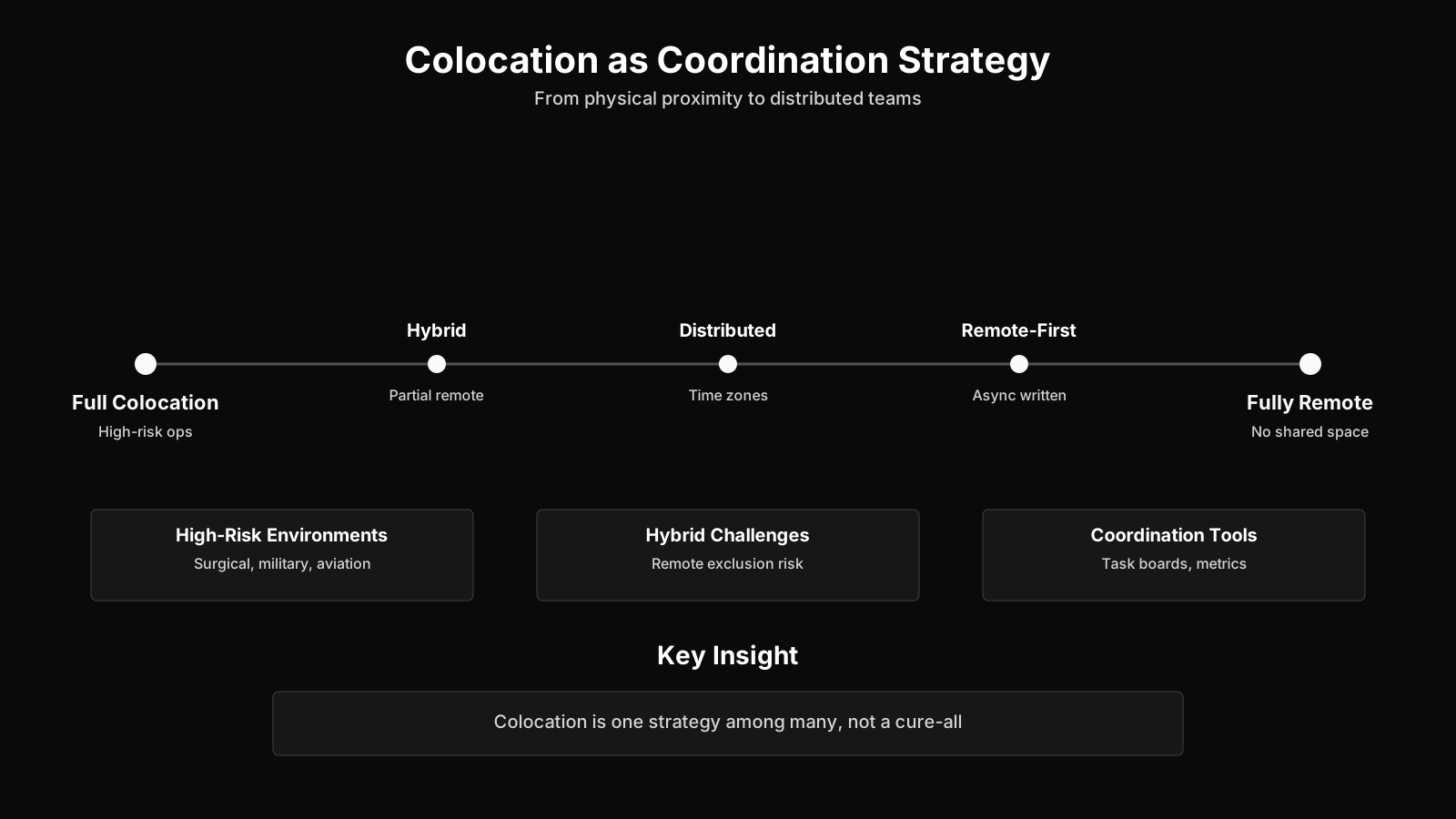
Colocated teams vs distributed teams is a common comparison in project management. A distributed team has members in different buildings, cities, time zones, or countries, which means work must be coordinated through technology and explicit documentation. A virtual team is a specific type of distributed team in which members rarely or never meet in person. Colocation and distribution exist on a spectrum. Most modern projects are neither fully colocated nor fully virtual. They operate with some mix of physical presence and remote access.
The distinction matters because the management techniques are different. A colocated team can rely on ambient visibility and impromptu conversation, while a distributed team needs scheduled synchronization points, shared digital repositories, and careful documentation of decisions. Neither model is inherently superior. Distributed teams can access a wider talent pool and can be more resilient to local disruptions. Colocated teams may gain speed in dense coordination but lose some of that flexibility and cost efficiency.
Hybrid Team Configurations
Hybrid configurations attempt to capture the benefits of both models. A project may colocate the product owner, solution architect, and lead developer while keeping specialized testers or subject matter experts remote. The key is to design communication protocols so that no group becomes persistently out of sync. Some teams use cameras and always-on video links to give the remote members a presence in the room. Others rotate remote members into the colocated space periodically to refresh relationships. Hybrid work is not a lesser form of colocation. It is a different operational pattern with its own risks and controls.
Key Takeaways on Location-Based Team Models
- Distributed teams bridge distance
- In a distributed team, members work from different buildings, cities, time zones, or countries, and they depend on shared technology and explicit documentation to coordinate effectively.
- Virtual teams rarely meet
- A virtual team is a specialized form of distributed team whose members rarely or never meet in person, which makes asynchronous communication the default operating mode.
- Colocation is a spectrum
- Colocation and distribution are not a binary choice; teams operate along a continuum that blends physical presence with remote access to match their needs.
- Management methods differ
- Colocated teams benefit from ambient visibility and informal conversation, whereas distributed teams need scheduled synchronization points, shared digital repositories, and disciplined documentation of decisions.
- Trade-offs shape choices
- Distributed teams offer access to a broader talent pool and stronger resilience against local disruptions, while colocated teams provide faster, tightly coupled coordination at the expense of flexibility, so many projects blend the two models by colocating key roles and keeping specialists remote.
Relationships to Other Project Management Concepts
Colocated teams and project management touch many related concepts, including communication management, team development, resource management, stakeholder engagement, and risk management. In communication management, colocation reduces the number of communication channels affected by distance and delay. In team development, the shared space can accelerate the forming and norming stages described by Tuckman’s model because people learn each other’s working styles faster. In resource management, colocation is a planned allocation of physical assets as well as human resources.
Colocation also interacts with project risk. It can reduce execution risk by shortening feedback loops, but it can introduce concentration risk if the whole team depends on a single facility or location. A power outage, transit disruption, or local health event can halt the project if there is no remote work continuity plan. This is why many project managers now treat colocation as a risk-responsive strategy rather than a permanent assumption.
Colocation and Team Development Models
Team development models often describe stages of forming, storming, norming, performing, and adjourning. Physical proximity can help a team move through misunderstanding faster because people can observe confusion directly and address it on the spot. However, colocation can also intensify storming because close quarters leave little room for cooling off after a disagreement. The project manager’s role is to create norms for respectful challenge and private feedback, regardless of how close the desks are.
Colocation and Communication Management
Communication management in a colocated setting shifts from scheduled push communication toward continuous pull communication. The team can gather around a board to see the current state instead of waiting for a status report. This can improve speed but requires discipline about what gets recorded. A conversation at a desk may resolve an immediate problem, but if it changes a requirement, a risk, or an interface, that change must still be reflected in the project artifacts. Otherwise the colocated advantage becomes a documentation and governance liability.
Evolution and Current Thinking on Colocated Teams
Colocated teams in modern project management are no longer the default assumption they once were. Early software and product development methods often treated colocation as a prerequisite for high bandwidth communication. Over time, the rise of remote collaboration tools, distributed talent models, and organizational cost pressures changed the conversation. The recent global shift toward remote and hybrid work made it impossible to treat physical presence as a permanent condition. As a result, colocation is now framed as a deliberate intervention rather than a baseline.
Current thinking distinguishes between colocation as a spatial arrangement and collaboration as a behavioral outcome. A team can be highly collaborative while distributed if it has strong rituals, clear documentation, and the right technology. Conversely, a team can be colocated and still suffer from low trust, unclear goals, or poor facilitation. Leading practitioners increasingly see the physical workspace as a portfolio choice. Certain phases, such as kickoff, release planning, architecture stabilization, and post-incident review, may justify temporary colocation while other phases proceed remotely.
There is also ongoing debate about the future of the team room. Some organizations are redesigning offices around team pods and project neighborhoods to preserve the benefits of colocation without requiring daily attendance. Others are investing in advanced digital whiteboards and virtual collaboration spaces to simulate the team room. The evidence in practice is mixed. The most effective approach often depends on the type of work, the maturity of the team, the regulatory environment, and the organization’s willingness to invest in both physical and digital infrastructure.
Current Best Practices
Current best practices treat colocation as a management decision based on work complexity and team needs. Project managers assess the project’s communication intensity before deciding whether to colocate. They design the space for visibility and problem solving rather than simply assigning seats. They establish explicit norms for documentation, interruption, and inclusion of remote members. And they regularly review whether the colocation arrangement is producing faster flow or just higher noise. This pragmatic view reflects a maturation of the concept from an idealistic team location model to a context-sensitive project management tool.
Core Takeaways on Colocation's Evolution
- From prerequisite to option
- Colocation has moved from being treated as a default requirement for high bandwidth communication to becoming one operational option among several, as remote collaboration tools, distributed talent pools, and financial discipline reshape how teams choose to convene.
- Space versus collaboration outcomes
- Organizations increasingly separate physical colocation from effective collaboration, recognizing that distributed teams with strong rituals and documentation can outperform colocated teams that struggle with trust, shared goals, or facilitation.
- Targeted temporary colocation
- Rather than maintaining permanent colocation, organizations now convene teams temporarily for discrete phases such as kickoffs, release planning, architecture stabilization, and post-incident reviews, and they redesign offices around team pods and project neighborhoods that enable flexible attendance.