A conflict model in project management is a structured framework for understanding how disagreements arise, escalate, and resolve within project teams and stakeholder groups. The term describes diagnostic lenses that help project managers categorize conflict sources, recognize behavioral patterns, and select appropriate response strategies. Unlike a simple list of conflict resolution techniques, a conflict model connects underlying causes, visible behavior, and potential outcomes.
Conflict Model: Key Topics at a Glance
| Key Concept | Summary |
|---|---|
| Conflict Models | Analytical frameworks that enable project managers to classify conflict sources, recognize recurring behavioral dynamics, and match intervention strategies to the specific type of dispute. |
| Diagnosis Value | Skipping diagnosis frequently leads to ineffective interventions, such as imposing compromise on issues that actually require clarification of scope, authority, or role boundaries. |
| Source-Based Analysis | Using a source-based model, a project manager can identify recurrent friction as structural, rooted in competing incentives between the sponsor and the delivery team rather than in individual behavior. |
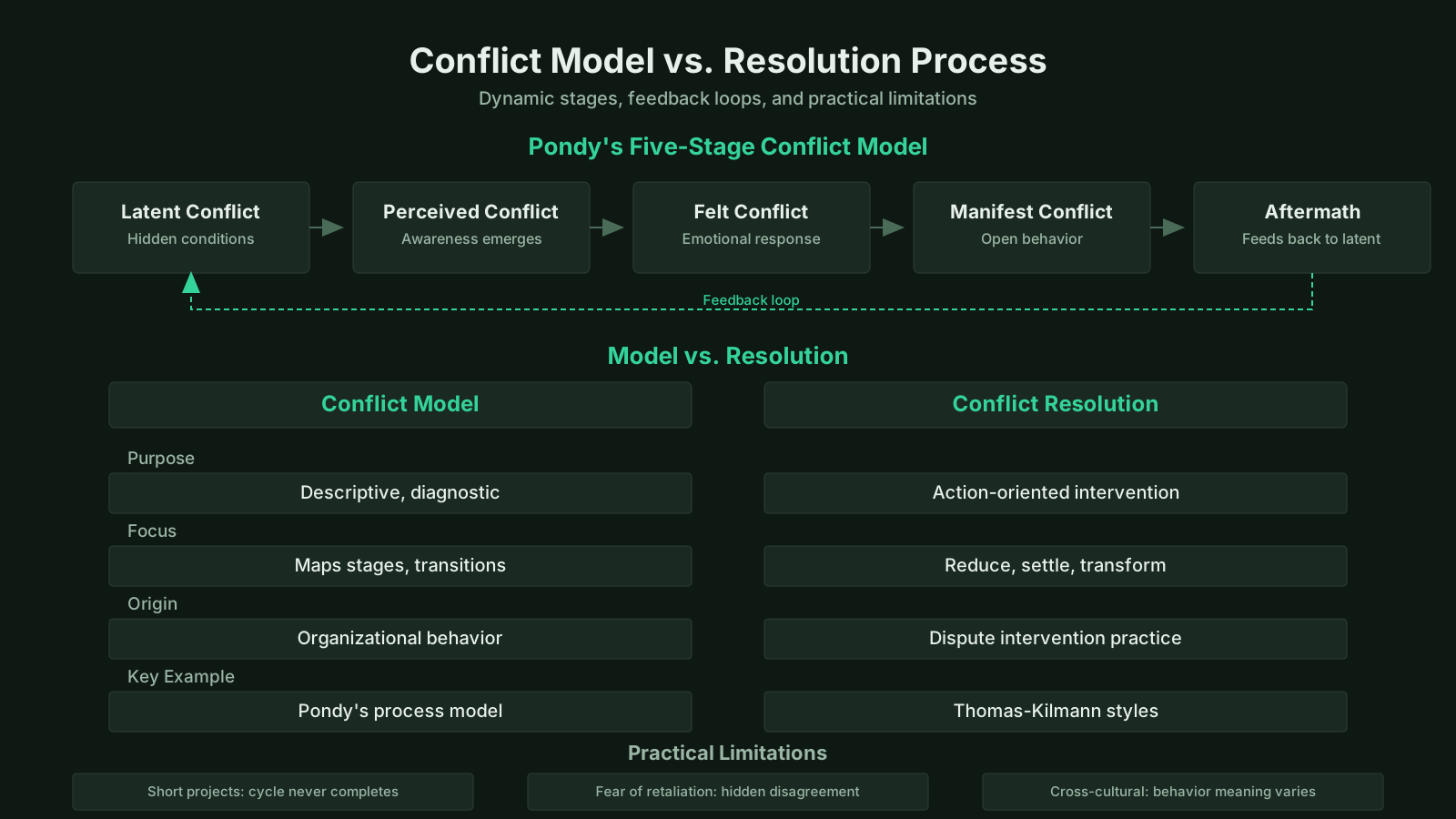
| Pondy's Process Model | Louis Pondy's framework describes conflict as it moves through five sequential stages: latent, perceived, felt, manifest, and aftermath, each requiring distinct management responses. |
| Conflict Phases | Early project phases typically generate disputes over priorities and procedures; execution phases surface disagreements about schedules and resource allocation; late phases intensify cost, quality, and performance trade-offs. |
| Cross-Industry Reach | Structured conflict models are applied beyond project management in healthcare, legal practice, international negotiation, and military planning to manage high-stakes disputes. |
| Medicine Application | In medicine, structured conflict models address disagreements within clinical teams, where status differences can silence junior staff and impede the identification of patient safety risks. |
| Behavioral Consistency | Although project environments seem unique because of tight deadlines and matrix authority structures, the underlying behavioral patterns mirror those in other high-stakes, cross-functional team settings. |
What Is a Conflict Model?
The conflict model definition in project management encompasses a systematic view of conflict as a dynamic condition rather than a single event. It treats disagreement as something with a source, a phase, an intensity level, and a set of possible responses. In this sense, a conflict model is more than a personality test or a communication style guide. It is a reference structure that helps a project manager interpret what is happening when team members push against each other, stakeholders resist a change, or technical experts dispute an approach.
Many practitioners confuse a conflict model with conflict resolution. The model itself does not resolve anything. It explains the shape of the conflict. Resolution comes from actions taken after diagnosis. That distinction matters because a project manager who skips diagnosis often applies the wrong intervention, such as forcing a compromise when the conflict actually requires clarification of scope or role boundaries.
Scope and Boundaries of the Term
In project management literature, the term conflict model is sometimes used narrowly to refer to the Thomas-Kilmann Conflict Mode Instrument. Its broader meaning includes process models, source models, and lifecycle models. A process model describes stages such as latent tension becoming open dispute. A source model classifies common triggers like schedule pressure, resource scarcity, or technical disagreement. A style model categorizes how individuals respond under conditions of disagreement.
A conflict model in practice is a mental map. A project manager might observe repeated friction in steering committee meetings and use a source-based model to determine that the conflict is not personal but structural, rooted in competing incentives between the sponsor and the delivery team. This layered explanation shifts focus away from blaming individuals and toward correcting the conditions that generate conflict.
Key Takeaways on Conflict Models
- Dynamic condition, not single event
- A conflict model frames disagreement as an evolving process that includes identifiable sources, distinct phases, varying intensity levels, and a range of possible responses, rather than treating it as a one-off incident.
- Reference structure for interpretation
- As a diagnostic framework, the model helps project managers interpret friction among team members, stakeholder resistance, and disputes between technical experts by clarifying underlying patterns and triggers.
- Diagnosis precedes resolution
- A conflict model guides diagnosis, while resolution consists of the actions taken afterward; skipping diagnosis frequently produces inappropriate interventions, such as enforcing a compromise when the actual requirement is scope clarification.
- Multiple model types exist
- The term covers both the Thomas-Kilmann instrument, which assesses conflict-handling styles, and broader process models that trace stages from latent tension to open dispute, as well as source-based models that distinguish structural from personal causes.
Origins and Cross-Industry Context
The origins of conflict models lie largely in organizational behavior and social psychology rather than in project management itself. Early work on constructive conflict dates back to management thinkers who saw disagreement as a potential source of innovation, not merely dysfunction. Later models formalized this view. Louis Pondy's conflict process model from the 1960s described conflict moving through latent, perceived, felt, manifest, and aftermath stages. Kenneth Thomas and Ralph Kilmann developed their widely used conflict mode instrument in the 1970s based on two dimensions: assertiveness and cooperativeness.
Project management adopted these models because projects are temporary, cross-functional, and pressure-heavy. Classic studies of project conflict identified that conflict sources shift across the project lifecycle. Early phases often produce disagreements about priorities and procedures, while execution phases produce disputes about schedules and resources, and late phases bring conflicts around cost and performance trade-offs.
Cross-Industry Influence
Outside project management, conflict models appear in healthcare, law, international negotiation, and military planning. Medicine uses structured conflict models to address disagreements in clinical teams where status differences can silence junior staff. Negotiation theory uses dual-concern models similar to Thomas-Kilmann. These fields reinforce the same core insight: conflict is predictable enough to be mapped.
The credibility of conflict models in project management comes partly from this cross-industry use. A project environment may feel unique because of deadlines and matrix authority, but the underlying behavioral patterns are consistent with those observed in other high-stakes team settings.
Key Components and Types of Conflict Models
The key components of a conflict model include conflict sources, conflict intensity, conflict stages, and conflict handling styles. Sources describe why a conflict exists. Intensity describes how much it affects performance and relationships. Stages describe how it evolves over time. Styles describe how people respond. A complete model usually combines at least two of these components.
This is where a lot of confusion enters. A manager might know the five conflict styles but have no language for the stages before open disagreement. That partial understanding can lead to reactive handling. A full conflict model gives attention to early signals, not just the moment of visible clash.
Thomas-Kilmann Conflict Mode Instrument
The Thomas-Kilmann model is the most recognized conflict style model in project management. It places conflict responses on two axes. Assertiveness reflects the degree to which a person pursues their own concerns. Cooperativeness reflects the degree to which a person tries to satisfy the other party's concerns. The intersection of these axes produces five modes: competing, collaborating, compromising, avoiding, and accommodating.
A project manager using this model understands that no single mode is always correct. Competing may be necessary when a safety decision must be enforced quickly. Collaborating works when the project can invest time in finding an integrative solution. Avoiding can be rational for minor irritations that distract from critical path work. The model does not label people, it labels behavior in context.
Pondy's Conflict Process Model
Pondy's model offers a lifecycle view. Latent conflict exists when conditions for disagreement are present but not recognized. Perceived conflict occurs when parties become aware of differences. Felt conflict adds emotion. Manifest conflict becomes visible through arguments, resistance, or passive withdrawal. Conflict aftermath shapes the next round of interaction, either productive or destructive.
This process view matters in project work because many project managers first encounter conflict at the manifest stage. By then, the disagreement has accumulated history. A conflict model that includes earlier stages encourages earlier detection, often before positions harden.
Project-Specific Conflict Source Models
Source models categorize conflict triggers common to projects. These typically include schedules, priorities, resources, technical opinions, administrative procedures, cost, and personality differences. The relative weight of each source changes with the lifecycle. During planning, schedule and priority conflicts dominate. During execution, resource and technical opinion conflicts increase. During closing, cost and performance disputes often surface.
The value of a source model is diagnostic. A disagreement that looks like a personality clash may actually be a resource conflict expressed through frustration. A schedule conflict may be a proxy for unclear scope acceptance criteria. Correctly naming the source changes the response.
PMBOK's Five Conflict Resolution Approaches
PMBOK references five approaches to conflict management that align closely with Thomas-Kilmann. These are withdraw or avoid, smooth or accommodate, compromise or reconcile, force or direct, and collaborate or problem solve. The wording in PMBOK reflects managerial actions rather than personal traits.
In practice, project managers often combine approaches over time. A manager may initially avoid a low-level disagreement to see if the team resolves it themselves. If it escalates, the manager may shift to collaboration. The model describes available paths, not a rigid sequence.
Core Insights on Conflict Models
- Four Key Model Components
- A robust conflict model integrates sources, intensity, stages, and handling styles so that disputes can be managed continuously from first trigger through final resolution.
- Thomas-Kilmann Five Modes
- The Thomas-Kilmann instrument distinguishes five conflict handling modes by measuring cooperativeness and assertiveness: competing, collaborating, compromising, avoiding, and accommodating.
- Early Signals and Stages
- Effective conflict models monitor early warning signals and transitional stages, enabling intervention before latent tensions escalate into open, destructive confrontation.
- Common Conflict Sources
- Project conflicts most often originate from competing demands in schedules, priorities, resources, technical approaches, administrative procedures, cost constraints, and interpersonal differences.
Conflict Model in PMBOK and PRINCE2
The conflict model PMBOK connection is most visible in the Resource Management knowledge area, where conflict management appears as an interpersonal and team skill used in processes like Develop Team and Manage Team. PMBOK does not prescribe a single conflict model, but the five conflict handling approaches form a de facto model that many practitioners treat as standard. The sixth edition placed conflict under tools and techniques for managing project teams. The seventh edition shifts toward principles and performance domains, where conflict is addressed through team performance and stakeholder engagement rather than a fixed process.
This means a project manager working within PMBOK can use any credible conflict model as long as it supports the documented approach. The model should align with the project's governance, culture, and communication plan. A source model may help in a matrix organization where functional managers and project managers disagree over resource allocation. A style model may help in a collocated team where repeated collaboration is necessary.
PRINCE2 and the Role of Defined Governance
PRINCE2 does not codify a conflict model as a formal management product. It handles conflict indirectly through clear roles, escalation paths, and management by exception. The project board, project manager, and team manager have defined responsibilities that reduce ambiguity-based conflict. When disagreement does arise, PRINCE2's stage boundaries and highlight reports provide structured moments to surface concerns.
Even so, PRINCE2 practitioners benefit from using a conflict model to interpret tensions that governance alone cannot prevent. For example, a project manager may face conflict between the senior user and senior supplier over acceptance criteria. The governance structure tells them who decides, but a conflict model helps explain why the disagreement persists and what resolution style may fit.
Conflict Model in Agile and Hybrid Environments
The conflict model in agile projects is often informal but highly present. Agile frameworks do not specify a conflict resolution procedure in the way they specify sprint reviews or daily scrums. However, the emphasis on self-organizing teams, transparency, and rapid feedback makes conflict visible earlier. Cross-functional teams naturally contain different perspectives, and those differences generate productive tension when managed well.
Scrum Masters and agile coaches function as conflict facilitators more than enforcers. They help teams surface disagreements during retrospectives or backlog refinement. The conflict model used in agile contexts tends to favor collaboration because the team needs shared ownership of outcomes. That does not mean forcing consensus. It means treating conflict as information about the product, the process, or team health.
Hybrid Environment Considerations
Hybrid projects combine predictive governance with agile delivery. Conflict models in hybrid settings must account for different authority structures. A phase gate board may demand compliance, while a sprint team expects autonomy. This clash of expectations is a common source of conflict. Project managers in hybrid environments often use a lifecycle conflict model to predict where gate decisions will collide with team commitments.
The practical effect is that no single model fits all moments. A directive style may be appropriate at a stage boundary where governance rules apply. A collaborative style may be appropriate within the delivery team. Recognizing which conflict model layer is active reduces the risk of applying agile openness to a contractual dispute or bureaucratic control to a technical debate.
Key Insights on Agile Conflict Models
- Informal yet visible conflict
- Agile frameworks rarely define formal conflict resolution procedures, but their emphasis on transparency and rapid feedback exposes disagreements earlier and more visibly than in traditional project settings.
- Facilitators, not enforcers
- Scrum Masters and agile coaches create conditions for disagreements to emerge during retrospectives and backlog refinement, guiding teams toward collaboration and shared ownership rather than imposing solutions.
- Hybrid lifecycle conflict awareness
- Project managers in hybrid environments use lifecycle conflict models to anticipate collisions between phase gate compliance demands and sprint team autonomy, which helps them recognize the active model layer and avoid applying the wrong resolution approach.
BVOP Perspective on Conflict Models
The BVOPM conflict handling perspective connects to its broader emphasis on cross-functional teams and transparent issue visibility. Because BVOPM mandates cross-functional teams as a core success factor, it expects disagreements among different functional perspectives to arise. Conflict is not treated as failure. It is treated as a signal that value definitions, priorities, or acceptance expectations are misaligned.
BVOPM's Transparent Board of Project Issues gives all roles a formal channel to raise concerns before they become entrenched disputes. This aligns with process-based conflict models that emphasize early visibility of latent conflict. In BVOPM, employee-created tools and open-source software are recognized as formal products, which can reduce the conflict that arises when contributions are dismissed as unofficial or peripheral.
This perspective reinforces the diagnostic purpose of conflict models. It does not replace Thomas-Kilmann or Pondy. It adds a governance layer that makes conflict visible at the program and portfolio level rather than leaving it to interpersonal chemistry.
Practical Application and Use in Projects
The most common reason for using a conflict model in project management is to avoid reacting to conflict as if every disagreement were either a discipline problem or a personality flaw. Project managers apply these models in steering committee meetings, team retrospectives, vendor negotiations, and cross-functional planning sessions. The model helps them classify the conflict and choose a measured response.
Consider a scenario where a project manager sees two senior engineers repeatedly clash during design reviews. A style-based model might show both are high in assertiveness and low in cooperativeness, producing competing behavior. A source model might reveal that the real issue is unclear technical authority, not mutual dislike. The intervention then becomes defining decision rights, not mediating personalities.
Lifecycle Timing and Roles
Conflict models are relevant across all project lifecycles. In initiation, stakeholder disagreement often centers on objectives and success criteria. In planning, conflicts arise over schedule, budget, and resource allocation. Execution brings technical disputes and team interpersonal friction. Monitoring and controlling surfaces conflict over variance and change requests. Closing may generate conflict about acceptance, lessons learned, or performance evaluation.
Project managers are not the only users. Program managers use conflict models to resolve disputes between projects competing for resources. PMO leads use them to design governance that reduces recurring conflict. Scrum Masters use them to improve team working agreements. The model is a shared diagnostic language across these roles.
Typical Organizational Scenarios
Matrix organizations produce conflict because team members report to both functional and project managers. A conflict source model helps separate authority conflict from resource conflict. Vendor projects produce conflict over contract interpretation and change orders. A lifecycle model helps anticipate conflict at delivery milestones. High-uncertainty projects produce task conflict about technical approach. A style model helps leaders decide when to encourage debate and when to close it.
None of this is mechanical. The model does not provide a script. It provides categories that sharpen judgment. Experienced practitioners use conflict models the way a pilot uses weather patterns: not to predict every gust, but to recognize dangerous conditions early enough to adjust.
Applying Conflict Models in Practice
- Avoiding misclassification of conflict
- Project managers apply conflict models to distinguish substantive disagreements from disciplinary or personality issues, allowing them to respond with calibrated, objective interventions instead of reflexive escalation.
- Application across project meetings
- In steering committee meetings, team retrospectives, vendor negotiations, and cross-functional planning sessions, these models provide a consistent framework for categorizing conflicts before any response is chosen.
- Style and source diagnosis
- A style-based model can identify high assertiveness combined with low cooperativeness as competing behavior, while a source model may trace the conflict to unclear technical authority and guide the team toward defining decision rights rather than mediating personality differences.
- Lifecycle relevance and early warning
- Conflict models remain relevant throughout every stage of the project lifecycle, including closing, where acceptance and performance evaluation can spark conflict, and experienced practitioners apply them much as pilots use weather patterns to recognize dangerous conditions early.
Common Challenges, Pitfalls, and Misconceptions
Among the most persistent common misconceptions about conflict models is the belief that all conflict is negative and should be eliminated. Decades of research in organizational behavior distinguish between task conflict and relationship conflict. Task conflict can improve decisions when it remains focused on ideas rather than personal attacks. Relationship conflict tends to reduce trust and performance. A conflict model helps separate these, but only if the project manager does not reflexively suppress disagreement.
Another misconception is that the collaborative style is always best. Collaboration consumes time and emotional energy. On a late-stage safety issue, a directive approach may be appropriate. In a low-stakes procedural dispute, avoidance may preserve team energy. The model does not impose a moral ranking on styles. It describes trade-offs.
Pitfalls and Limitations
Conflict models have real limitations. The Thomas-Kilmann model assumes relatively equal power between parties. In a hierarchical project environment, a junior team member may not be free to choose an assertive style. Cultural differences also shape conflict expression. Some cultures value direct confrontation, others value indirect signaling. Applying a style model without cultural awareness can misinterpret behavior as avoidance when it is actually respect.
Source-based models can also oversimplify. A conflict labeled as a resource dispute may have deeper roots in historical mistrust between departments. Process models like Pondy's are diagnostic, not predictive. They describe stages but do not tell a manager how long a conflict will remain latent or when it will become manifest.
When Not to Rely on a Conflict Model
There are situations where a conflict model should not be the primary tool. In formal contract disputes, legal or procurement processes take precedence. In cases of harassment, discrimination, or safety violations, organizational policy and human resources processes override any team-level conflict model. A project manager should not use a style model to mediate behavior that requires formal investigation.
Conflict models also lose value when the real problem is not disagreement but ambiguity. If requirements are genuinely unknowable, no amount of conflict resolution will substitute for iterative discovery. The model should be used to interpret disagreement, not to force certainty where uncertainty belongs.
Relationship to Other Project Management Concepts
Understanding the conflict model vs conflict management distinction is important. Conflict management is the broader set of actions taken to handle disagreements. A conflict model is the conceptual framework that informs those actions. The model tells a project manager what kind of conflict exists. Management tells them what to do about it. One is diagnosis, the other is intervention.
Conflict models also connect to the issue log and the risk register. A conflict that has become an open disagreement is typically recorded as an issue, not a risk. A risk is a future uncertain event. A conflict is a present condition. However, unresolved conflict can become a risk if it threatens future team performance or stakeholder support.
Connections to Team Development and Stakeholder Engagement
Team development models such as Tuckman's forming-storming-norming-performing describe conflict as a predictable stage. A conflict model gives the project manager a language for what happens during storming. The team may experience task conflict as members establish roles and technical direction. The project manager can use a source model to see that early storming conflicts often revolve around priorities and procedures rather than personal incompatibility.
Stakeholder engagement plans often include conflict response strategies for key individuals or groups. A conflict model supports that by classifying the stakeholder's likely conflict style or the structural source of their resistance. Negotiation skills also use the dual-concern framework found in Thomas-Kilmann. The same five modes appear in negotiation theory as competitive, collaborative, compromising, avoiding, and accommodative approaches.
Emotional intelligence is relevant here. A manager can know every conflict model and still fail if they cannot read emotional cues. The model organizes knowledge. The person applies it through judgment.
Key Takeaways on Conflict in Project Management
- Model versus management distinction
- Conflict management covers the practical strategies and interventions used to address disagreements, while a conflict model supplies the conceptual framework that helps diagnose the conflict type and determine the most suitable response.
- Issues versus risks classification
- Current disagreements are usually recorded as issues because they require immediate attention, but unresolved conflict can become a risk when it begins to undermine future team performance or stakeholder confidence.
- Alignment with team development stages
- Tuckman's forming-storming-norming-performing framework treats conflict as an expected stage of team development, allowing project managers to plan appropriate interventions before tensions disrupt delivery.
- Source model for early conflicts
- A source model helps project managers recognize that conflicts during the storming phase typically stem from competing priorities, unclear procedures, or resource constraints rather than from personal incompatibility.
- Connection to negotiation theory
- The five conflict handling modes correspond directly to established negotiation styles: competitive, collaborative, compromising, avoiding, and accommodative.
Evolution and Current Thinking
The evolution of conflict models reflects a shift from seeing conflict as a breakdown to seeing it as a natural feature of complex work. Early management theory often treated friction as a sign of poor leadership. Later human relations research recognized that some conflict could be functional. Contemporary project management thinking distinguishes between task conflict that improves technical decisions and relationship conflict that damages psychological safety.
Current best practices embed conflict model awareness in team charters, working agreements, and decision protocols. Many teams explicitly agree on how they will surface and handle disagreement before it becomes destructive. This preventive use of conflict models is a notable shift from earlier reactive uses.
Debates and Current Practice
There is ongoing debate about whether project managers should aim to resolve all conflict or manage it. Resolution implies an endpoint. Management implies ongoing attention. Most contemporary practitioners lean toward management because complex projects rarely eliminate disagreement; they learn to hold it productively.
Remote and distributed teams have changed conflict expression. Written communication can amplify ambiguity and reduce the social cues that soften disagreement. Conflict models in virtual teams often need to account for asynchronous escalation, where a conflict smolders in messages and becomes manifest days later. Psychological safety has become a central theme. A team with high psychological safety can engage in robust task conflict without triggering relationship damage.
PMBOK's shift from process-heavy detail to principles and performance domains mirrors this evolution. It treats conflict as a team performance issue rather than an isolated tool. PRINCE2's continued emphasis on governance provides a counterbalance, showing that structure and clear roles still reduce conflict. Neither approach negates the need for a conflict model. They simply use it at different altitudes.
