A change log in project management is a formal, sequential record of all change requests, their evaluation outcomes, and the actions taken in response to proposed alterations to a project’s approved baselines. It functions as a single source of truth for understanding the history and status of every modification that could affect scope, schedule, cost, quality, or other performance constraints. Rather than being a simple to-do list, a change log captures the decision-making trail that accompanies each change, including who initiated it, when it was raised, what impact assessment was performed, and whether it was approved, deferred, or rejected. This documentation discipline keeps project teams, sponsors, and stakeholders aligned when shifting requirements or unexpected conditions inevitably arise.
Key Topics in This Change Log
| Purpose | Summary |
|---|---|
| Decision Trail | Captures the complete decision lifecycle for each change: who requested it, when, the evaluated impact, and the final approval outcome, creating a fully auditable record. |
| Scope | Tracks every alteration to the original project agreement, ranging from minor specification refinements to comprehensive budget re-baselines. |
| Transparency | Critical in contract-driven, regulated, or multi-stakeholder environments; a missing log entry can provoke disputes over scope adherence, payment milestones, or regulatory compliance. |
| Analysis | Reveals systemic issues through pattern recognition: persistent scope creep from one department signals unstable requirements; budget shifts without scope change often indicate estimation inaccuracies or gold-plating. |
| Identifier | Assigns a unique sequential or coded ID to each change request, enabling effortless cross-referencing with impact assessments, approvals, and other supporting documents. |
| Status | Displays the current state (open, under review, implemented, closed) for immediate distinction between pending actions and resolved items, driving workflow clarity. |
| Category | Groups changes by origin (regulatory, user feedback, technical discovery, market shifts) to surface systemic drivers and focus mitigation efforts in complex programs. |
| PMBOK | Per the PMBOK Guide, the change log is a project document created and updated during the Perform Integrated Change Control process within the Monitoring and Controlling Process Group. |
What Is a Change Log in Project Management?
The term "change log" originates from software configuration management, where developers recorded alterations to source code to ensure version control and traceability. In project management, the concept extended naturally to encompass any request that would modify what was originally agreed upon, from a subtle tweak in a deliverable specification to a fundamental re-baseline of the project budget. The change log definition in modern practice goes beyond a simple chronological list; it is a structured artifact that enforces accountability by documenting the rationale and authorization behind each approved deviation. Without it, a project drifts into unmanaged scope creep, where it becomes impossible to reconstruct why decisions were made months later during a post-mortem or audit.
In many organizations, the change log sits at the core of integrated change control, a process that demands that every change be formally recorded, assessed, and decided upon by the appropriate authority. The log itself is not the decision-maker but the repository that makes the decision-making visible. This transparency is especially important in environments with contractual obligations, regulatory oversight, or multiple funding sources, where a missing entry can lead to disputes over scope, payment, or compliance. The artifact is also distinct from informal notes or email threads, which lack the rigor, completeness, and synchronization needed to serve as an authoritative record.
It’s a common observation among experienced project managers that a well-maintained change log often reveals patterns invisible in day-to-day work. For example, a cluster of scope expansion requests originating from the same stakeholder department might indicate underlying requirement instability, while a series of budget adjustments without corresponding scope changes could signal estimation errors or creeping gold-plating. The log thus doubles as a diagnostic tool, providing lessons not just for the current project but for the organization’s planning maturity as a whole.
Change Log Essential Insights
- Software configuration management origins
- The change log originated in software configuration management to track source code revisions and version histories, and later evolved into a project management tool for documenting any departure from the originally agreed scope.
- Structured accountability artifact
- In modern practice, the change log acts as a structured accountability mechanism that captures the justification and formal authorization for every approved deviation from the project baseline.
- Core of integrated change control
- Central to integrated change control, the change log ensures every modification is formally recorded, evaluated, and approved by the designated authority, a discipline that is essential in contractually and regulatorily sensitive environments.
- Diagnostic tool for patterns
- A meticulously maintained change log also serves as a diagnostic instrument, exposing patterns such as persistent scope expansion from a single department or budget variations that point to systemic estimation errors or gold-plating.
The Structure and Components of a Change Log
A change log is not a free-form diary; it follows a predictable structure that makes retrieval and analysis straightforward. The exact fields vary by organization and methodology, but several key components appear consistently across effective implementations. The change log components typically include a unique change identifier, which assigns a sequential or coded number to each request for easy cross-referencing with supporting documents. Alongside the identifier, the log records the date the change was first submitted, a concise description of the proposed modification, and the name of the requestor, ensuring ownership is never ambiguous.
Beyond the basic header information, the log continues with the disposition and reasoning. A summary of the impact assessment captures the expected effect on scope, time, cost, quality, and risk, often referencing a more detailed change request form for the underlying analysis. The decision field records whether the change was approved, approved with conditions, deferred, or rejected, along with the name of the authorizing body or individual. The date of the decision and the effective date, when the change is implemented, establish the timeline for auditing. A status column indicates the current state—open, in review, implemented, closed—so that anyone scanning the log can quickly identify what is pending versus what is settled.
Some logs also include additional fields like priority, category, related work package, or a link to the updated version of the affected plan. The category field is particularly useful in multi-faceted programs, where changes might originate from regulatory updates, user feedback, technical discoveries, or market conditions. By capturing category data, the log enables trend analysis that can inform future risk responses. The structure should be lightweight enough to encourage consistent use, yet sufficiently detailed to prevent the log from becoming a meaningless bureaucratic exercise; striking that balance is a recurring challenge in practice.
The Change Log in PMBOK and PRINCE2 Frameworks
Within the PMBOK Guide, the change log is referenced as a project document that is created and updated during the Perform Integrated Change Control process, which falls under the Monitoring and Controlling Process Group. It exists alongside the change management plan, the change request form, and the configuration management plan. PMBOK treats the log as an output of the process, updated each time a change request is processed, and it serves as an input to subsequent change reviews, ensuring no request is lost. The change log in PMBOK is not a standalone artifact; it is part of a broader governance framework where all modifications to baselines must pass through formal evaluation and approval.
The emphasis in PMBOK is on integration—seeing how a change ripples across multiple knowledge areas. For example, a change that expands scope will likely affect the schedule, cost estimates, resource allocations, and possibly the risk register. The change log captures the outcome of that integrated analysis, documenting not just that the scope was expanded, but that the corresponding adjustments to the project management plan were authorized. This makes the log essential for maintaining the integrity of the project’s approved baselines, which are only changed through formal control.
PRINCE2, by contrast, frames the change log within the issue and change control theme. The methodology uses a single log—the issue register—to capture both issues (problems that are happening now) and changes (requests for future modification). A distinct change log may be maintained as a subset or a separate register depending on project size. PRINCE2 explicitly defines the change log’s relationship with the project board’s change authority, requiring that the log record the board’s decisions and any tolerances granted. The methodology’s focus on management stages means the log is reviewed at stage boundaries, helping to assess whether accumulated changes have invalidated the project’s business case.
Core Insights on Change Log Across Frameworks
- PMBOK integrated governance role
- The change log in PMBOK is initiated during Perform Integrated Change Control to systematically record each request, providing an auditable trail from submission through formal evaluation and approval.
- Cross-knowledge area impact tracking
- PMBOK leverages the change log to capture interconnected impacts on scope, schedule, cost, resources, and risk, safeguarding baseline integrity against unintended drift.
- Log supports baseline control
- The change log records every authorized adjustment to the project management plan, enforcing that baselines evolve strictly through formal, documented control rather than ad hoc changes.
- PRINCE2 single issue register
- PRINCE2 consolidates all tracking into a single issue register that houses current problems, off-specifications, and future change requests, streamlining governance by avoiding multiple log silos.
- Stage boundary business case review
- At each stage boundary, the project board reviews the change log to assess whether the cumulative effect of approved changes has undermined the continued viability of the business case.
The Role of a Change Log in Agile and Hybrid Environments
Agile environments present a different dynamic, where change is embraced rather than controlled through formal gates. Product backlogs, sprint backlogs, and visible information radiators function as living artifacts that absorb new insights continuously. However, this does not mean that change logging disappears; it shifts form and purpose. In many Agile teams, the change log in Agile projects exists as a lightweight record of significant decisions that alter release plans, architectural direction, or key sprint goals, rather than every user story addition.
For instance, an Agile team might log when a product owner approves a major pivot that changes the ordering of product backlog items for the next three sprints, or when a cross-team dependency forces a definition-of-done adjustment. These entries are often kept in a wiki or project management tool, tagged with the sprint and decision outcome, to provide a historical record for retrospectives and for new team members who need context. The artifact is used to answer the question “why did we go that direction?” not “what tiny user story was added yesterday?”
Hybrid environments, which blend predictive planning with iterative delivery, often maintain a formal change log for the upfront scope baseline while allowing more fluidity within each iteration. A common pattern is to log changes that affect the overall release roadmap or that cross the threshold of a predefined tolerance limit, such as a 10% budget shift. The log serves as a bridge between the governance expectations of a PMO and the adaptive needs of delivery teams, providing the traceability that stakeholders demand without suffocating the team’s agility. This dual-use approach is increasingly common in large-scale projects where compliance and innovation must coexist.
Purpose and Importance of Maintaining a Change Log
The core purpose of a change log is to prevent unmanaged scope creep by making the cost and impact of every change transparent to decision-makers before approval. When a sponsor sees a request growing from a minor clarification into a major enhancement, the log provides the factual timeline and the accumulated cost of serial approvals, making it harder for pet features to slip in unnoticed. The purpose of a change log extends into protecting team morale as well: it shields the delivery team from last-minute, undocumented demands by requiring that any change be formally submitted and assessed rather than slipped into a hallway conversation.
Another critical function is audit readiness. In regulated industries—pharmaceuticals, aerospace, finance—external auditors or clients may require proof that alterations to validated systems were evaluated for risk and authorized through a defined governance channel. The change log, when meticulously maintained, becomes a legal record demonstrating due process. Even in less regulated settings, the log serves as a contractual shield when a client later disputes why a previously promised feature was not delivered or why a budget overrun occurred. The log shows that the client approved a trade-off that deprioritized that feature.
Beyond compliance and defense, the log provides intellectual capital. Project retrospectives often rely on the change log to identify the root causes behind schedule slippage or cost variance. A pattern of late-stage change clusters might reveal a failure in elicitation, while a high rejection rate for a particular change type could indicate poor stakeholder alignment early on. These insights feed into organizational process assets, improving estimation, risk identification, and change control procedures for future initiatives. The log thus moves from being a reactive administrative record to a proactive driver of continuous improvement.
Core Takeaways on Change Logs
- Prevents uncontrolled scope creep
- By making the cost and impact of every modification transparent before approval, the change log exposes how minor clarifications can escalate into major enhancements, forcing deliberate scope decisions.
- Shields team morale
- Requiring formal submission and assessment intercepts last-minute, undocumented demands that would otherwise slip in through informal conversations, protecting the team's focus and collective morale.
- Ensures audit readiness
- In regulated industries, a meticulously maintained change log serves as a legal record proving that system alterations were risk-evaluated and approved through proper governance before implementation.
- Functions as contractual shield
- When clients later dispute missing features or budget overruns, the log provides an authoritative, time-stamped trail of formally requested and approved changes, clarifying accountability and reducing liabilities.
- Supports retrospective insights
- The change log enables project retrospectives to trace the root causes of schedule slippage and cost variance, transforming those insights into better estimation and tighter change control for future initiatives.
Practical Application and Use Cases
In practical terms, a change log becomes active the moment a project’s scope baseline is approved. During a construction project, for example, an architect might submit a design alteration to move a load-bearing wall, triggering an impact assessment on structural integrity, material costs, and the critical path. The project manager logs the request, whether it was approved with the contractor’s price adjustment, and the corresponding schedule extension. Months later, when the client’s representatives question a delay, the log provides a clear, non-confrontational answer. The change log use case in this scenario is as a neutral historical record that depersonalizes disputes.
In software development, a product owner might request a reporting dashboard feature that was not in the initial release scope. The change log captures the request, notes that it was approved after a trade-off with another low-priority item, and records the additional sprint cycles needed. The log entry ensures that when the stakeholder who originally championed the displaced feature asks about its absence, the team can reference the trade-off decision, including the date and the approval body. This prevents the common frustration of one team being blamed for “missing” requirements that were consciously de-scoped.
At the portfolio level, a change log that consistently shows a high volume of budget re-allocations between projects can alert portfolio managers to systemic estimation issues or shifting corporate priorities that merit a broader replanning exercise. Program managers often aggregate change log data from constituent projects to identify cross-project impacts—for instance, when a change in Project A introduces a dependency delay in Project B. The log becomes a key input to program risk management, demonstrating that its value scales beyond individual project boundaries.
Common Challenges, Pitfalls, and Misconceptions
One of the most persistent pitfalls is the “empty log syndrome,” where project managers create the artifact during planning but fail to maintain it once execution pressure mounts. This often results in a log that contains only early-stage changes, leaving a significant gap that undermines its reliability for audits or retrospectives. Another frequent mistake is conflating the change log with meeting minutes, where informal discussions about potential modifications are recorded without the structured impact analysis and decision rationale that a true change log requires. The change log challenges also include over-engineering the log with dozens of mandatory fields that team members find cumbersome, leading to resistance and incomplete records.
A common misconception is that change logs are only necessary for large, traditional projects with fixed baselines. In reality, even highly adaptive Agile projects benefit from a decision log that captures the rationale behind significant pivots, because the fact that change is expected does not guarantee that all decisions are sound or well-communicated. Another myth is that the change log is a substitute for a change request form; it is not. The log serves as a summary index, while the detailed analysis and approvals live in the request forms. Using the log to replace those documents results in an information-poor record that fails to meet audit standards.
There is also the risk of “log fatigue,” where the person responsible for maintaining the log becomes overwhelmed by a surge of minor changes and begins to batch entries, losing the real-time tracking that makes the log valuable. This often masks the accumulative effect of small changes, each of which might be trivial on its own but collectively shift the project’s trajectory. To counter this, some organizations set a de minimis threshold—such as a half-day of effort or a $500 cost impact—below which changes are not logged individually, though this requires clear policy to avoid abuse.
Core Insights on Change Log Pitfalls
- Empty log syndrome
- Empty log syndrome takes hold when a change log is created during planning but maintenance stops under schedule pressure, leaving only early-stage entries that compromise audit reliability and honest post-mortem analysis.
- Logs versus meeting minutes
- A common pitfall is conflating the change log with meeting minutes or restricting its use to large traditional projects, when in fact Agile environments also require structured impact assessments and a clear record of rationale for meaningful pivots.
- Over-engineering and log fatigue
- Over-engineering logs with excessive mandatory fields or overwhelming maintainers with low-impact changes generates resistance, encourages batched entries, and destroys real-time visibility; introducing de minimis thresholds and clear policy guardrails effectively counters these dynamics.
Relationships Between the Change Log and Other Project Artifacts
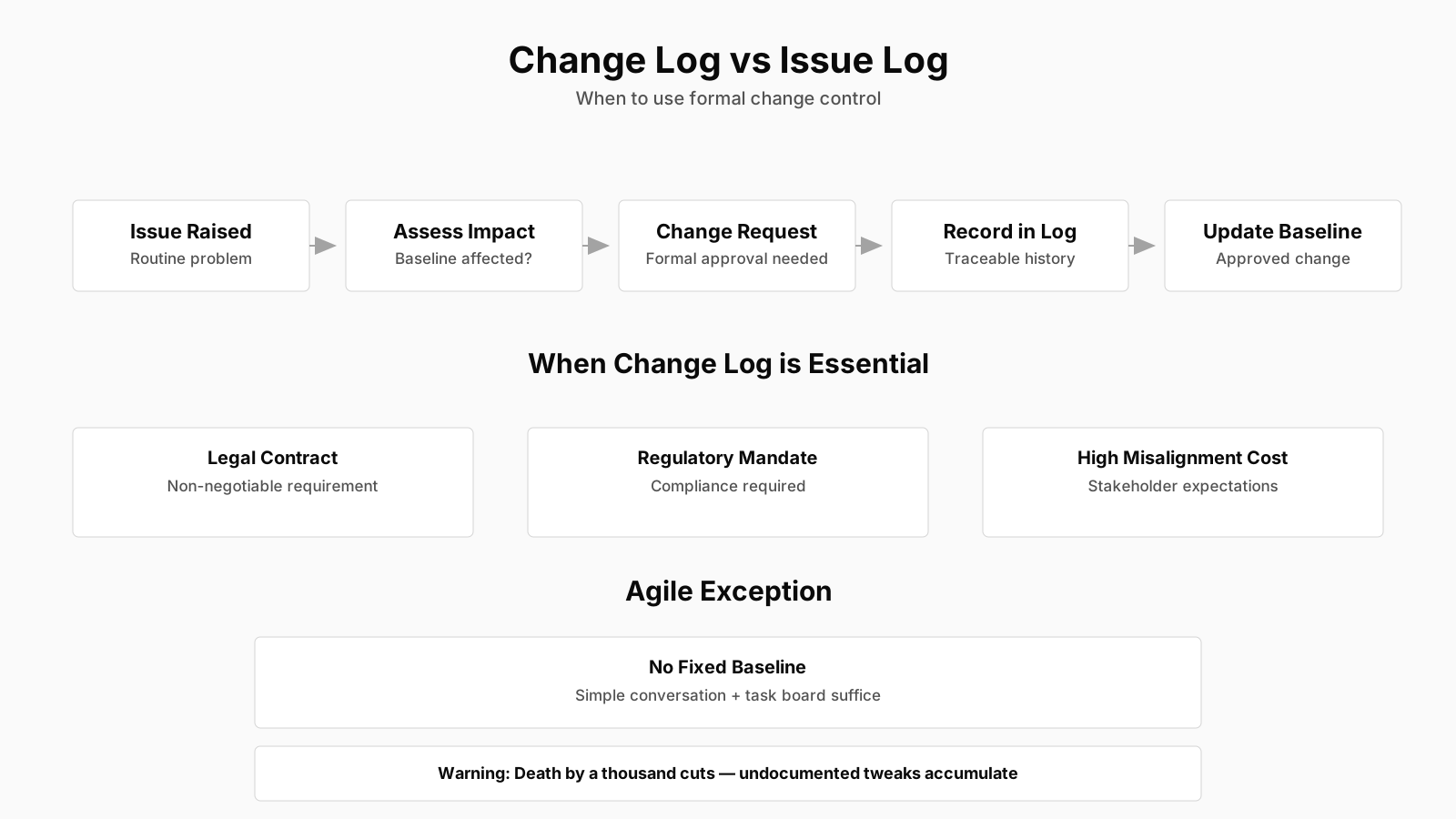
The change log does not exist in isolation; it is tightly coupled with the issue log, configuration management system, risk register, and the overall change management plan. The distinction between a change log and an issue log is crucial: an issue log records unplanned events that have already occurred and need resolution, while a change log records intentional decisions to modify planned baselines. However, an issue may trigger a change request, at which point the resolved issue gets linked to a change log entry. Understanding this change log vs issue log relationship helps prevent duplication and ensures that each artifact serves its intended governance role.
The configuration management system provides the version-controlled environment for the deliverables, while the change log provides the commentary on why certain versions were altered. For example, when a design document moves from v2.1 to v2.2, the change log entry explains that a stakeholder requirement revision caused the update, approved by the design authority on a specific date. This linkage is especially important in highly regulated environments where traceability from the eventual product back through each modification to its authorization is required. Without the log, version history becomes a sequence of “what” without the “why.”
The risk register and change log also interplay dynamically. A risk response plan might include a contingency action that, when triggered, results in a change request. That request is logged, and if approved, the corresponding risk status is updated. Conversely, a proposed change that introduces new risks must be recorded in the risk register, with the change log entry providing the cross-reference. This bidirectional connection ensures that the project’s risk profile reflects the cumulative effect of approved changes, not just the initial baseline snapshot.
Evolution and Current Thinking on Change Logging
The concept of logging changes has moved from paper-based forms and spreadsheet trackers to cloud-based project management tools that automate much of the recording. Modern platforms like Jira, ServiceNow, and Microsoft Project integrate change log functionality directly into workflows, where status updates, approvals, and impact assessments are captured automatically. This change log evolution has reduced the administrative burden, but it also creates a dependency: if the tool configuration is poor, the log can become an unstructured heap of data with inconsistent fields. Practitioners now emphasize the importance of designing the log as a reporting layer on top of a structured change process, not an afterthought.
Current thinking also acknowledges a spectrum of logging rigor. For safety-critical systems, the log must be exhaustive and auditable in real time. For internal marketing campaigns, a lighter approach is often more practical. The debate in the project management community centers on where the threshold should lie for different project categories. Some argue that the rising use of AI and analytics means that change log data, when aggregated across many projects, can predict project health with surprising accuracy—spikes in unlogged changes, for instance, correlate strongly with late-stage crises. This has prompted a push to treat the change log as a leading indicator, not just a lagging record.
The conversation also increasingly touches on psychological safety. When a team perceives the change log as a tool for blame assignment, people stop accurately recording requests and decisions, fearing that an entry will later be used against them. Progressive organizations frame the log as a shared memory aid that protects the team from false accusations and clarifies trade-offs, fostering a culture where logging a change is seen as a responsible, neutral act. This human factor is often the missing piece in implementations that look perfect on paper but fail in practice.
Core Insights on Modern Change Logging
- From paper to automated cloud tools
- Change logging has evolved from paper forms and spreadsheets into cloud-based platforms such as Jira, ServiceNow, and Microsoft Project that automatically capture status updates, approvals, and impact assessments directly within workflows, turning the log into a real-time audit trail rather than a static record.
- Poor configuration creates unstructured logs
- While automation reduces manual effort, it intensifies the dependency on rigorous configuration; without consistent field standards and validation rules, the log quickly becomes an unstructured collection of data that undermines traceability and reliable analysis.
- Log as reporting layer, not afterthought
- Forward-thinking practitioners now design the change log as an intentional reporting layer built on top of a structured change process, ensuring that each entry serves a clear analytical purpose rather than accumulating as a passive byproduct of the workflow.
- AI predicts health from log data
- When aggregated and analyzed with AI, change log data across projects reveals predictive health indicators with surprising consistency; a marked rise in undocumented changes, for example, strongly correlates with late-stage project crises.
- Blame culture undermines accurate logging
- A blame-oriented environment drives teams to sanitize or omit requests and decisions, eroding the log's integrity. In contrast, leading organizations frame the change log as a shared memory that safeguards institutional knowledge, clarifies trade-offs, and encourages honest documentation.
The BVOP Perspective on Change Logging
Business Value-Oriented Project Management (BVOPM) approaches the change log with a focus on preserving the connection between change and value delivery. Change log data in BVOPM can extend beyond classical scope-schedule-cost updates to include the effect on Business Value Points, tracking whether approved changes progressively erode the project’s core value proposition. When a log shows persistent decline in value delivery despite individual change approvals that seem reasonable, it triggers a formal re-evaluation of whether the project should continue—aligning with BVOPM’s practice of monitoring value trends as an early closure signal. Additionally, BVOPM encourages categorizing change impacts in ways that reveal process damage, such as overwork or perfectionism, ensuring that the log serves as a diagnostic for invisible organizational harm rather than a purely administrative asset.