In project management, an agreement is a mutually accepted understanding between two or more parties that establishes commitments, deliverables, conditions, and the behavioral or contractual framework within which project work is executed. Agreements span a wide spectrum, from legally binding contracts governed by commercial law to informal working norms adopted by a self-organizing team. The term "agreements" encompasses documents like contracts, memoranda of understanding, service level agreements, project charters, and team working agreements, each designed to align expectations, allocate risk, and provide a basis for accountability. Without a clearly articulated agreement, projects drift into ambiguity: scope becomes contested, deadlines slip through interpretation gaps, and stakeholder relationships corrode under unspoken assumptions.
Agreement Key Topics Overview
| Key Concept | Summary |
|---|---|
| Definition | An agreement is a shared understanding that formalizes commitments, deliverables, constraints, and the behavioral or contractual framework needed to execute project work, creating a common baseline for accountability. |
| Scope | Agreements range from legally enforceable contracts to informal social norms, encompassing documents such as contracts, memoranda of understanding, service level agreements, project charters, and team-level working agreements, each serving distinct governance functions. |
| Binding Force | The binding force of an agreement stems from legal enforceability, contractual penalties, peer accountability, or procedural governance, forming a continuum of obligation that shifts with context and stakeholder relationships. |
| Layering | Multiple layers of agreements operate simultaneously in a project, from the high-level project charter and procurement contracts to iteration-level sprint backlogs and implicit mutual support expectations, each reinforcing the overall governance fabric. |
| PMBOK Context | Although the PMBOK Guide formally addresses agreements within Procurement Management, they fundamentally underpin every knowledge area, acting as foundational instruments that shape scope, schedule, cost, quality, and risk management rather than being a peripheral procurement concern. |
| Historical Roots | Formalized agreements trace back to ancient trade practices and were significantly shaped by 19th and early 20th century megaprojects, diplomatic treaty-making, and public administration reforms that codified modern contracting principles. |
| Core Components | Every robust agreement specifies identifiable parties, scope and deliverables, timeline, resource and cost commitments, acceptance criteria, risk allocation, change management procedures, and a dispute resolution mechanism, together providing a complete governance structure. |
| Contract Types | Fixed-price, cost-reimbursable, and time-and-materials contracts each distribute risk distinctively, directly influencing incentives, buyer-seller collaboration dynamics, and the overall project delivery strategy. |
| Internal Norms | Team-level agreements such as a Definition of Done, communication charters, or working agreements set behavioral expectations that are socially enforced, creating psychological contracts that govern daily interactions outside formal legal frameworks. |
| Core Purpose | Agreements convert ambiguous intentions and unspoken assumptions into explicit, shared commitments, systematically narrowing the gap between stakeholder expectations and realized outcomes. |
What Is an Agreement in Project Management?
The concept of an agreement in project management extends well beyond the procurement department. A project management agreement definition includes any formal or informal articulation of common intent that governs how work will be conducted, how resources will be exchanged, and how success will be measured. In predictive environments, agreements are often front-loaded with detailed specifications, rigid milestones, and penalty clauses. In adaptive settings, agreements emphasize collaboration, iterative validation, and shared governance. Regardless of the approach, an agreement acts as the invisible infrastructure holding disparate interests together, converting vague aspirations into actionable obligations.
When we strip away the jargon, an agreement is simply a set of rules everyone agrees to play by. Think of a house construction project: the owner and the builder might have completely different mental pictures of what "high-quality finish" means unless that term gets pinned down in writing with measurable examples or visual references. An agreement forces those fuzzy mental models out into the open, where they can be examined, debated, and reconciled. It transforms a handshake into a shared reality, reducing the gap between expectation and delivery.
The binding force of an agreement can be legal, contractual, social, or procedural. A formal contract with a vendor is enforceable in court. A team working agreement, by contrast, relies on peer pressure and shared professional values. Even within a single project, multiple types of agreements coexist, layered on top of each other like sediment. The project charter authorizes the project manager, the procurement contract binds the supplier, the sprint backlog commits the development team, and the informal "we'll help each other out during crunch time" norm keeps morale intact. Recognizing this layering is essential to understanding why agreements are not a one-time event but an ongoing management discipline.
In the lexicon of the PMBOK Guide, agreements are primarily discussed in the context of procurement management, where they represent any document establishing the relationship between buyer and seller. However, the integrative nature of project management means that agreements permeate every knowledge area. The project charter is an agreement between sponsor and manager; the scope baseline is an agreement on what will be delivered; the risk response plan is an agreement on who owns which threats. The concept is thus foundational, not peripheral.
Core Insights on Project Agreements
- Definition beyond procurement scope
- A project management agreement encompasses any formal or informal expression of shared intent that defines how work is executed, resources are allocated, and success is evaluated, reaching well beyond the procurement function alone.
- Predictive versus adaptive formats
- In predictive environments, agreements are front-loaded with exhaustive specifications, fixed milestones, and penalty clauses, while adaptive contexts prioritize collaboration, iterative verification, and joint governance.
- Converting vague expectations into obligations
- Agreements expose unspoken assumptions, forcing ambiguous terms such as “high-quality finish” to be debated and translated into measurable benchmarks, thereby closing the gap between what is expected and what is delivered.
- Layered binding forces coexist
- Agreements draw their binding power from legal, contractual, social, or procedural sources, and within a single project, instruments like the charter, vendor contract, sprint backlog, and informal team norms coexist in overlapping layers.
- Foundational across knowledge areas
- Although the PMBOK Guide primarily links agreements with procurement, the scope baseline, risk response plan, and project charter are themselves agreements, making the concept a cornerstone of project management rather than a peripheral concern.
Origins and Cross-Industry Context of Agreements
The practice of formalizing agreements predates project management by millennia. Commercial contracts existed in ancient Mesopotamia, maritime insurance agreements emerged in medieval Italy, and military campaign charters articulated command hierarchies well before the industrial revolution. These early forms of agreement served the same function they do today: they reduced uncertainty, defined obligations, and provided a mechanism for resolving disputes when parties no longer saw eye to eye.
The origins of agreements in project management can be traced to the large-scale engineering endeavors of the 19th and early 20th centuries, where railway, canal, and bridge projects required intricate contractual frameworks to manage the interests of investors, governments, and construction firms. The legal profession developed standardized contract forms that later influenced the procurement modules of modern project methodologies. In parallel, the fields of diplomacy and public administration contributed the concept of the memorandum of understanding, a lighter-weight instrument that signals intent without the full force of law.
Cross-industry exposure further shaped how project managers think about agreements. In software engineering, the agile manifesto's emphasis on customer collaboration over contract negotiation did not eliminate agreements; it reoriented them toward value delivery and adaptability. In pharmaceuticals, regulatory submissions serve as a form of agreement between the sponsor and health authorities about what constitutes acceptable evidence. In event management, vendor contracts for venues and catering are agreements whose breach can derail an entire project timeline. Each domain injects its own nuance, but the core mechanic remains the same: two or more parties declaring what they will do, by when, under what conditions.
Key Components and Types of Agreements in Project Management
Every agreement, whether scribbled on a whiteboard or notarized in a lawyer’s office, contains a recognizable anatomy. Key components of project agreements include the identification of parties, a clear description of scope and deliverables, a timeline or schedule, cost or resource commitments, acceptance criteria, an allocation of risks and liabilities, a change management protocol, and, crucially, a dispute resolution mechanism. The absence of any one of these elements increases the probability of project conflict, because parties will fill the vacuum with their own interpretations, which rarely align.
Beyond the structural bones, agreements differ in formality and enforceability. Contracts are legally binding and typically used for external procurement of goods or services. A Statement of Work often accompanies a contract, detailing the technical specifications and project-specific execution terms. Memoranda of Understanding signal a cooperative intent without creating hard legal obligations, making them suitable for early partnership explorations or interdepartmental collaborations within a large organization. Service Level Agreements define performance metrics and response times for ongoing services, bridging the gap between project delivery and operational handover. Meanwhile, internal team agreements, such as a Definition of Done in Scrum or a communication charter, establish behavioral norms that fall outside the legal domain but are no less binding in practice.
Formal Contracts and Procurement Agreements
In procurement-heavy projects, contracts represent the most consequential type of agreement. Fixed-price contracts transfer significant risk to the seller but simplify budget control for the buyer. Cost-reimbursable contracts shift risk back to the buyer but allow for greater flexibility when scope is uncertain. Time and materials contracts offer a middle ground, often chosen when neither scope nor duration can be precisely estimated. The choice of contract type is itself a strategic agreement that shapes the entire collaboration dynamic, influencing incentives, communication patterns, and tolerance for change.
Internal and Team-Level Agreements
Not all agreements involve money or external entities. The project charter, while not a contract, constitutes a crucial internal agreement where the sponsor delegates authority and commits organizational resources. Team working agreements establish norms around meeting etiquette, decision-making protocols, conflict resolution, and work hours. In hybrid and agile settings, these social contracts are often revisited during retrospectives and refined based on experiential learning. They may seem informal, but experienced project managers know that their absence is a reliable predictor of team dysfunction.
Core Takeaways on Project Agreements
- Complete anatomy prevents project conflict
- Identifying the parties, scope, deliverables, timeline, cost, acceptance criteria, risk allocation, change management, and dispute resolution in every agreement prevents the conflicting interpretations that fuel project disputes.
- Agreement types span a formality spectrum
- Project agreements span a continuum from legally binding contracts and detailed Statements of Work to collaborative Memoranda of Understanding, performance-based Service Level Agreements, and informal team charters, with each form carefully matched to the relationship’s trust level, complexity, and intended outcomes.
- Contract choice shapes collaboration dynamics
- The choice among fixed-price, cost-reimbursable, and time-and-materials contracts is a strategic decision that shifts risk between buyer and seller, and it fundamentally shapes incentives, communication cadence, and adaptability to evolving requirements.
Agreements in PMBOK, PRINCE2, and Agile Frameworks
Different project management frameworks weave agreements into their processes with varying emphasis. How PMBOK, PRINCE2, and Agile handle agreements reveals a spectrum from rigid formalization to adaptive collaboration. In the PMBOK Guide, agreements are most prominently featured in the Procurement Management knowledge area, which spans planning, conducting, and controlling procurements. The term appears repeatedly in processes such as Plan Procurement Management, where the output includes procurement documents and source selection criteria, and in Conduct Procurements, where a signed agreement formalizes the buyer-seller relationship. However, a careful reading of the guide shows that agreements also underpin the Develop Project Charter process, where the charter itself is an agreement between sponsor and project manager, and the Develop Team process, where team ground rules emerge as an informal agreement.
PRINCE2 takes a principle-based approach. The project brief and the project initiation documentation serve as agreements between the project board and the project manager about what the project will deliver and under what constraints. Supplier contracts are managed within the Managing Product Delivery process, but PRINCE2’s emphasis on continued business justification means that the agreement to proceed is constantly revalidated at stage boundaries. If the business case no longer holds, the agreement can be terminated early, a feature that aligns with the methodology’s governance rigor.
In Agile, the very concept of an agreement transforms. Agile frameworks treat customer collaboration as the primary agreement, with detailed contracts seen as secondary and potentially obstructive if they lock in early assumptions. The Scrum Guide explicitly mentions the Sprint Backlog as a commitment by the developers, and the Definition of Done as a shared understanding that governs quality, effectively serving as an agreement whose terms are visible to everyone. Agile contracts, when they do exist, often use incremental delivery clauses, target-cost models, or opt-out provisions that preserve flexibility while still providing commercial safeguards. This represents a philosophical shift: the agreement is not a fence to prevent change but a platform from which change is negotiated transparently.
The BVOPM Perspective on Agreements
Business Value-Oriented Project Management brings its own specific lens to how agreements are formed and validated at the project’s inception. BVOPM agreement validation centers on ensuring that all stakeholder voices are heard before authorization, going beyond the sponsor’s sign-off to include input from roles that might otherwise be overlooked. BVOPM advocates for a Transparent Board of Project Issues, a mechanism where concerns about scope, risks, or resource adequacy can be raised openly by anyone with a stake in the outcome, whether they hold formal authority or not. This board operates as a living validation of the foundational agreement, making sure the project charter or initial contract does not paper over unresolved tensions.
This approach does not seek to make agreements legally tighter; it seeks to make them sociologically more robust. The underlying belief is that many project failures trace back to agreements that were technically sound but socially invalid, because key voices were never invited to the table. By structuring an explicit validation layer into the initiation phase, BVOPM reduces the later friction that arises when unconsulted stakeholders feel the agreement was imposed upon them.
Core Insights on Agreement Validation
- Inclusive stakeholder sign-off
- BVOPM insists that every stakeholder voice is heard and considered before a project is authorized, extending beyond the typical sponsor sign-off to capture perspectives from functional roles that might otherwise remain silent.
- Transparent Board of Project Issues
- This board offers a transparent venue for any interested party to openly raise concerns about scope, risks, or resource sufficiency, functioning as an ongoing validation mechanism that prevents unresolved tensions from being concealed within the project’s foundational agreement.
- Sociological robustness over legal tightness
- BVOPM intentionally reinforces agreements through social validation rather than legal contracts, grounded in the recognition that many project failures stem from technically sound but socially illegitimate agreements where critical voices were never brought into the conversation.
Practical Application of Agreements in the Project Lifecycle
Agreements are not static artifacts filed away after the initiation phase; they pulse through every stage of the project lifecycle. Using agreements in project management practice requires understanding how they evolve from inception to closure. At initiation, the project charter functions as the prime agreement, authorizing the project and establishing high-level boundaries. When external resources are needed, procurement agreements are drafted alongside the detailed planning that hammers out scope, schedule, and cost baselines. These baselines themselves are internal agreements that the project team commits to, subject to formal change control.
During execution, team-level agreements govern daily interactions and quality standards. A development team’s Definition of Done, for instance, is an agreement that prevents the eternal debate about whether a task is truly complete. Similarly, communication agreements ensure that the right information reaches the right stakeholders at the right cadence, a simple but often neglected form of social agreement that prevents surprise escalations. When issues arise, the change control process laid out in the original agreement kicks in, but only if the agreement was explicit about how changes are to be proposed, evaluated, and approved. Projects that lack this clause find themselves renegotiating their foundational agreement under duress, a recipe for eroded trust.
Consider a hypothetical implementation of an enterprise software system where the client organization signs a fixed-price contract with a vendor for a specific set of modules. Six months in, the client realizes that an additional reporting module is critical for regulatory compliance. The contract contains a clear change request procedure with defined cost and schedule impact assessment. Because the agreement anticipated and codified this very scenario, both parties navigate the modification without animosity. Without that clause, the vendor might have felt taken advantage of, and the client might have accused the vendor of inflexibility. The agreement did not prevent the change; it provided a civilized pathway for handling it.
At project closure, agreements re-emerge in the form of acceptance documents, warranty terms, and handover protocols. Formal acceptance by the customer or sponsor is an agreement that the deliverables meet the criteria stipulated at the start. When a project transitions to operations, service level agreements bridge the gap, defining what ongoing support the project’s outputs will receive. Even the lessons-learned documentation represents an informal agreement among the team about what worked and what should never be repeated.
Common Challenges, Pitfalls, and Misconceptions About Agreements
Despite their centrality, agreements are frequently misunderstood and poorly executed. Common pitfalls of project agreements begin with the assumption that a signed document guarantees alignment. A signature demonstrates intent, not comprehension. Parties often sign agreements they have not fully read or internalized, leading to later disputes that could have been avoided with a joint walkthrough of the clauses. Another widespread pitfall is the use of boilerplate templates without tailoring, which can embed irrelevant conditions that create friction or omit critical protections the project genuinely needs.
One of the most damaging misconceptions is that agile projects do not require agreements. This notion confuses the rejection of rigid upfront contracting with the absence of any agreed-upon framework. Agile teams operate under numerous agreements: sprint goals, definitions of ready and done, velocity norms, and working agreements. What differs is the level of detail and the timing of their creation, not their existence. Similarly, the belief that an informal handshake is sufficient for low-stakes internal projects overlooks the political reality of organizational life. Memory is malleable, and without a written record, even well-intentioned colleagues can recall past commitments differently once pressure mounts.
Another challenge arises from the asymmetry of power in agreement negotiation. A large client may impose contractual terms that a smaller vendor cannot resist but also cannot realistically fulfill without cutting corners. The resulting agreement looks solid on paper but is structurally unstable. Experienced project managers learn to spot these fragile agreements early and either renegotiate or build mitigation plans into the risk register. There is also the temptation to delay the resolution of ambiguous clauses to avoid confrontation during the procurement phase, only to have that ambiguity explode into a full-blown crisis during execution. The discipline of surfacing and resolving those ambiguities before signing, however uncomfortable, is one of the most undervalued skills in the profession.
Imagine a marketing campaign project where the creative agency and the client signed a scope document that listed "social media strategy" as a deliverable without any further elaboration. The agency delivered a lightweight content calendar; the client expected a comprehensive audience analysis and platform-specific execution plan. Because the agreement lacked detail, both sides were left feeling betrayed. The agreement had the appearance of clarity but no actual substance. This type of semantic delusion is a recurring theme in project failures, and it underscores the need for specificity that goes beyond buzzwords.
Key Insights on Agreement Pitfalls
- Signatures do not guarantee comprehension
- A signature confirms the intention to be bound, yet it offers no proof of full comprehension; consequently, contracts are frequently signed without thorough review, spawning disagreements that a collaborative clause by clause walkthrough could have averted.
- Agile projects still require agreements
- Agile methodologies still depend on codified expectations: sprint goals, definitions of ready and done, velocity norms, and working agreements clarify scope; the real shift lies in the granularity and timing of these commitments, not in the absence of an agreement framework.
- Power imbalances create fragile agreements
- When a powerful client forces conditions that a smaller vendor cannot meet without sacrificing quality, the contract may seem robust but remains structurally fragile; such imbalances require early renegotiation or proactive risk mitigation to avoid future breakdowns.
- Vague terms cause semantic delusion
- Deliverables described in vague terms, like "social media strategy," simulate precision without providing actual definition; when unspoken assumptions eventually surface and collide, both sides feel deceived and the partnership unravels.
Relationship Between Agreements and Other Project Management Concepts
Agreements do not exist in isolation; they form a dense web of connections with nearly every other project management artifact and process. Agreements and project scope management are so tightly coupled that one cannot be fully discussed without the other. The scope baseline, comprising the scope statement, work breakdown structure, and WBS dictionary, is effectively the technical heart of the project’s internal agreement. Any change to the baseline requires a formal change request, which itself modifies the original agreement through a documented amendment process. The project manager who treats the baseline as a living agreement rather than a static target is better equipped to manage stakeholder expectations when trade-offs become necessary.
Risk management intersects with agreements at multiple levels. The contract type selected for procurement allocates specific risks between buyer and seller. The risk register captures threats that could affect the fulfillment of agreements, such as a supplier’s financial instability or regulatory changes that invalidate contractual terms. Contingency reserves are essentially funded agreements about how much buffer the project carries. In program management, agreement structures determine how risks cascade from one component project to another, and inter-project agreements can be used to formalize dependencies that would otherwise be managed through hope and informal requests.
Stakeholder engagement strategy draws directly from the clarity of agreements. When stakeholders see their interests reflected in the project charter and procurement documents, their commitment levels rise. When they feel excluded from those agreements, passive or active resistance often follows. Communication management plans, too, are agreements about who gets what information and when, and their breach can be just as damaging as a contractual violation. In integration management, the project manager’s primary role is to weave these disparate agreements into a coherent whole, resolving conflicts before they tear the project apart.
Evolution of Agreements and Current Thinking
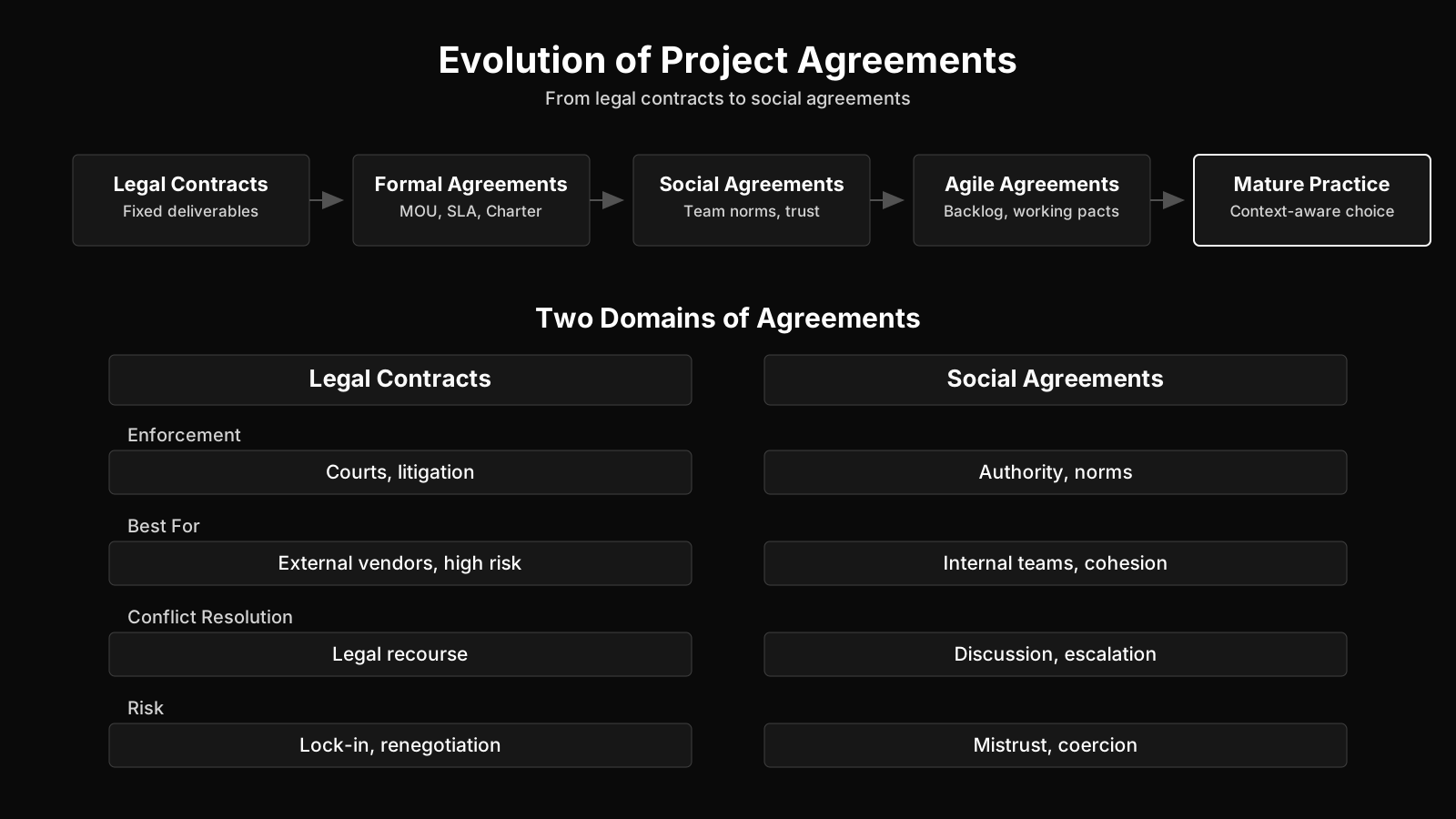
The way projects conceive of agreements has shifted dramatically over the past few decades. The evolution of agreements in project management reflects a broader trend away from adversarial, legally-armed relationships toward collaborative, trust-based models. The construction industry, long plagued by claims and litigation, pioneered relational contracting and alliancing agreements where risk and reward are shared transparently, and the emphasis is on joint problem-solving rather than contractual weaponization. This approach has migrated into IT and consulting, where outcome-based agreements and gain-sharing clauses encourage vendors to innovate rather than protect their minimum obligations.
Agile contracting is a particularly vibrant area of current thinking. Models like graduated fixed-price contracts, where each increment has its own price tag and scope definition, or money-for-nothing clauses that allow the customer to cancel with pre-defined compensation for unused capacity, are becoming more common. Smart contracts, powered by blockchain, introduce the possibility of automated enforcement of certain agreement terms, such as releasing payment upon verified code deployment, though they remain nascent in mainstream project management. Meanwhile, the psychological contract, an unwritten set of mutual expectations between employer and employee or between project manager and team, has gained recognition as a powerful but fragile agreement that influences motivation and retention.
Debate continues over how much detail an agreement should contain. One school argues that exhaustive specifications prevent disputes; another argues that over-specification causes brittleness and discourages creative problem-solving. The reality is context-dependent. High-uncertainty projects benefit from agreements that establish principles and decision-making frameworks rather than detailed prescriptions. High-certainty, repeatable projects can profit from comprehensive documentation. The skill lies not in choosing one extreme but in calibrating the agreement’s density to the project’s uncertainty profile. This calibration is a learned intuition that separates competent project managers from those who merely fill out forms.
The most forward-looking organizations are beginning to view agreements as sense-making devices rather than mere control instruments. An agreement that is reviewed and dynamically adjusted at stage gates, in response to new information, becomes a tool for maintaining collective orientation in a complex environment. It no longer sits behind glass, untouchable; it lives in the project’s daily conversations, informing trade-offs and constantly being stress-tested against reality. This fluid conception of agreements, while demanding a higher level of stakeholder maturity, offers a realistic path for managing projects where the ground shifts underfoot faster than any lawyer can draft a change order.
Key Takeaways on Agreement Evolution
- Shift to collaborative contracting
- Project agreements are moving away from adversarial, legally rigid contracts toward relational models that build trust, pool risks, and enable joint problem-solving.
- Agile contracting innovations
- Graduated fixed-price mechanisms, money-for-nothing clauses, smart contracts, and psychological contracts are reshaping project agreements to foster flexibility, shared incentives, and rapid adaptation.
- Calibrating agreement detail
- The right level of contractual detail scales with project uncertainty: work that is ambiguous and evolving benefits from principle-based guidelines, while well-understood tasks gain precision from exhaustive documentation.
- Agreements as living tools
- Visionary organizations deploy agreements as dynamic sense-making tools, systematically revisiting and refining them at stage gates to preserve alignment in fast-changing environments.