The Business Model Canvas is a strategic management template that project managers, program managers, and portfolio decision-makers use to visualize, interrogate, and align a project’s value proposition with organizational strategy before committing significant resources. In project management, it functions as a concise, one-page model that maps the logic of how an initiative will create, deliver, and capture value, making assumptions explicit and testable rather than burying them in lengthy business case documents.
Business Model Canvas: Key Topics at a Glance
| Key Concept | Summary |
|---|---|
| Strategic Purpose | The Business Model Canvas distills a project's value creation, delivery, and capture logic onto a single page, enabling critical assessment before significant resources are allocated. |
| Origin & Adoption | Conceived by Alexander Osterwalder and Yves Pigneur from strategic management research, the canvas evolved into a globally recognized framework for designing and iterating business models in entrepreneurial and corporate innovation contexts. |
| Project Alignment | As a front-end alignment artifact, it translates strategic ambitions into a coherent preliminary scope, ensuring that project initiatives are tightly coupled with business objectives before detailed planning commences. |
| Essential Clarity | The canvas compels sponsors and core teams to precisely define the beneficiary, the core problem addressed, the necessary activities and resources, and the financial logic that validates the endeavor's viability. |
| Customer Segments | Specific groups the project intends to serve are isolated here. Attempting to serve an overly broad audience dilutes focus and undermines the delivery of differentiated value. |
| Customer Relationships | The intended nature and depth of interactions with each segment directly inform requirements for user experience design, support documentation, training programs, and organizational change management. |
| Revenue Streams | Even internally funded projects must articulate revenue in the form of cost reduction, risk mitigation, or regulatory compliance. Governance bodies demand a transparent link to measurable return on investment. |
| Portfolio Integration | Within portfolio management frameworks such as Management of Portfolios (MoP), canvases from candidate initiatives are compared side by side to evaluate strategic contribution and establish a consistent prioritization vocabulary. |
What Is the Business Model Canvas in Project Management?
Originally developed by Alexander Osterwalder and Yves Pigneur, the Business Model Canvas emerged from the broader field of strategic management and quickly found traction in entrepreneurial and corporate innovation settings. Within project management, however, the tool serves a more targeted purpose: it acts as a front-end alignment artifact that bridges the gap between fuzzy strategic intent and the concrete scope statement. The canvas forces project sponsors and core teams to articulate who the project serves, what fundamental problem it solves, the key activities and resources required, and how success will be financially justified. When embedded in a project lifecycle, the Business Model Canvas in a project management context transforms strategic conversations from abstract debate into structured, visual negotiation.
Unlike a traditional project charter, which can focus heavily on governance, milestones, and constraints, the canvas privileges value logic. A project manager might use it during initiation to pressure-test whether the proposed solution actually maps to a real customer segment and whether the revenue or cost-avoidance streams credibly outweigh the effort. In portfolio management, multiple canvases can be compared side by side to evaluate strategic coherence and resource allocation trade-offs. In program management, a canvas can capture the overarching value model that subordinate projects must collectively realize. The canvas does not replace artifacts like the business case or the project scope statement; rather, it supplements them by making the underlying business assumptions transparent and falsifiable. This is particularly valuable when the project’s environment is uncertain and the definition of success is itself still taking shape.
Key Insights on Business Model Canvas
- Front-end alignment bridge
- During project initiation, the canvas bridges vague strategic intent with a concrete scope statement by forcing teams to articulate customers, problems, key activities, resources, and financial justification before formal planning begins.
- Visual strategy negotiation
- Unlike a project charter that emphasizes governance, milestones, and constraints, the canvas prioritizes value logic, transforming abstract strategic debates into a structured visual dialogue that stress-tests the proposed solution against genuine customer segments and viable value streams.
- Portfolio and program applications
- Portfolio managers compare multiple canvases side by side to assess strategic coherence and resource allocation trade-offs, while program managers rely on a single canvas to articulate the overarching value model that subordinate projects must collectively deliver.
- Supplements existing artifacts
- The canvas complements rather than replaces the business case or scope statement by making underlying business assumptions transparent and testable, a quality that becomes especially valuable in uncertain project environments where success criteria are still emerging.
Key Components of the Business Model Canvas
The standard canvas comprises nine interconnected building blocks, each representing a fundamental question about the business model. When applied to projects, these blocks shift from describing a sustained enterprise to framing a temporary endeavor’s reason for being. The nine blocks are Customer Segments, Value Propositions, Channels, Customer Relationships, Revenue Streams, Key Resources, Key Activities, Key Partnerships, and Cost Structure. A project team that rigorously fills in these blocks often discovers misalignments that would otherwise surface only after execution has begun, when rework becomes exponentially more expensive. Practitioners do not treat the blocks as a checklist; they iterate through them, revisiting earlier assumptions as later insights emerge.
Customer-Facing Building Blocks of the Business Model Canvas
On the right side of the canvas, the customer-oriented blocks define the external face of the project. Customer Segments identify the distinct groups of people or organizations the project aims to serve, which is critical because a project defined for “everyone” rarely delivers focused value. In project terms, this block forces a decision about whose needs will be prioritized when inevitable trade-offs arise. The Value Proposition block captures the bundle of products, services, and intangibles that solve a customer problem or fulfill a need. For a project manager, this is the core hypothesis: what will be different after the project that justifies its existence. Channels describe how the value proposition reaches the customer segments, which, for an internal project, might be the deployment mechanism or the training and onboarding approach. Customer Relationships outline the type of interaction the project establishes with its users, from automated self-service to dedicated personal support, and this directly influences requirements for user experience, documentation, and change management.
Infrastructure and Financial Building Blocks of the Business Model Canvas
The left side of the canvas defines the operational and financial engine the project must assemble or reconfigure. Key Activities are the most important actions the project must perform to deliver the value proposition, and these map loosely to major work packages or high-level deliverables in a work breakdown structure. Key Resources are the assets required—human, financial, intellectual, physical—and they surface dependencies that the project schedule will later have to respect. Key Partnerships describe the network of suppliers, external teams, or strategic alliances that will shoulder parts of the work or supply critical components. On the financial dimension, the Cost Structure block identifies the major cost drivers the project will incur, while Revenue Streams capture how the organization will earn money or accrue measurable benefit from the project’s outcomes. Even internal projects that do not generate direct revenue must articulate a Revenue Stream in the form of cost savings, risk reduction, or compliance avoidance, because project governance bodies increasingly demand a clear line of sight to tangible return on investment.
The Business Model Canvas in PMBOK and Traditional Frameworks
The PMBOK Guide, particularly in its seventh edition, shifts from a purely process-oriented view to a principles-based framework that includes a wide array of models, methods, and artifacts. The Business Model Canvas aligns with the Strategy domain of the PMBOK’s tailoring guidance, where it can serve as a strategic artifact that informs the project’s business case and benefits management plan. In predictive environments, the canvas typically appears in the initiation or pre-initiation phase, often during feasibility analysis or the development of the project charter. A project manager might use it to consolidate stakeholder interviews and document the business logic before drafting the formal scope statement. The canvas helps ensure that the project’s objectives are not defined in isolation but are visibly connected to customer outcomes and financial viability. From a governance standpoint, the canvas becomes a reference point for stage-gate reviews, where the sponsor can ask whether the project’s underlying business logic still holds as conditions change.
PRINCE2 does not explicitly prescribe the canvas, but its principle of continued business justification aligns naturally with the canvas’s purpose. In PRINCE2, the Business Case theme requires that a project’s rationale remains viable throughout the lifecycle. The canvas can serve as a collaborative precursor to the formal Business Case, helping the project board and senior user articulate the high-level logic before the detailed investment appraisal is written. Because PRINCE2 emphasizes management by stages, the canvas can be revisited at the end of each management stage to verify that the value proposition remains intact and that the project still serves the right customer segments. This prevents projects from continuing on inertia long after the original justification has eroded. In portfolio management practices informed by frameworks like Management of Portfolios (MoP), canvases from candidate projects are compared to assess strategic contribution, creating a consistent language for prioritization that goes beyond simple financial metrics.
Summary: Canvas Adoption in Project Frameworks
- Strategic support for PMBOK
- The Business Model Canvas maps directly to the PMBOK Guide Seventh Edition's Strategy domain, transforming it into a tangible strategic artifact that crystallizes the business case and underpins the benefits management plan.
- Early use in predictive projects
- In predictive project lifecycles, the canvas is applied during initiation or pre-initiation to synthesize stakeholder perspectives and forge a clear link between project deliverables, desired customer outcomes, and long-term financial sustainability.
- Reinforcing PRINCE2 justification
- It reinforces PRINCE2's continued business justification principle by serving as a participatory precursor to the formal Business Case, with periodic reviews at each management stage boundary to confirm that the value proposition still holds.
The Business Model Canvas in Agile and Lean Environments
Agile and Lean environments treat the Business Model Canvas as a living artifact that co-evolves with discovery. A Scrum team working on a new product may generate an initial canvas during a product vision workshop and then refine it sprint by sprint as customer feedback arrives. The canvas complements the product backlog by providing the strategic why behind the backlog items, reducing the risk that the team delivers features that are technically sound but commercially irrelevant. In Lean Startup contexts, the canvas becomes the central hypothesis sheet, and each block is subjected to cycles of build-measure-learn. A project that aims to launch a minimum viable product will use the canvas to identify the riskiest assumptions, often starting with customer segments and value proposition, and then define experiments to validate or invalidate those assumptions. This practice transforms the project from a predictive execution exercise into a structured learning endeavor, where scope is emergent and the definition of done includes validated learning about the business model.
Kanban teams and hybrid project approaches also benefit from the canvas by making work prioritization policies more transparent. When a team visualizes its workflow, understanding which customer segment a work item serves and what value proposition it advances allows more nuanced decisions about sequencing and class-of-service designation. The canvas also facilitates the alignment that large-scale Agile frameworks like SAFe demand at the portfolio and program level, where program epics are expected to have a lightweight business case that the canvas can succinctly represent. Through this lens, the Business Model Canvas becomes a boundary object that connects the language of strategy with the language of execution, bridging the gap that often plagues Agile-at-scale transformations.
The Business Model Canvas and Business Value-Oriented Project Management
Business Value-Oriented Project Management (BVOPM) places particular emphasis on early and continuous stakeholder involvement, transparent issue resolution, and the treatment of scope change as feedback rather than failure. In this context, the Business Model Canvas fits naturally into the project initiation workflow. BVOPM’s requirement for a Transparent Board of Project Issues, where all roles can raise concerns before authorization, aligns with the practice of building the canvas through collaborative workshops. When a cross-functional team, including business owners, users, and developers, co-creates the canvas, implicit disagreements surface immediately. One team member might assume the primary Customer Segment is internal legal staff, while another believes it is the external client, and the canvas forces that conflict into the open before resources are assigned. The canvas acts as a visual record of assumptions that the BVOPM principle of formal stakeholder input validation can then ratify or challenge.
The BVOPM scope management approach, which uses a five-level scale from Definite to Unlikely and treats scope change as user feedback, also resonates with the canvas. The building blocks naturally stratify scope: the core value proposition and must-have customer segments map to Definite scope, while experimental features or secondary revenue streams might fall into Possible or Unlikely categories. As the project receives feedback, the canvas is updated, and items can migrate across the scope scale without triggering a change-request culture that penalizes adaptation. Furthermore, BVOPM’s concept of process damage, the invisible harm caused by misaligned decisions, can often be traced back to a flawed business model logic that went unexamined. By investing the time to rigorously debate the canvas at the outset, teams reduce the likelihood of process damage accumulating silently during execution.
Key Insights on Canvas-BVOPM Integration
- Collaborative canvas creation surfaces hidden conflicts
- Jointly building the Business Model Canvas with cross-functional stakeholders forces implicit disagreements about customer segments and value propositions into the open, enabling teams to realign before resources are committed.
- Business Model Canvas stratifies scope
- The Business Model Canvas anchors core value propositions in the Definite scope and relegates experimental features to Possible or Unlikely tiers, so scope changes are reinterpreted as constructive learning rather than project failure.
- Early canvas debate averts process damage
- Debating the canvas rigorously at project startup prevents the silent accumulation of process debt that results from executing on unvalidated business model logic throughout delivery.
Practical Application of the Business Model Canvas in Projects
In practice, project managers introduce the Business Model Canvas most commonly during the concept and initiation phases, though its use persists throughout the lifecycle as a reference for decision-making. A typical scenario involves a half-day workshop during the project’s formative stage, where the sponsor, key stakeholders, and core team members gather around a large printout or a digital canvas. They populate the nine blocks with sticky notes, debating each assumption. For a project aimed at deploying an internal knowledge management platform, the team might identify the Customer Segment as customer support engineers, the Value Proposition as reducing average call resolution time by forty percent, and the Revenue Stream as annual cost savings from avoided escalations. The exercise often reveals that the team’s initial intuitive idea of the solution needs adjustment: they may discover that the real bottleneck lies not in knowledge storage but in the channel through which engineers access it, shifting the Key Activities from content migration to integration with existing tools.
Beyond initiation, project managers use the canvas during major milestone reviews to check whether external changes have invalidated earlier assumptions. A program manager orchestrating a suite of digital transformation projects might maintain a summary canvas for each project and review them quarterly with the portfolio steering committee. When a competitor launches a feature that reshapes customer expectations, the canvas exposes which projects still rest on outdated assumptions about Customer Relationships or Value Propositions. The canvas also proves useful in risk management: a preliminary canvas often highlights dependencies on Key Partners or Key Resources that the project team has not yet secured, converting latent risks into actionable items for the risk register. Practical application of the Business Model Canvas depends heavily on the facilitator’s ability to prevent the exercise from becoming a box-filling formality and to keep the conversation focused on testable business hypotheses rather than wishful thinking.
Common Challenges, Pitfalls, and Misconceptions
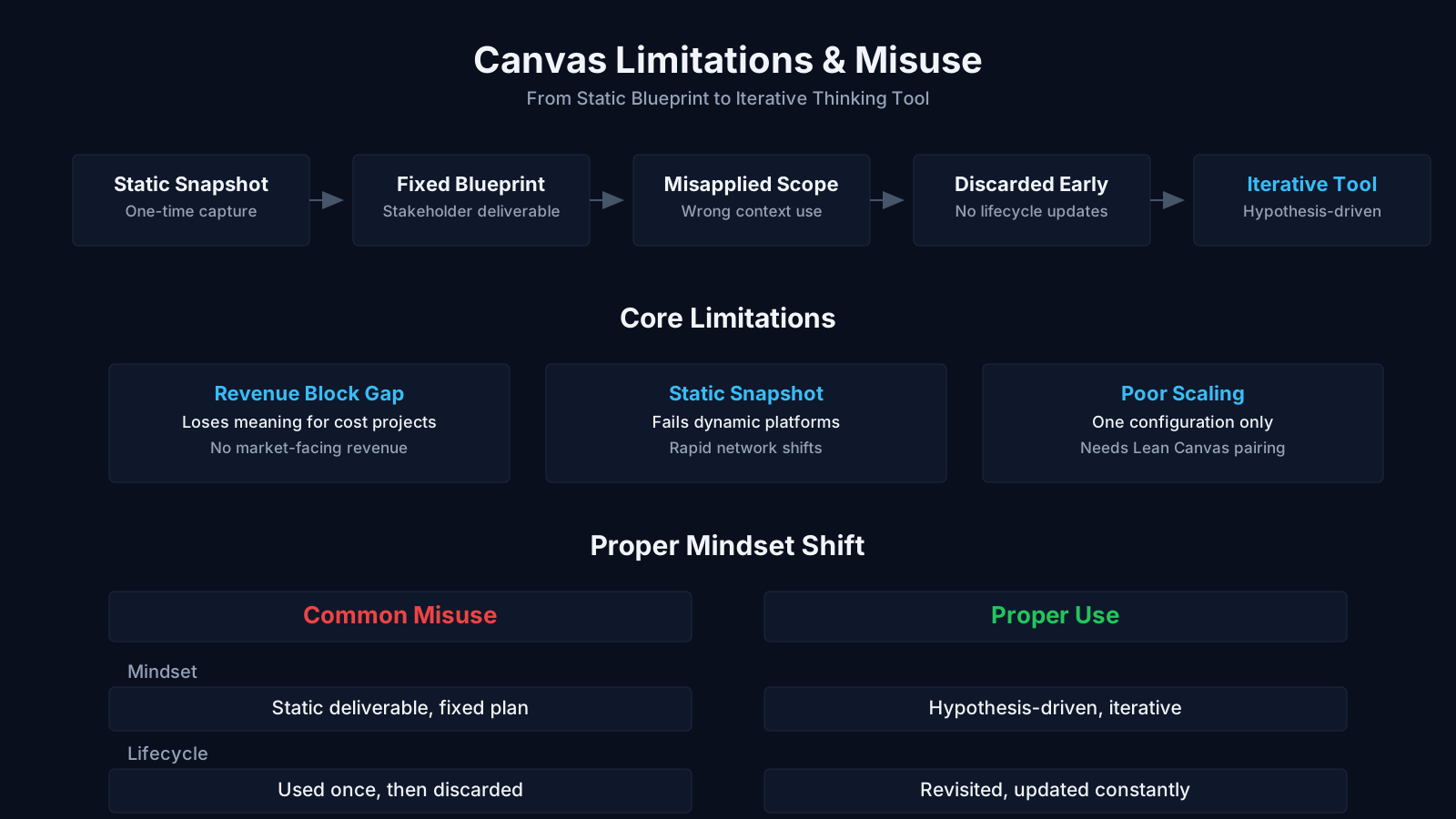
The most persistent misconception about the Business Model Canvas is that it is a deliverable rather than a thinking tool. Teams sometimes treat the completed canvas as a finished product to be archived, rather than as a dynamic model that must evolve as learning accumulates. When the canvas is created once at the start and never revisited, it forfeits its diagnostic power and becomes a snapshot of early assumptions that may quickly become obsolete. Another common pitfall is filling the canvas with generic, non-falsifiable statements. A Value Proposition that reads “improve efficiency” is dangerously ambiguous; it provides no basis for measuring success or challenging the underlying logic. Project managers who facilitate canvas sessions learn quickly that insisting on specificity, ideally expressed in quantifiable terms, is essential for the artifact to have any future utility. There is also a tendency to overstuff the canvas with every conceivable idea, which destroys the clarity that is its primary virtue. A canvas should represent the minimal coherent model, not an exhaustive inventory of every possible feature or stakeholder.
Another challenge surfaces when the canvas is used in organizations with rigid governance that expects fully costed, detailed business cases before any funding is released. The canvas, by design, is a sketch, and it thrives in environments that tolerate iterative refinement and provisional commitment. Common pitfalls when using the Business Model Canvas include the failure to distinguish between different customer segments with conflicting needs, leading to a Value Proposition that tries to please everyone and satisfies no one. Additionally, project teams sometimes mistake the canvas for a substitute for a project charter or a work breakdown structure. It is not a scheduling or resource-loading tool; it provides the strategic logic that justifies the project, but it does not define the detailed execution plan. Recognizing these boundaries is essential for using the canvas effectively without creating governance gaps.
Key Insights on Canvas Pitfalls
- Tool for thinking, not deliverable
- The Business Model Canvas serves as a continuous thinking instrument for testing assumptions, not a polished deliverable to be archived after initial completion.
- Continuous evolution required
- A canvas drafted once and ignored becomes a frozen snapshot of early guesses rather than a dynamic model that sharpens with ongoing learning.
- Specific, falsifiable statements needed
- Generic claims like “improve efficiency” are dangerously vague because they offer no measurable standard for assessing success or scrutinizing the underlying logic.
- Minimal coherent model principle
- The canvas should surface only the essential elements of the business model, not become an exhaustive inventory of every conceivable feature or stakeholder.
- Strategic logic, not execution plan
- The canvas provides the strategic logic that justifies a venture, but it does not substitute for a scheduling, resource-loading, or detailed execution tool.
Relationship to Other Project Management Concepts
The Business Model Canvas sits at the intersection of several established project management artifacts and processes. It is most directly related to the business case, but where the traditional business case often focuses on financial justification and investment appraisal, the canvas foregrounds the operational logic and customer dynamics that underpin the numbers. A project scope statement defines the boundaries of what the project will deliver; the canvas explains why those boundaries make sense. The canvas can be seen as a visual elaboration of the benefits management plan, linking each planned benefit back to a customer segment and a value proposition. Stakeholder mapping and the canvas are also deeply complementary: a stakeholder register identifies who has an interest in the project, and the canvas clarifies what value the project intends to deliver to each of those stakeholders. Together, these artifacts create a richer picture of both the social and the economic architecture of the project.
When compared to a Lean Canvas, a variant popularized by Ash Maurya that adapts the Business Model Canvas for startups by replacing some blocks with Problem, Solution, Key Metrics, and Unfair Advantage, the original canvas remains more suitable for projects within established organizations because it retains the holistic business model structure that enterprise environments expect. The Difference between the Business Model Canvas and a project charter lies in their focus: the charter authorizes the project and assigns the project manager, whereas the canvas models the business logic that justifies that authorization. In a mature project management ecosystem, the charter, the business case, the canvas, and the scope statement form a coherent documentation set, each artifact answering a different set of questions and serving a different audience moment. Understanding where each artifact adds value prevents duplication and cognitive overload.
Evolution and Current Thinking
Since its introduction, the Business Model Canvas has spawned a family of variant canvases, including the Mission Model Canvas for mission-driven organizations and the Portfolio Canvas for aligning a set of initiatives to strategy. Within project management, the most significant evolution has been the integration of the canvas with iterative and adaptive lifecycles. Contemporary thinking no longer treats the canvas as a one-time upfront document but as a continuously updated model that reflects the project’s evolving understanding of value. Digital collaboration tools now allow distributed teams to co-edit canvases asynchronously and link each block to supporting data, evidence from customer interviews, or live dashboards. This transforms the canvas from a static poster into a living information radiator that can be displayed on team portals and reviewed during sprint reviews or steering committee presentations.
Current debates center on the appropriate level of granularity and the canvas’s role in highly complex projects, such as large-scale infrastructure or regulatory compliance programs, where the business model is effectively pre-determined by external mandates. In these contexts, the canvas can still serve as a communication device to explain the project’s rationale to a broader audience, but its analytical power is diminished because the fundamental business logic is not in question. Another line of discussion involves the canvas’s relationship to benefits realization management, where practitioners argue that the canvas should explicitly include a “benefits” layer or be augmented with a benefits dependency map to trace how outputs lead to outcomes. Despite these debates, the tool’s enduring appeal lies in its simplicity and its ability to externalize mental models, making strategy tangible enough to critique. As project management continues to absorb design thinking and systems thinking principles, the Business Model Canvas will likely remain a staple artifact for ensuring that projects are not just executed correctly, but that the right projects are chosen in the first place.
Key Insights on Canvas Evolution
- Expanding canvas family
- The original Business Model Canvas has given rise to specialized variants, such as the Mission Model Canvas for mission-driven organizations and the Portfolio Canvas, which directly aligns initiatives with strategic priorities.
- Living, continuously updated model
- Today, the canvas is treated as a living artifact that continuously captures the team's deepening insights into value creation, rather than a static, one-time deliverable.
- Digital collaboration transformation
- Digital platforms enable distributed teams to co-edit canvases in real time and link each block to supporting data, customer evidence, and live dashboards, transforming the canvas into a dynamic, shared source of insight.
- Debates on granularity and complexity
- Ongoing discussions focus on the ideal level of detail and on the canvas's usefulness in highly complex projects where external mandates largely predefine the business model, limiting its diagnostic potential.
- Benefits realization and simplicity appeal
- Although some practitioners advocate adding an explicit benefits layer or dependency map, the canvas's enduring appeal comes from its elegant simplicity and its ability to surface underlying assumptions for rigorous strategic debate.