In project management, a contingency reserve is defined as the amount of time or money allocated within the project baseline to address identified risks that may or may not materialize. This reserve is explicitly linked to known risks recorded in the risk register and is activated through agreed risk response strategies. It is not a general buffer for unknown changes or scope additions; those are handled separately through management reserve or formal change control. In cost terms, the contingency reserve sits inside the cost baseline, and in schedule terms it exists as reserve time embedded in the schedule baseline.
Contingency Reserve: Key Topics at a Glance
| Definition | Summary |
|---|---|
| Contingency Reserve | The PMBOK Guide defines a contingency reserve as a dedicated time or cost provision allocated to identified risks, including accepted risks and risks with planned response strategies. |
| Cost Reserve | A cost contingency reserve absorbs the financial consequences of identified risks, such as the additional expense of expedited shipping when a critical delivery is delayed. |
| Schedule Reserve | A schedule contingency reserve absorbs time-related impacts by adding duration to critical path activities, for example to accommodate a known permitting delay. |
| Key Components | Essential components include traceability to the risk register, the estimation method, the assigned ownership and control mechanism, and the release criteria for when a risk does or does not materialize. |
| Estimation Methods | Rigorous estimation applies expected monetary value analysis, multiplying each identified risk's probability by its financial impact, and Monte Carlo simulation to model probabilistic outcomes and set a reserve level aligned with organizational risk tolerance. |
| Scope Limitation | Contingency reserve is not intended to cover scope additions, design changes, or unidentified events; these require management reserve or formal change control. |
| Drawdown Authority | The project manager may draw from the reserve when a specified risk occurs, but authority is constrained and typically requires evidence that the risk was identified, that the drawdown aligns with the approved response, and that the remaining reserve remains sufficient. |
| Category Reserves | Some organizations maintain distinct contingency reserves by category, such as quality rework, regulatory delay, or supplier failure, yet these remain tied to identified risks rather than general uncertainty. |
What Is a Contingency Reserve?
The phrase what is a contingency reserve often surfaces when project stakeholders confuse the baseline estimate with the total authorized budget. A contingency reserve is specifically the quantified allowance for identified risks that the project team has decided to accept or manage through contingency plans. This amount is not intended for scope additions, design changes requested by stakeholders, or unknown events; those fall under management reserve or require formal change control. The reserve is calculated before the project baseline is approved and becomes visible in the cost and schedule performance baselines.
In daily project work, a contingency reserve functions as a conditional promise. If a specified risk occurs, the project manager can draw from the reserve to implement the planned response without immediately seeking new funding or schedule relief. If the risk never occurs, the reserve remains unspent or is released according to organizational policy. This conditional nature distinguishes a contingency reserve from padding, which is hidden slack that lacks traceability and accountability. Contingency reserve is documented, defensible, and tied to the risk process.
The concept is closely aligned with the idea of known unknowns. These are risks that the project team can identify and describe, even though the exact timing or full impact may remain uncertain. A known unknown might be the possibility of a critical supplier delaying a component delivery by two weeks. The project can plan for that delay, estimate its cost and schedule impact, and hold a reserve to absorb it. Unknown unknowns, by contrast, are addressed through management reserve because they cannot be identified during planning.
Contingency Reserve Key Takeaways
- Identified risk allowance
- A contingency reserve is a quantified provision for identified risks that the project team has chosen to accept or actively manage through predefined contingency plans.
- Not for scope or unknowns
- Scope additions, stakeholder-driven design changes, and unidentified events are excluded from the contingency reserve; these are addressed through the management reserve or a formal change control process.
- Calculated before baseline approval
- The reserve is determined before the project baseline is approved and is then incorporated into both the cost and schedule performance baselines, making the allowance visible and traceable.
- Conditional risk funding
- When a specified risk materializes, the project manager draws on the reserve to fund the planned response; if the risk does not occur, the reserve remains unspent or is released in accordance with organizational policy.
- Distinct from padding
- Unlike undisclosed schedule or cost padding, a contingency reserve remains traceable and accountable because each portion is linked to specific identified risks, such as a critical supplier's two-week delivery delay.
Key Components and Characteristics of a Contingency Reserve
A contingency reserve has several distinct characteristics that separate it from other forms of project slack. The most defining trait is traceability to identified risks. Each portion of the reserve, in mature organizations, can be linked back to a specific risk entry, a response strategy, or a probabilistic model output. Key components of a contingency reserve include the risk register linkage, the estimation method, the ownership and control mechanism, and the release criterion when a risk does or does not materialize.
Two primary forms appear in most project environments. A cost contingency reserve covers the financial impact of identified risks, such as the extra expense of expedited shipping if a delivery runs late. A schedule contingency reserve covers the time impact, such as additional duration added to a critical path activity to absorb a known permitting risk. Some organizations also maintain separate contingency reserves for specific categories like quality rework, regulatory delay, or supplier failure, but these are still tied to identified risks rather than general uncertainty.
Estimation methods vary widely depending on organizational maturity and project complexity. Simple approaches include a percentage of the overall estimate or a fixed amount based on historical performance. More rigorous methods use expected monetary value analysis, which multiplies the probability of each identified risk by its cost impact, and then aggregates the results. Monte Carlo simulation goes further by modeling many possible outcomes and producing a probability distribution that helps the project team select a reserve level consistent with the organization's risk tolerance.
Ownership of the contingency reserve sits with the project manager in most cases, while management reserve typically sits with the sponsor or a portfolio governance body. The project manager can authorize use of the contingency reserve when an identified risk occurs, following the control procedures defined in the risk management plan. This authority is not unlimited; many organizations require the risk owner to demonstrate that the risk was previously identified, that the drawdown matches the approved response, and that the remaining reserve remains adequate for other outstanding risks.
Contingency Reserve in PMBOK, PRINCE2, and Agile
The treatment of contingency reserve PMBOK guidance is fairly specific within the PMBOK framework. The PMBOK Guide describes contingency reserve as budget or schedule allowance for identified risks that are accepted or for which contingent responses are developed. It is an output of the Plan Risk Responses process and is incorporated into the cost baseline during Determine Budget and into the schedule baseline during Develop Schedule. The reserve is included in the performance measurement baseline, which means earned value calculations treat it as part of the project's planned value and not as an external cushion.
Contingency Reserve in PMBOK
Within the PMBOK process groups, contingency reserve planning occurs primarily during planning, but its use is monitored and controlled throughout execution. The risk register provides the input, because each identified risk carries an agreed response strategy. When a risk response includes a contingency plan, the associated reserve is explicitly allocated. The project manager typically reviews the risk register and the contingency reserve together during Control Risks to determine whether the remaining reserve is still sufficient for the risks that remain open. If new risks emerge, the reserve may need to be adjusted through integrated change control.
A practical illustration helps clarify this. Suppose a construction project has identified a risk that a specific permit may take ten days longer than planned. The team estimates a forty percent probability of this delay and calculates that the delay would add six thousand dollars in extended site costs. The contingency reserve might include twenty-four hundred dollars for that risk, along with reserve time of four days. If the permit is delayed, the project manager draws from the reserve. If the permit arrives on time, that portion of the reserve remains unused and may be released or held for other identified risks.
Contingency Reserve in PRINCE2
PRINCE2 does not use the term contingency reserve in exactly the same way as PMBOK, but the concept maps closely to the PRINCE2 risk budget. The risk budget is an amount of money set aside within the project budget to fund management responses to threats and opportunities that have been identified in the risk register. PRINCE2 also separates the risk budget from the change budget, which covers changes in scope or requirements. This separation is conceptually similar to the PMBOK distinction between contingency reserve and management reserve, although the PRINCE2 change budget is not identical to management reserve because it is tied to change authority rather than unknown unknowns.
PRINCE2 emphasizes management by exception, so the use of the risk budget may trigger a reporting threshold. The project manager can typically draw from the risk budget within agreed tolerances, but exceeding those tolerances requires escalation to the project board. This aligns with the broader PRINCE2 principle of defined roles and responsibilities. In practice, the risk budget is documented in the risk management approach and monitored through the risk register, which is a controlled management product throughout the project lifecycle.
Contingency Reserve in Agile and Hybrid Environments
In Agile environments, contingency reserve takes a less formal and more capacity-oriented form. Teams rarely maintain a separate monetary contingency reserve for each sprint, because Agile delivery emphasizes empirical process control and continuous reprioritization. Instead, teams may protect capacity by leaving slack in a sprint, limiting work in progress, or maintaining a buffer of unallocated time for unexpected defects and dependencies. The product backlog itself functions as a risk management tool, because high-risk items can be pulled forward to reduce uncertainty early in the release cycle.
Hybrid projects often blend these approaches. A project may have a predictive cost baseline with a contingency reserve for known technical risks, while the delivery team also uses Agile capacity buffers for day-to-day variability. The key is avoiding double counting. If a risk is already funded through a formal contingency reserve, the team should not also hide additional time in every sprint to cover the same risk. Clear definition of what the reserve covers, and what remains within normal team capacity, prevents inflated estimates and reduces stakeholder mistrust.
Key Insights on Reserve Management
- PMBOK contingency reserve definition
- PMBOK defines the contingency reserve as a budget or schedule allowance for identified risks that have been accepted or require contingent responses. This reserve is incorporated into the performance measurement baseline, which links risk acceptance directly to cost and schedule performance tracking.
- Ongoing reserve monitoring process
- During the Control Risks process, the project manager compares the risk register against the contingency reserve to confirm that remaining funds still match the risks that remain open and to reallocate reserves when the project risk profile changes.
- PRINCE2 and Agile alternatives
- PRINCE2 manages reserves through a change budget tied to the change authority, while Agile teams protect delivery capacity by building slack into sprints, enforcing limits on work in progress, and holding buffers for unexpected defects and dependencies.
Purpose and Importance of a Contingency Reserve
The purpose of a contingency reserve is to increase the probability that a project meets its approved cost and schedule objectives despite the occurrence of identified risks. Without it, the project manager would need to request additional funding or schedule relief every time a known risk materialized. That would slow decision-making, increase administrative burden, and create the impression of poor planning. A properly sized reserve allows the project to absorb anticipated variability while preserving the integrity of the baseline.
Contingency reserves also support honest communication with stakeholders. When a project includes a visible, documented reserve, sponsors and customers understand that the baseline is not a single deterministic promise but a commitment within a defined risk tolerance. This reduces the pressure on estimators to hide padding inside individual work packages. Hidden padding distorts task-level estimates and undermines earned value analysis. A centralized reserve is more transparent and easier to govern.
The reserve also creates a trigger for risk management. Because the reserve is tied to specific risks, drawing from it forces a conversation about the risk status, the effectiveness of the response, and the remaining exposure. This makes risk management operational rather than theoretical. Teams that use contingency reserve well tend to have more active risk registers, because the reserve gives the risk register financial and schedule consequences that people can see and act on.
Contingency Reserve vs Management Reserve
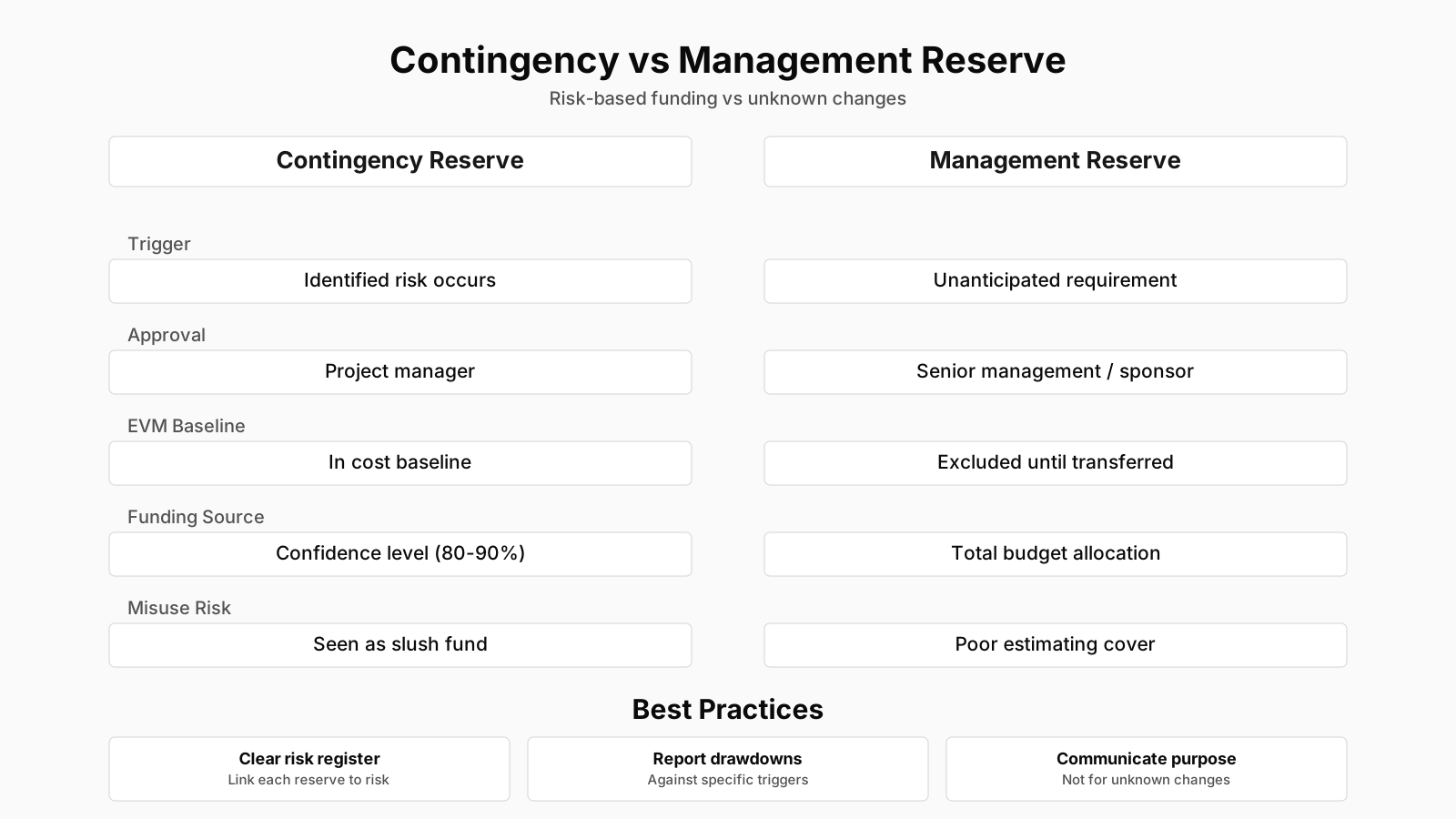
The distinction between contingency reserve vs management reserve is one of the most important concepts in project budgeting and scheduling. Contingency reserve addresses identified risks, also called known unknowns. Management reserve addresses unidentified risks, or unknown unknowns. This difference in risk identification drives everything else: who controls the reserve, where it sits in the budget structure, and how it is accessed.
In PMBOK terms, the cost baseline includes contingency reserve but excludes management reserve. The project budget, which is the total funding authorized for the project, includes both the cost baseline and the management reserve. Management reserve is typically controlled by senior management, the sponsor, or a portfolio management office, and its use requires a change request or formal approval. Contingency reserve is controlled by the project manager and can be used without changing the project baseline, because it is already part of that baseline.
A common misconception is that management reserve is simply a larger, more senior version of contingency reserve. In reality, they respond to different types of uncertainty and have different governance mechanisms. A project should not use management reserve to cover risks that could have been identified during planning. Doing so weakens the incentive for rigorous risk identification and shifts accountability away from the project team. Similarly, contingency reserve should not be treated as a general purpose fund for minor scope changes or ordinary cost overruns. Scope changes require change control, not risk reserve.
Core Takeaways on Reserve Distinctions
- Defining known and unknown risks
- Contingency reserve is allocated for identified risks, often referred to as known unknowns, whereas management reserve is set aside for unidentified risks, commonly called unknown unknowns.
- Distinct budget placements
- The cost baseline incorporates contingency reserve while excluding management reserve; the total project budget, by contrast, includes both reserve types.
- Senior management controls management reserve
- Access to management reserve is controlled by senior management, the sponsor, or a portfolio management office, and any use typically requires a change request or formal approval.
- Not a larger contingency reserve
- Viewing management reserve merely as a larger, higher-level contingency reserve undermines the discipline of rigorous risk identification and transfers accountability away from the project team.
- Contingency reserve misuse warning
- Contingency reserve must not be used as a general-purpose fund for minor scope changes or routine cost overruns.
Common Challenges, Pitfalls, and Misconceptions
One of the most persistent common misconceptions about contingency reserves is that they are optional buffers that can be removed when budgets are tight. Cutting contingency reserve without reducing project scope or accepting more risk does not make a project cheaper. It simply transfers the financial impact of identified risks back to the project's operating budget or to future change requests. Sponsors who view contingency reserve as fat often create projects that appear lean but repeatedly exceed their baseline when known risks occur.
Another frequent pitfall is double counting risk. An estimator may add contingency to an individual activity estimate, and the project manager may also add a centralized contingency reserve for the same risk. This results in a bloated baseline that misrepresents the true cost and schedule exposure. Organizations reduce this problem by requiring that contingency reserve be calculated separately from work package estimates and by auditing the linkage between reserve line items and specific risk register entries.
Political misuse also occurs. Some project managers treat the contingency reserve as a hidden fund to cover poor performance or unapproved scope additions. This undermines the risk process and erodes trust. When stakeholders discover that reserve money was spent on issues never documented in the risk register, they may demand tighter controls that make legitimate risk responses harder to execute. Clear reserve drawdown criteria and regular reporting help prevent this behavior.
Business Value-Oriented Project Management addresses a related problem by treating product risk separately, using quantified loss size units and dynamic filtering rather than a single undifferentiated reserve. This approach reduces the tendency to lump all uncertainty into one bucket and forces more precise discussion about what the reserve is actually protecting. It does not eliminate the need for contingency reserve, but it changes the analysis around it.
Relationships to Other Project Management Concepts
A contingency reserve explained only makes sense alongside the risk register, the risk response plan, and the project baselines. The risk register identifies the specific risks that justify the reserve. The risk response plan describes what will be done if those risks occur. The cost baseline and schedule baseline include the reserve amounts. These artifacts are mutually dependent. A reserve without a risk register is just padding, and a risk register without a reserve leaves identified risks unfunded.
The contingency reserve also interacts with earned value management. Since the reserve is part of the performance measurement baseline, planned value includes the reserve. If the project draws down the reserve, the cost performance index may not immediately change because the budgeted cost of work performed already accounted for that planned contingency. This can create a misleading sense of stability if the team is simultaneously consuming reserve faster than planned. Practitioners often track reserve burn separately from cost variance to understand whether risk consumption is outpacing the plan.
Schedule contingency reserve relates closely to critical path management and buffer management. In critical path method scheduling, reserve time can be added to the project end date or to specific activities based on risk exposure. In critical chain project management, buffers are used more deliberately, with feeding buffers protecting chains of activities and a project buffer protecting the overall completion date. Critical chain buffer management treats buffers as visible management tools rather than hidden slack, which aligns well with the intent of a contingency reserve.
Contingency reserve is also distinct from contingency plan and fallback plan. A contingency plan is a predefined set of actions to take if a risk occurs. A fallback plan is used when the contingency plan does not produce the desired result. The reserve is the resource that funds or enables those plans. You can have a contingency plan without a cash reserve, but then the plan may be unimplementable when the risk occurs because no funding or time has been set aside to execute it.
Key Insights on Reserve Integration
- Risk documents justify the reserve
- The risk register identifies the specific threats and opportunities that the reserve is intended to absorb, and the risk response plan ties each reserve allocation to approved mitigation or contingency actions within the cost and schedule baselines.
- Track reserve burn separately
- Because reserve drawdowns are recorded outside the cost performance index until the contingency is formally released, tracking the burn rate as a separate metric provides early warning when actual risk consumption exceeds the planned absorption rate.
- Buffer approaches vary by method
- The critical path method distributes reserve time into activity durations or aggregates it as a project end contingency, while critical chain places feeding buffers on non-critical paths and a project buffer at the end, making buffer consumption a visible control signal.
Evolution and Current Thinking on Contingency Reserves
The current thinking on contingency reserves has moved away from simple percentage allocations toward probabilistic and risk-driven methods. Decades ago, many organizations applied a flat ten percent or fifteen percent contingency to every project, regardless of its risk profile. That approach was easy to administer but often produced reserves that were too small for high-uncertainty projects and too large for low-uncertainty projects. Modern practice emphasizes integrated cost and schedule risk analysis, often using Monte Carlo simulation to determine the reserve needed to achieve a stated confidence level, such as an eighty percent probability of finishing within the baseline.
This evolution reflects a broader shift toward quantitative risk management. Instead of asking how much extra money feels safe, project teams now ask what specific risks are most likely to consume reserve and how those risks correlate. Correlated risks are especially important because multiple risks can hit at once. A supplier failure and a regulatory delay might both be caused by the same underlying market condition, and a naive addition of individual risk reserves would understate the total exposure. Probabilistic models capture these correlations more effectively than simple percentage rules.
There is also a growing recognition that contingency reserve is not a static amount. It should be reviewed at key points in the project lifecycle, such as phase gate reviews or major milestone achievements. As risks are closed, expired, or changed, the reserve should be adjusted. Some organizations release unused contingency reserve to the funding sponsor when the related risks no longer exist. Others retain the reserve until project close to cover residual risks. Both approaches are valid, but the decision should be explicit rather than left to the project manager's discretion without governance.
Agile and hybrid delivery models have further reshaped the conversation. In these environments, the language of contingency reserve is often replaced by concepts like buffer capacity, risk-adjusted backlogs, and protected time. Yet the underlying principle remains the same: acknowledge that uncertainty exists, quantify it where possible, and allocate a visible allowance that lets the team respond without destabilizing the project. The tools have changed, but the discipline of reserving resources for known risks remains a core element of competent project management.
Current thinking also warns against treating contingency reserve as a substitute for good risk response planning. A reserve is not a strategy. It is the financial or schedule capacity that makes a strategy executable. Mitigating a risk, avoiding it, transferring it, or accepting it all have different reserve implications. A mature organization links the reserve directly to the risk response, measures its drawdown, and uses that data to improve future estimates. That feedback loop is what turns contingency reserve from a static budget line into a living part of the project's risk management system.