Contingency plans in project management are predefined response strategies that document the actions, resources, owners, and decision thresholds a project team will activate if a specific risk event or trigger condition occurs. A contingency plan definition centers on preparation rather than prevention. The project team does not expect the risk to happen, but it has agreed in advance what to do if it does. This is different from mitigation, which seeks to lower the probability or impact of a risk before it materializes.
Contingency Plans: Key Topics at a Glance
| Concept | Summary |
|---|---|
| Contingency Plan | A structured response protocol that assigns owners, allocates resources, and defines decision thresholds in advance, activated when a specific risk event or trigger condition occurs. |
| Distinction | The term separates this focused response document from a risk management plan, which governs the full risk lifecycle, and from a business continuity plan, which addresses enterprise-wide operational disruptions. |
| Purpose | The primary objective is to compress response time and contain impact when a known risk escalates from a possibility into an active issue. |
| Benefits | A prepared response eliminates early ambiguity over leadership, communication duties, and baseline revisions, enabling teams to act immediately after a trigger fires. |
| Key Components | Each plan specifies the trigger condition, response actions, resource commitments, accountable owner, and escalation path. |
| Trigger Types | A metric-based trigger activates when a quantitative indicator crosses a defined threshold, for example when defect density exceeds the agreed quality limit. |
| High Stakes | Contingency plans are most critical on projects with dense interdependencies, fixed regulatory or contractual deadlines, penalty exposure, or safety implications. |
What Is a Contingency Plan in Project Management?
Within the PMBOK framework, a contingency plan is defined as a predetermined set of actions to be implemented if a specific risk event occurs. It is a component of the overall risk response plan, not a generic recovery document. The plan is tied to a risk that has been identified, analyzed, and deemed important enough to warrant a prepared response. It describes what will happen after a defined trigger point is reached. In practice this means the team does not have to design a response in the middle of a crisis. It has already thought through the sequence, assigned owners, and identified the resources that will be needed.
When practitioners ask what is a contingency plan, they are usually trying to distinguish it from a broader risk management plan or a business continuity plan. The distinction is narrow but meaningful. A project risk management plan sets the overall approach, roles, and cadence for risk work. A contingency plan is more granular. It says if the architectural review reveals a data migration defect in the third sprint, then the integration team will switch to the prebuilt staging environment and delay the cutover by two days. The trigger, action, owner, and fallback are all named in advance.
Think of a contingency plan as a fire drill for project work. The team does not want the fire to happen, but it knows exactly which exit to use if it does. The rehearsal exists so that people do not freeze or improvise poorly when pressure is high. In a project, the fire might be a supplier failure, a critical resource leaving, or a security audit finding. The plan removes some of the cognitive load from the moment of failure.
Core Insights on Contingency Planning
- Predetermined risk response actions
- Within the PMBOK framework, a contingency plan is a predefined sequence of actions that the project team executes only when a specific, previously analyzed risk event actually materializes.
- Trigger points drive execution
- Activation occurs at a clearly defined trigger point, allowing the team to move immediately into a known sequence of tasks with assigned owners and allocated resources rather than improvising a response under pressure.
- Distinct from broader plans
- Unlike a general project risk management plan or a business continuity plan, a contingency plan addresses a single identified risk with a tailored response, such as switching to a staging environment if a data migration defect is detected.
Purpose and Importance of Contingency Plans
The purpose of contingency plans in project management is to reduce reaction time and limit damage when a known risk becomes a live problem. Without a prepared response, a team may waste hours or days deciding who should lead, what should be communicated, and whether the issue justifies resetting the baseline. The plan compresses that decision process. It also protects stakeholder confidence because the response appears measured rather than chaotic.
Contingency plans also have a less obvious benefit. The act of writing them forces the team to confront the real implications of a risk. A risk register entry that says vendor delay, high impact is vague. A contingency plan forces the question: which deliverables are affected, how much schedule reserve remains, who talks to the vendor, and what is the alternative source. This produces better risk awareness even if the plan is never activated.
They matter most on projects with high interdependencies, fixed external deadlines, regulatory penalties, or safety consequences. A clinical trial project, an infrastructure rollout, or a product launch tied to a legal date cannot afford open-ended improvisation. In such environments, the absence of contingency plans is often viewed as a governance failure. Stakeholders expect the project team to show not only that risks have been identified, but also that the team has thought through what it would do if those risks materialize.
Key Components of Contingency Plans
A useful contingency plan includes several identifiable elements. The key components of a contingency plan are the trigger condition, the response action, the resource allocation, the response owner, and the escalation path. Each component answers a different practical question. The trigger defines what must happen before the plan is activated. The response action defines what the team will do. The resource allocation identifies what time, money, equipment, or people will be diverted. The owner is accountable for activation, and the escalation path protects against the response itself failing.
Triggers deserve special attention. A trigger must be observable and measurable, not interpretive. Saying activate if the vendor starts falling behind is weak because it requires someone to decide when behind is behind enough. A better trigger is activate if the vendor misses the first integration test window by more than three business days. That clarity prevents both premature activation and dangerous delay. It also gives the response owner a defensible reason to act.
Trigger Conditions and Decision Thresholds
Trigger conditions are the boundary between monitoring and acting. In risk management practice, triggers can be time-based, event-based, or metric-based. A time-based trigger activates at a date if a milestone has not been met. An event-based trigger activates when something specific occurs, such as a regulator issuing a notice. A metric-based trigger activates when a performance indicator crosses a threshold, such as defect density exceeding a set level during system testing.
Teams sometimes confuse a trigger with a risk symptom. A trigger is the agreed activation point, while a symptom is early evidence that a risk may be developing. The distinction matters in practice. A weak symptom might justify increased monitoring, but the contingency plan should not launch until the predefined threshold is reached. Otherwise the team can exhaust its reserves too early and lose credibility with governance bodies.
Reserves, Actions, and Response Owners
Contingency plans draw on contingency reserves. A contingency reserve is the amount of time, budget, or both that is set aside for identified risks after risk response planning. The reserve is not free buffer for scope growth or poor estimation. It is specifically linked to known risks. If a risk has a contingency plan, the associated reserve should be enough to execute that plan without an immediate baseline change request.
The response owner is not always the risk owner. The risk owner monitors the environment and watches for triggers. The response owner may be a different person, often the one with operational control over the area that must change. A supplier risk owner might be the procurement manager, while the response owner could be the technical lead who will switch integration vendors. The plan should make this distinction explicit. Ambiguity here can delay activation at the worst possible moment.
Core Insights on Plan Components
- Five essential components
- A complete contingency plan combines trigger condition, response action, resource allocation, response owner, and escalation path, each addressing a distinct operational question and together defining how the plan converts early warning into coordinated response.
- Two distinct trigger types
- Event-based triggers respond to discrete occurrences such as a regulator issuing a formal notice, whereas metric-based triggers engage only after a measured performance indicator, such as defect density during system testing, breaches a predefined threshold.
- Resources, ownership, escalation
- Resource allocation defines the time, budget, equipment, and personnel that will be redirected to the response; the designated owner carries accountability for activation; and the escalation path provides a safeguard if the initial response proves insufficient.
- Contingency reserve and thresholds
- A contingency reserve is the time, budget, or both that remains available for identified risks after response planning; weak symptoms justify closer monitoring, not plan activation, until a predefined threshold is actually reached.
Types of Contingency Plans in Project Management
Projects typically use several types of contingency plans depending on the risk category. The most common are schedule contingency plans, cost contingency plans, technical contingency plans, and operational contingency plans. Each type focuses on a different failure mode and has a different activation logic. Some projects also prepare communication contingency plans to manage stakeholder reactions during a visible failure.
Schedule and Cost Contingency Plans
Schedule contingency plans specify how the team will recover time when a known risk threatens a milestone. They might include using fast tracking, approving overtime, deploying a reserve team, or resequencing noncritical work. Cost contingency plans address budget threats, such as currency fluctuations, supplier price increases, or unexpected regulatory fees. The cost response often involves drawing on contingency reserve, shifting procurement, or renegotiating terms.
These plans are closely tied to quantitative risk analysis. A project with a thirty percent probability of a four-week vendor delay might set aside a proportional amount of schedule reserve and prepare a specific workaround. The plan does not guarantee recovery, but it prevents the team from treating every schedule slip as a fresh crisis. It also makes the trade-offs visible to sponsors before the risk occurs.
Technical, Operational, and Continuity Contingency Plans
Technical contingency plans respond to risks such as integration failures, architecture flaws, or performance shortfalls. They often involve alternative technical solutions, fallback architectures, or mock environments that can be activated quickly. Operational contingency plans cover people, facilities, and process failures, such as loss of a key specialist or unavailability of a test environment. Continuity plans, while often viewed as a separate discipline, can overlap with project contingency planning when a disaster affects project execution.
In software projects, a common technical contingency is the use of a feature flag or a kill switch. The team may plan to disable a problematic module rather than roll back the entire release. In construction, a technical contingency might be an alternative material supplier prequalified before the main supplier fails. These are not abstract risk statements. They are actionable, preapproved branches in the execution path.
Contingency Plans in PMBOK, PRINCE2, Agile, and BVOP
The contingency plans in project management frameworks vary in name and formality, but the underlying logic is consistent across PMBOK, PRINCE2, and Agile delivery. Each framework treats planned reactive capacity as a legitimate part of risk response, though the artifacts differ. The formal documentation is heavier in predictive frameworks and lighter in adaptive ones, but the need for preagreed response logic does not disappear.
Contingency Plans in PMBOK
The PMBOK Guide places contingency planning within the Plan Risk Responses process, after risk identification and analysis. The output is documented in the risk register and the risk report. PMBOK also distinguishes between contingency plans and fallback plans. A contingency plan is executed when the risk event occurs. A fallback plan is used if the contingency plan is ineffective or cannot be fully executed. This distinction is useful but often collapses in practice when teams write a single response and assume it will work.
Contingency Plans in PRINCE2
PRINCE2 treats contingency planning as part of its risk management procedure. The method includes a risk response category often called fallback, which corresponds to a planned reaction if a threat occurs. PRINCE2 also emphasizes the role of the risk owner and the risk actionee, keeping accountability separated from execution. A PRINCE2 project may maintain a risk budget and a risk register that includes trigger indicators, planned responses, and residual risk exposure after the response.
In practice, PRINCE2 projects in regulated environments often produce more formal contingency documentation than textbook PMBOK projects. The stage boundary process gives a natural review point for checking whether contingency plans remain valid before committing to the next stage. This review reduces the risk of carrying outdated plans into a new phase.
Contingency Plans in Agile and Hybrid Delivery
Agile delivery does not usually produce a document called a contingency plan. The discipline shows up differently through timeboxes, spikes, buffer iterations, feature toggles, and risk-adjusted backlog ordering. A team may plan a spike in the next sprint to investigate a risky integration before committing a larger feature. That spike is a proactive risk action more than a contingency plan. The true contingency is often the slack built into the release train or the ability to descope low-value features if a critical path risk disrupts the iteration.
Hybrid projects blend the two approaches. They may use formal contingency reserves and triggers at the release level while relying on adaptive responses within sprints. The key alignment issue is making sure the team understands which risks have formal plans and which are simply absorbed through iterative adjustment. Confusion here leads to double counting or invisible risk.
The BVOP Perspective on Contingency Planning
Business Value-Oriented Project Management addresses risk through separate product risk management with quantified Loss size units and dynamic filtering. In this context, contingency plans are linked to the measured potential loss rather than a broad qualitative rating. The Loss size units give the team a clearer basis for deciding how much contingency reserve is justified and which risks deserve detailed response scripts. Defect analysis under BVOPM also uses predefined root-cause categories, which can feed directly into more precise contingency triggers for technical and quality risks.
Cross-Framework Contingency Planning Insights
- Universal reactive capacity logic
- PMBOK, PRINCE2, and Agile each recognize intentionally reserved reactive capacity as a core risk response, although the way this capacity is documented and governed varies significantly across the frameworks.
- PMBOK response planning process
- PMBOK places contingency planning inside the Plan Risk Responses process, which follows risk identification and analysis, and formally distinguishes fallback plans as the predefined actions to take when a threat materializes.
- PRINCE2 risk registers and budgets
- PRINCE2 keeps a dedicated risk budget and risk register that record trigger indicators, planned responses, and the residual risk exposure remaining after each response has been carried out.
- Agile adaptive contingency tools
- Agile builds contingency directly into delivery through timeboxes, spikes, buffer iterations, feature toggles, and risk-adjusted backlog ordering, while real slack is commonly embedded in the release train or created by descoping low-value features.
- BVOP quantified risk management
- Business Value-Oriented Project Management handles contingency through a distinct product risk management process that applies quantified Loss size units and dynamic filtering to focus attention on the most significant exposures.
How Contingency Plans Are Applied in Practice
In real project work, contingency plan activation follows a rhythm that is less dramatic than the term suggests. A trigger is reached, the response owner confirms the condition, and the team shifts to the preplanned workaround. Communication is often the first step. Stakeholders are told which risk occurred, what the plan entails, and whether the baseline will be affected. The activation itself may take minutes, but the surrounding coordination can take days unless the plan includes a communication script.
Contingency plans are used at all stages of the lifecycle, but their character changes. During planning, teams develop the plans and allocate reserves. During execution, they monitor triggers and activate responses. During closing, they review which plans were used and whether the reserves were sufficient. Program and portfolio levels aggregate these plans to understand cross-project exposure, especially when multiple projects depend on the same supplier, platform, or shared specialist pool.
Activation Scenarios
A common activation scenario involves a critical resource departing in the middle of a phase. The contingency plan might name a backup contractor, define a handover window, and preapprove a temporary increase in budget. Another scenario is a technical failure during integration. The plan might specify rollback steps, data restoration points, and the exact sequence for returning to a stable state. These scenarios are not hypothetical. They recur enough that experienced project teams often keep template plans for recurring risks like supplier failure, data corruption, or security breaches.
Ownership and Escalation
Effective activation depends on clear ownership. The response owner must have authority to commit resources without renegotiating every decision. If the plan requires the project manager to seek three layers of approval, it is not really a contingency plan. It is a proposal. Escalation paths matter when the response fails or the impact exceeds the reserve. In that case, the team moves to fallback planning, change control, or management reserve requests. The contingency plan should define where that boundary lies.
Common Challenges, Pitfalls, and Misconceptions About Contingency Plans
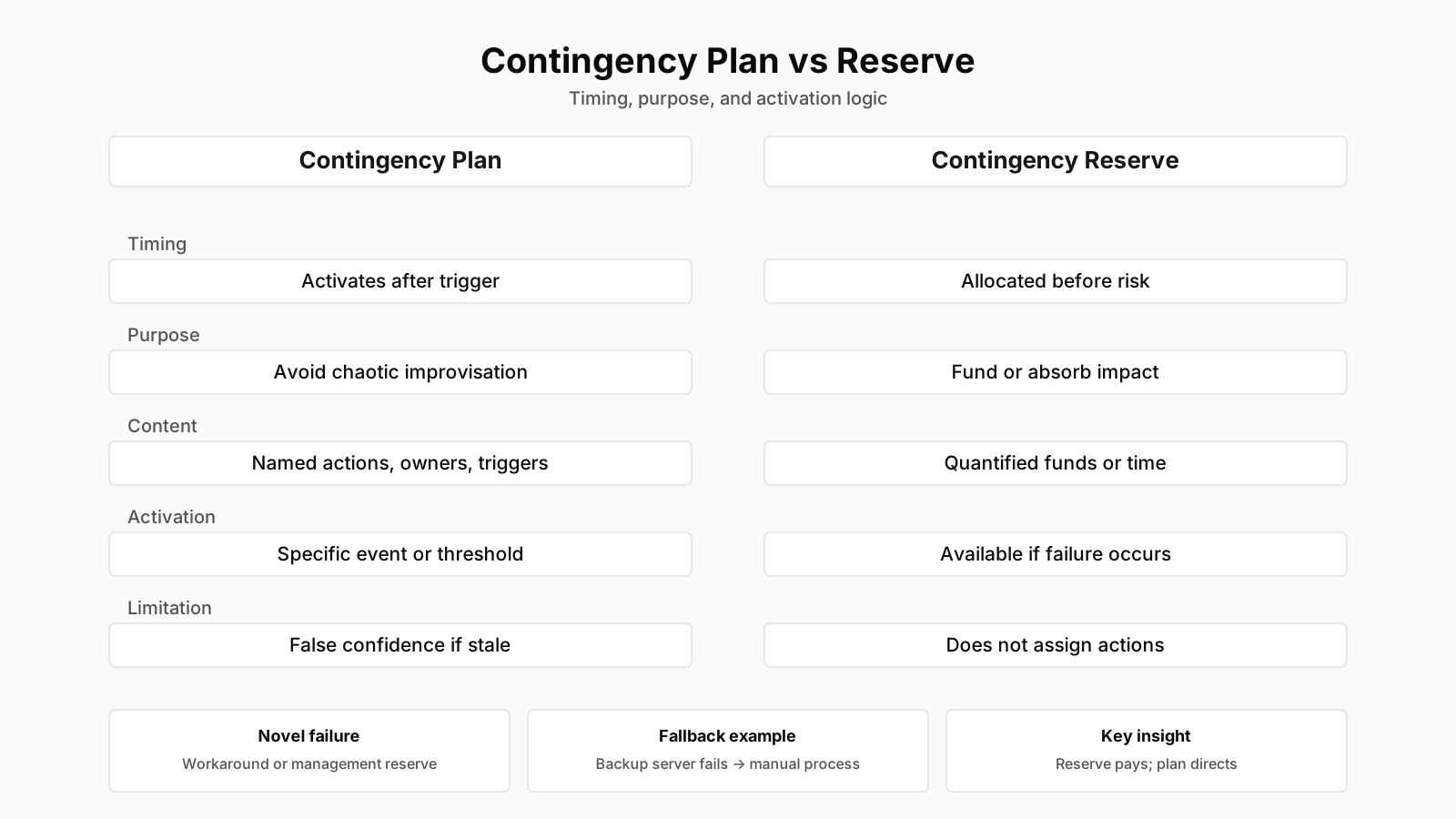
Several common misconceptions about contingency plans undermine their value. One is that writing the plan makes the risk less likely. That is false. The plan does not reduce probability unless it includes preventive elements. A second misconception is that a contingency plan equals a reserve. A financial reserve without a decision framework is just unallocated money. The plan needs triggers, owners, and actions, not just a line item in the budget.
Another common mistake is treating contingency plans as static. They are often written once during planning and never revisited. By the time the risk triggers, the named owner may have left, the alternative supplier may be out of business, or the technical fallback may no longer be compatible with the current architecture. Dormant plans create an illusion of preparedness. Regular risk reviews should validate that the trigger thresholds still make sense and the response remains feasible.
Planning Fallacies and Overconfidence
Teams frequently underestimate the cost of executing a contingency plan. They assume the fallback will be smoother than it actually is. This optimism bias comes from the same cognitive patterns that cause schedule overruns. A quality review of contingency plans should ask what could go wrong with the response itself. If the backup vendor also has capacity constraints, or the rollback script has never been tested, the plan may be more fragile than the team believes.
Practitioners often observe that the plan itself matters less than the conversation that created it. That conversation reveals hidden assumptions, conflicting priorities, and weak handoffs. But the value only persists if the plan remains connected to current project reality. Otherwise the document becomes a comfort object rather than a decision tool.
When Not to Use Contingency Plans
Not every risk warrants a contingency plan. Low-probability, low-impact risks are usually accepted without a formal response. High-probability risks may need mitigation instead of, or in addition to, a contingency plan. Risks that are better addressed through transfer, such as certain legal liabilities, may not need an operational response plan at the project level. Overplanning every risk consumes time and creates document noise that hides the few plans that truly matter. Experienced project managers often limit detailed contingency plans to a shortlist of risks with high impact and reasonable detectability.
Key Pitfalls in Contingency Planning
- Reserve without a decision framework
- A contingency reserve alone provides little operational value because funds without clear triggers, named owners, and pre-agreed response actions remain inert when disruption occurs.
- Plans decay without validation
- Plans can quickly become theoretical when named owners depart, suppliers change their terms, or technical fallbacks become obsolete, so regular validation exercises are essential to confirm that triggers and responses remain feasible.
- Execution costs are underestimated
- Readiness is often overestimated because teams assume untested rollback scripts and backup vendors with capacity constraints will perform as expected, whereas some risks may be better addressed through transfer or insurance rather than a purely operational plan.
Contingency Plans vs Related Project Management Concepts
Confusion among related risk terms is common. The distinction between contingency plans vs mitigation plans is one of timing and intent. Mitigation acts before the risk event to reduce probability or impact. A contingency plan acts after the trigger to contain the damage. A project facing a risk of vendor failure might mitigate by qualifying a second vendor and awarding a small maintenance contract. The contingency plan would specify what to do if the primary vendor still fails despite that mitigation.
Fallback plans are another related concept. In PMBOK terminology, a fallback plan is used when the contingency plan does not work as intended. If the contingency is to switch to a backup data center and that backup fails, the fallback might be to suspend processing and restore from offline archives. Most real projects blur this distinction, but the conceptual layering helps teams avoid betting everything on a single response.
Contingency Plans vs Contingency Reserves
A contingency reserve is not the same as a contingency plan. The reserve is the allocated time or money, while the plan is the set of actions and triggers that consume the reserve. A project can have a reserve without a detailed plan, which often means the money will be spent reactively and without discipline. A plan without a reserve is equally problematic because the team may have no resources to execute the response when the time comes. The two are designed together for risks that justify both.
Contingency Plans vs Business Continuity and Recovery Plans
Business continuity and disaster recovery plans operate at a different level. They focus on restoring critical business functions after a major disruption, often across the organization. Project contingency plans are narrower, tied to project objectives and deliverables. A flood that disables a data center may trigger both a business continuity plan for the organization and a project contingency plan for the delayed implementation. The two should link but not duplicate each other.
Position in the Broader Risk Management Ecosystem
Contingency plans sit within a broader risk management ecosystem that includes the risk register, risk report, issue log, change control, and reserve analysis. The risk register records the plan and its trigger. The risk report aggregates exposure for governance boards. The issue log takes over once the risk becomes an actual issue. Change control activates if the response requires baseline changes. Understanding these handoffs prevents the contingency plan from becoming an isolated document that nobody uses after approval.
Evolution and Current Thinking on Contingency Plans
The evolution of contingency planning in project management reflects a shift from static documentation toward adaptive capacity. Early predictive approaches treated contingency plans as bound documents, signed off and rarely revisited. Modern practice treats them as living decisions embedded in recurring risk reviews. Teams still write the plans, but they expect to revise triggers and resources as the project environment changes.
There is also a growing recognition that contingency planning works best when it is combined with early experimentation. Instead of only planning a response to a technical failure, teams run small-scale tests to validate the fallback before they need it. This aligns with Agile principles of early learning and fail fast. A rollback script that has never been executed is a hypothesis, not a plan. Testing it in a staging environment strengthens the contingency without waiting for the crisis.
Debates and Different Schools of Thought
Practitioners disagree about how much detail a contingency plan should contain. One school argues that too much detail creates false precision and administrative burden. The plan should be a lean decision aid, not a procedure manual. Another school, common in safety-critical industries, insists that detailed step-by-step responses are necessary because high-pressure situations degrade judgment. Both positions are defensible depending on the risk context. A nuclear facility contingency plan is very different from a marketing campaign fallback.
A second debate concerns whether contingency reserves should be visible to the project team. Some managers hide contingency reserve to prevent scope creep, while others believe transparency improves discipline. Modern governance generally favors transparent risk reserves with clear rules for access. Hidden reserves often lead to mistrust and create an incentive to invent crises to unlock extra budget.
Current best practice tends toward risk-based prioritization, tested fallbacks, clear triggers, and regular reserve reconciliation. The contingency plan is not a ceremonial document. It is a visible commitment that the team has thought about what could go wrong and has agreed on a restrained, preauthorized response. When that commitment is real, the plan reduces both the operational damage and the emotional noise that accompany project failures.
Key Insights on Contingency Plans
- Shift from static to living plans
- Contingency planning has shifted from static documents that were formally approved but seldom revisited to living decisions that are actively embedded in recurring risk reviews.
- Revision of triggers and resources
- Contemporary project teams routinely reassess and adjust contingency triggers and resource allocations as soon as the surrounding project environment changes.
- Early experimentation validates fallbacks
- Conducting small-scale tests to validate a fallback option before it becomes critical reflects Agile principles of early learning and rapid feedback.
- Detail level remains debated
- While safety-critical industries insist on detailed step-by-step responses because high-pressure situations can undermine judgment, the prevailing best practice in other sectors favors risk-based prioritization, validated fallbacks, unambiguous triggers, and routine reconciliation of contingency reserves.