Culture in Team refers to the shared set of values, assumptions, behavioral norms, and unspoken rules that shape how members of a project team interact, make decisions, resolve conflict, and perform project work. In project management, culture in team operates as an informal system beneath formal processes, schedules, and role descriptions. It influences whether a team escalates issues early or hides problems, whether members challenge a flawed estimate, and whether knowledge flows freely across functional boundaries. Unlike organizational culture, which develops over years across an entire enterprise, culture in a project team can emerge quickly because teams are often temporary and formed under deadline pressure.
Key Topics in Team Culture: Summary Table
| Definition | Summary |
|---|---|
| Team Culture | Team culture is the shared set of values, assumptions, behavioral norms, and implicit rules that shape how members communicate, make decisions, resolve conflicts, and execute work. |
| Influence on Delivery | Team culture governs whether risks surface early or remain concealed, whether unrealistic estimates are challenged, and whether expertise moves freely across functional boundaries. |
| Illustrative Example | A team with a deeply embedded culture of rigorous estimation review continues to scrutinize optimistic timelines even after the original schedule owner departs. |
| Historical Origins | Organizational culture first gained traction through organizational behavior research, while team culture emerged from subsequent studies of group dynamics and effectiveness in matrix organizations. |
| Industry Recognition | High-stakes sectors such as aviation, medicine, and the military recognized the operational impact of team culture early, because poor communication and rigid hierarchies there carry severe consequences. |
| Agile and Lean Integration | Agile and Lean methodologies incorporated team culture as a foundation for quality and adaptability, positioning it as an operational priority rather than a separate human resources concern. |
| Defining Components | The defining components of team culture rarely appear in a single documented artifact; they emerge most clearly in behavior under pressure, exposing gaps between stated values and operating assumptions. |
| BVOP Perspective | Business Value-Oriented Project Management connects team culture to delivery outcomes by mandating cross-functional teams and recognizing employee-created tools as legitimate project deliverables. |
What Is Culture in Team?
In a project management context, the culture in team definition centers on the recurring behaviors that emerge when formal rules do not specify exactly how team members should act. It is not the same as a team charter, even though a charter may describe desired values. A team may have a charter that encourages transparency while the actual culture rewards silence during status meetings. Culture is what actually happens, not what is written in a plan. Practitioners observe culture through patterns of interaction, emotional response to mistakes, speed of decision making, and tolerance for disagreement.
Culture in team is sometimes described as the personality of the project team. It is separate from individual personalities because it persists even when one member leaves or joins. For example, a project team that has developed a culture of rigorous estimation review will continue questioning optimistic durations even if the original schedule lead is replaced. This persistence is what makes culture meaningful for project outcomes. It becomes an asset when aligned with delivery goals and a risk when it reinforces avoidance, secrecy, or blame.
The term culture entered management language through organizational behavior research, where companies were analyzed as having distinct values, rituals, and stories. Project management adopted the idea later, as project teams became more cross-functional and less bound by single departments. The narrower concept of team culture grew from studies of group dynamics and team effectiveness, particularly as matrix organizations created teams whose members answered to multiple managers. In these teams, formal authority was often unclear, so informal norms became more important for coordination.
The practical importance of team culture was recognized early in aviation, medicine, and military settings, where poor communication and rigid hierarchies have serious consequences. Crew resource management in aviation trains cockpit crews to challenge authority and share critical information regardless of rank. Surgical teams use structured checklists and time-out procedures partly to reshape team culture around speaking up. In software and product development, Agile and Lean approaches imported many of these ideas, framing culture as a foundation for quality and adaptability rather than a separate human resources topic. Culture in team explained simply is the difference between what a team claims to value and what the team actually rewards when trade-offs emerge.
Key Insights on Team Culture
- Recurring behaviors define culture
- Culture is the pattern of recurring behaviors that teams develop in situations where formal rules, processes, or role definitions leave room for interpretation.
- Culture observed through interactions
- In practice, culture becomes visible through how people interact, how they respond emotionally to failure, how quickly decisions are made, and how much disagreement the team can tolerate.
- Adopted from organizational research
- The concept of culture entered mainstream management through organizational behavior research and later became part of the project management vocabulary as teams grew more cross-functional and interdependent.
- Safety-critical fields led adoption
- Safety-critical fields such as aviation, medicine, and the military pioneered applied work on team culture, while Agile and Lean approaches positioned culture as the foundation for sustained quality and adaptability.
Key Components of Culture in Team
The key components of culture in team are rarely documented in a single artifact, but they appear consistently in how people behave under pressure. These components include shared assumptions, behavioral norms, rituals, feedback patterns, trust levels, and the team’s orientation toward risk and accountability. Some components are visible, such as whether meetings start on time or how interruptions are handled. Others are hidden, such as the belief that a senior engineer’s estimate should not be challenged.
Shared Values and Assumptions
Shared values are the collective judgments about what matters most in the project. Some teams value speed over precision, while others prioritize correctness even when it delays delivery. Assumptions are deeper and often invisible. A team may assume that asking for help signals incompetence, or it may assume that raising a concern demonstrates responsibility. These assumptions shape behavior more powerfully than posted values on a wall or a statement in a team charter. A project manager may observe a disconnect between stated values and actual assumptions when team members say they support work-life balance but routinely respond to late-night messages.
Behavioral Norms and Rituals
Behavioral norms are the unwritten rules that team members follow without being told. Norms determine punctuality, interruption patterns, documentation expectations, and what happens after a missed deadline. Rituals reinforce norms. A daily standup, a recurring risk review, or a retrospective can function as a ritual that shapes how the team treats planning and learning. In some project teams, the ritual of a blame-free root cause review signals that errors will be examined as process failures rather than personal failures. In other teams, the same meeting becomes an exercise in defending individual performance. The ritual itself does not create culture; the way it is run and experienced does.
Communication and Feedback Patterns
Communication patterns are among the most direct expressions of culture in team. Some teams communicate openly across roles, while others route most information through a project manager or team lead. Feedback culture determines whether team members offer criticism early enough to prevent rework or wait until issues become severe. In project environments with strong feedback norms, a junior business analyst can question a requirement without fearing status loss. In weak feedback cultures, the same information may circulate informally but never reach decision makers. These patterns affect project performance because defects, risks, and unrealistic expectations are hidden from those who can act.
Trust, Safety, and Accountability
Trust and psychological safety are closely related but distinct components. Trust refers to the expectation that team members will keep commitments and act with competence. Psychological safety is the belief that one can speak up without being punished or embarrassed. Both are important for project teams, especially in complex work with high uncertainty. Accountability is the other side of the trust equation. A culture with high trust but weak accountability can become complacent. A culture with high accountability but low trust may produce fear-driven compliance rather than genuine ownership. Effective team cultures hold both in tension, allowing honest challenge while maintaining clear expectations for delivery.
Types and Characteristics of Team Culture
The types of team culture found in project environments vary widely, but most fall along a few recognizable patterns. Some teams develop a collaborative and learning-oriented culture. Others become competitive, hierarchical, safety-focused, or delivery-obsessed. These types are not fixed categories, and a single team may show different tendencies depending on the project phase, the leader’s behavior, and the nature of the work.
Collaborative cultures emphasize shared problem solving, open disagreement, and collective ownership. They are common in Agile software teams and cross-functional product development groups. Hierarchical cultures rely on role authority and formal escalation. They may be appropriate in highly regulated environments where compliance and audit trails are paramount. Competitive cultures reward individual visibility and outperforming peers, which can drive innovation but also reduce knowledge sharing. Safety-focused cultures prioritize risk identification and error reporting, a pattern common in construction, aerospace, and healthcare projects. Delivery-obsessed cultures measure success almost entirely by milestone completion, sometimes at the expense of quality or sustainability.
Practitioners often observe that no single type is universally better. The right culture depends on the project’s objectives, complexity, and constraints. For example, a safety-focused culture is essential on a plant turnaround project but may feel excessively cautious in a rapid prototyping effort. A competitive culture might accelerate a sales pipeline rollout but undermine a data migration requiring close cooperation. The key is alignment between culture and the work being performed.
Subcultures and Local Variations
Within a project team, subcultures often form around technical disciplines, vendors, geographic locations, or work shifts. A development subculture may value experimentation, while a finance subculture may value strict approval controls. These variations are normal, but they become risk factors when subcultures stop communicating or actively compete. Project managers and team leads often read these local norms rather than assuming the whole team shares one culture.
Core Insights on Team Culture Types
- Culture shifts with context
- A team's culture type is fluid rather than fixed, shifting with project phase, leadership style, and the specific demands of the work.
- Four recognizable culture patterns
- Project environments commonly produce four recognizable culture patterns: collaborative, competitive, safety-focused, and delivery-obsessed, each optimizing for a distinct outcome such as shared ownership, individual visibility, risk reduction, or milestone completion.
- Fit depends on project type
- The most effective culture depends on the project context: safety-first approaches fit plant turnarounds yet feel excessive in rapid prototyping, while competitive cultures energize sales pipeline work but can undermine data migrations that require close cooperation.
Culture in Team in Project Management Frameworks
In formal project management frameworks, culture in team is not usually treated as a standalone process, but it appears as an environmental and behavioral factor throughout planning, execution, and monitoring. The culture in team PMBOK perspective treats team culture as part of enterprise environmental factors and a key influence on the Develop Team and Manage Team processes. It affects how resources are managed, how conflicts are resolved, and whether performance feedback leads to improved behavior or defensive withdrawal.
Culture in Team PMBOK
Within the PMBOK framework, the Develop Team process focuses on improving competencies, team interaction, and the overall team environment. Culture is embedded in this process because team-building activities and recognition programs are only effective when they align with the actual norms of the group. The Manage Team process tracks performance and resolves issues, but its success depends on a culture that accepts feedback. If a project manager gives critical feedback in a culture that treats any critical comment as a personal attack, the formal process will not produce the intended outcome. The PMBOK also recognizes that organizational culture influences project governance and stakeholder behavior, but team culture is more immediate and malleable.
Culture in Team and PRINCE2
PRINCE2 does not explicitly define culture in team as a management product, but the methodology’s emphasis on defined roles, management stages, and exception reporting creates a particular behavioral environment. A PRINCE2 project team that internalizes the principle of management by exception may develop a culture of disciplined autonomy, where project-level decisions are made without unnecessary interference. Conversely, a team that misunderstands the framework may become overly bureaucratic, with every interaction governed by formal logs and reports. The method itself is neutral; the culture determines whether its controls feel enabling or restrictive.
Culture in Team in Agile and Hybrid Environments
Agile frameworks make team culture more explicit than traditional methods. The Agile Manifesto values individuals and interactions over processes and tools, and Scrum names five values: commitment, focus, openness, respect, and courage. These values are not simply posters; they are intended to shape daily behavior. A Scrum team’s culture determines whether sprint retrospectives uncover real process issues or become routine meetings with polite but shallow comments. In hybrid environments, culture in team becomes especially important because the team must reconcile predictive controls with adaptive delivery. A hybrid team with a high-trust culture can maintain phase gates while still responding quickly to new information. A low-trust hybrid team may use the predictive elements to protect turf and avoid accountability.
BVOP Perspective on Culture in Team
Business Value-Oriented Project Management connects culture in team to delivery through its requirement for cross-functional teams and its treatment of employee-created tools as legitimate project outputs. When team culture encourages internal tool building, BVOP recognizes those tools as formal products rather than unauthorized side work. This perspective reinforces a culture where solving a recurring problem with a small script or template is seen as value creation, not scope violation. BVOP does not position culture as a separate process, but its focus on waste reduction and stakeholder involvement assumes a team environment where people can challenge inefficient practices without fear.
Purpose and Importance of Team Culture
The importance of team culture becomes most visible during periods of uncertainty, conflict, or rapid change. Formal project plans rarely predict every interaction, and when unexpected issues arise, team members rely on shared norms rather than written instructions. A culture that encourages early escalation can prevent a minor technical issue from becoming a schedule disaster. A culture that punishes bad news can hide the same issue until it is too late to correct. This is why culture has practical consequences for schedule, cost, quality, and risk outcomes.
Culture also affects retention and motivation. Project teams often operate under intense deadline pressure. In a supportive culture, that pressure can become a source of focus and camaraderie. In a toxic culture, the same pressure produces burnout, absenteeism, and turnover. The loss of a key team member during a critical phase is not only a resource problem; it disrupts the informal knowledge network that the team relied on. Replacing that person takes longer than the staffing plan suggests because the new member must learn not just tasks but also the expected behaviors.
Another practical impact is decision quality. In a team where disagreement is normalized, estimates are stress-tested and risks are surfaced more reliably. In a team where agreement is enforced socially, the loudest or most senior voice often determines the decision, and project managers may never know that a dissenting member had critical information. This is a known pattern in project failures. Culture shapes whether technical expertise actually influences decisions or gets filtered through status and fear.
Key Insights on Culture's Role
- Culture guides when plans fail
- When formal plans cannot cover every interaction or surprise, team culture provides the shared behavioral norms that guide communication, escalation, and problem-solving.
- Culture drives project outcomes
- Culture shapes schedule, cost, quality, and risk outcomes by determining whether early warnings surface in time to protect the project, since norms that reward transparency keep minor issues from escalating while norms that punish bad news allow them to compound unnoticed.
- Supportive culture transforms deadline pressure
- A supportive culture converts intense deadline pressure into focused collaboration and mutual accountability, but the departure of a key member can fracture informal knowledge flows and extend recovery beyond what staffing plans typically anticipate.
- Social conformity silences critical dissent
- Social pressure to conform gives the loudest or most senior voice unchecked influence over decisions, and it often prevents project managers from discovering that a dissenting member held information essential to the outcome.
Practical Application and Impact on Project Execution
Culture in team does not remain an abstract concept; it shows up in daily project execution through task estimation, risk reporting, status meetings, and response to change requests. In practice, team culture in project execution determines whether a risk register contains real risks or only safe, politically acceptable entries. It also influences whether a critical path status report reflects true progress or the progress that the team believes the sponsor wants to see.
During project initiation and planning, culture forms through the way the project charter is interpreted and the team charter is created. Even the most detailed team charter cannot specify every behavior. What matters is whether senior leaders and the project manager model the stated norms. A project manager who asks for honest estimates but reacts badly to bad news will teach the team to produce optimistic estimates. This learning happens quickly and is difficult to reverse once established.
During execution, culture affects how work is coordinated. In a software project, a culture that encourages developers to pair with testers early may reduce defects. In a construction project, a culture that treats safety observations as contributions rather than complaints can lower incident rates. The project management plan may define quality checkpoints, but the culture determines whether people complete those checkpoints with rigor or treat them as administrative formalities.
Monitoring and controlling processes also depend on culture. Earned value analysis, variance reporting, and change control all rely on accurate data. A team culture that tolerates hiding bad news undermines these tools, because the numbers will eventually diverge from reality. The project manager may see a healthy cost performance index while the actual product is failing. Culture is therefore a hidden variable in project performance measurement. It can amplify or distort the value of formal control systems.
At project closure and transition, culture determines how lessons learned are captured. A team with a learning culture will produce honest retrospective insights. A team with a blame culture will produce generic statements that satisfy the process but carry no real value for future projects. This is one reason why many organizations struggle to turn post-project reviews into genuine improvement; they have created a process for learning but not a culture that rewards it.
In distributed and hybrid teams, culture is expressed through digital channels. Response times, meeting etiquette, camera usage, and the tone of written feedback become the visible artifacts. Culture in a remote team often forms more slowly because there are fewer informal interactions. A project manager may misinterpret silence on a video call as agreement when it actually reflects technological friction or cultural discomfort. This makes deliberate checking of team norms more important, even though the culture itself remains informal.
Common Challenges, Pitfalls, and Misconceptions
One of the most common misconceptions about team culture is that it is simply the sum of the leader’s stated values. Teams often hear values announced at a kickoff meeting and then observe different behavior during the first real crisis. The actual culture is formed more by what is rewarded and tolerated than by what is written. Another misconception is that a positive culture means everyone is always comfortable and agreement is frequent. In high-performing teams, discomfort is common because members challenge assumptions and demand evidence. Comfort without challenge can indicate apathy or groupthink.
A recurring pitfall is treating culture as a soft issue that can be addressed after technical matters are settled. In reality, culture is embedded in technical decisions. A team that does not trust its members will add excessive approval steps, which slows delivery. A team that fears blame will overdocument every change, consuming effort that could go to testing or stakeholder engagement. These are not separate people problems; they are direct drivers of cost and schedule variance.
Another challenge is cultural fragmentation. Large projects often bring together internal staff, contractors, vendors, and client representatives. Each group may arrive with different norms about authority, communication, and time. The project team does not automatically form a unified culture just because everyone appears on the same org chart. Misaligned norms can create friction at exactly the points where integration matters most, such as between design and construction or between development and operations.
There is also a risk of over-engineering culture. Some organizations attempt to force a specific culture through slogans, mandatory social events, or rigid behavioral scripts. These efforts often backfire because they treat culture as a deliverable rather than an emergent property of repeated interactions. Culture cannot be installed like a software update. It changes through consistent leadership behavior, incentives, and the conversations that occur when things go wrong.
Culture also should not be used to explain every project problem. When a project lacks a clear scope or has an unrealistic baseline, no cultural intervention will fix the structural issue. A team can have excellent communication and still fail because the requirements were never validated. It is important to distinguish between cultural failures and process failures, even though they often interact. Blaming culture for what is actually poor planning can create cynicism and delay the hard work of re-estimating.
Culture Myths and Costly Pitfalls
- Culture is not stated values
- A team's real culture emerges through behavior under pressure, not through values posted at kickoff meetings, and any gap between stated values and daily actions quickly erodes trust.
- Positive culture includes productive discomfort
- High-performing teams routinely create productive friction by challenging assumptions and requiring evidence, which means sustained comfort and unanimous agreement often signal stagnation rather than health.
- Culture directly affects delivery costs
- When culture is dismissed as a soft issue, teams accumulate unnecessary approval layers, overproduce documentation, and absorb avoidable cost and schedule variance, turning culture into a measurable operational risk.
Culture in Team vs Organizational Culture and Related Concepts
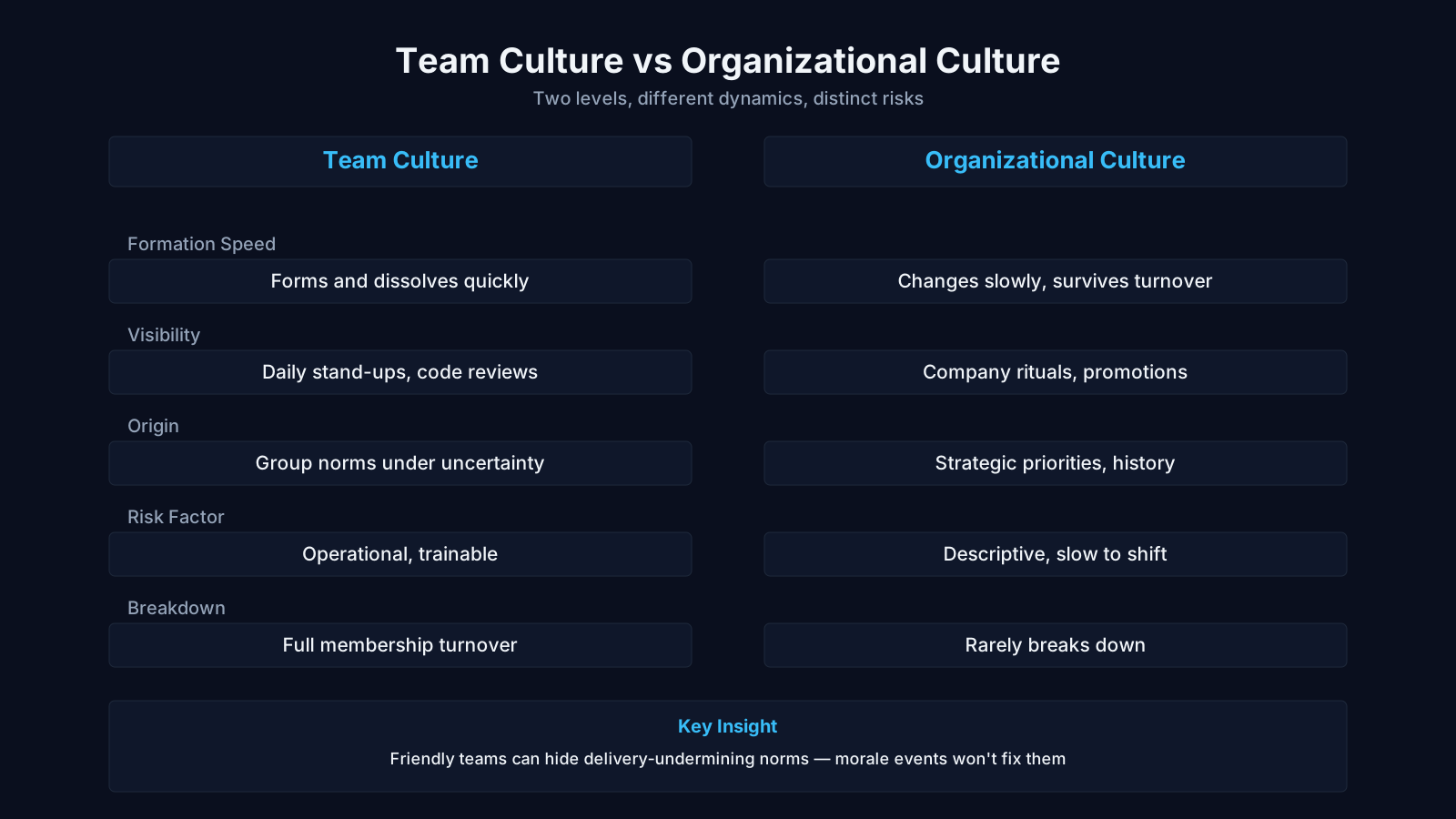
The phrase team culture vs organizational culture refers to a distinction that project managers must understand. Organizational culture is the broader set of values and practices that characterize an enterprise or business unit, such as a preference for formal approvals or a tolerance for risk. Team culture is narrower and more local. A project team inside a risk-averse organization can still develop a culture of controlled experimentation if the project leader protects the team from excessive oversight. Likewise, a team inside an innovative organization can become rigid if its internal norms reward compliance over learning.
Culture in team is also distinct from team climate. Climate is the current mood or morale of the group, which can shift after a difficult sprint or a sponsor change. Culture is deeper and more stable. A team may have a positive culture but experience a temporary drop in climate due to an unrealistic deadline. Practitioners often confuse the two because both show up in surveys and retrospectives. Culture explains why the team consistently responds to pressure in a certain way; climate captures how people feel at a particular moment.
Other related concepts include psychological safety, team norms, team charter, and group cohesion. Psychological safety is a condition that supports a learning culture but is not the whole culture. Team norms are specific rules such as no laptops in meetings or response time expectations. A team charter documents desired norms and working agreements. Culture is what happens when those agreements are tested. Group cohesion can be high even in a toxic culture if the group bonds around shared fear or rivalry with other teams. None of these concepts is interchangeable, but they influence one another.
Culture in Team vs Psychological Safety
Psychological safety is often treated as a proxy for culture, but the relationship is narrower. A team can be psychologically safe for senior engineers but not for junior testers, or safe for technical questions but not for schedule concerns. Culture captures these asymmetries across the whole team. When project managers say they want a psychologically safe team, they are usually describing one dimension of a healthy culture. That dimension matters, but it does not replace accountability, decision-making clarity, or delivery discipline.
Evolution and Current Thinking in Team Culture
Current thinking on team culture has moved away from the idea that culture is a fixed personality type that a team either has or lacks. It is now understood as a dynamic, context-dependent system that can be intentionally influenced but not mechanically controlled. Research and practice in project management increasingly tie team culture to measurable outcomes such as defect rates, schedule reliability, safety incidents, and employee retention. The conversation has shifted from superficial team-building events to the daily behaviors that leaders reinforce.
Earlier project management approaches largely treated culture as background noise. The focus was on tools, techniques, and process compliance. Agile methods changed this by placing values and interactions at the center of delivery. Distributed teams and remote work then forced another evolution, because many informal cultural signals disappeared. Project managers had to become more explicit about norms around availability, documentation, and conflict resolution. The result is a more pragmatic understanding: culture is not a luxury, but it is also not a substitute for clear scope and competent execution.
There is still debate about how much a project manager can shape culture. Some practitioners argue that culture is mostly set by senior leadership and organizational incentives, making project-level influence limited. Others point to the strong effect of immediate team leaders on local norms, especially in Agile teams where the team has more control over its own practices. The reality is likely situational. A project manager can strongly influence culture in a small, stable team but has far less control in a large, matrixed project with many contracted vendors. Recognizing this limitation prevents frustration and helps focus effort where it can have the most impact.
Another current thread is the link between team culture and diversity, equity, and inclusion. A culture that values different perspectives is more likely to surface risks and generate innovative solutions, but only if disagreement is handled constructively. Diversity without inclusion can create a polite but fragmented team. Inclusion without diversity can produce comfortable consensus. The highest-performing project teams typically combine a mix of backgrounds with norms that allow dissent and resolve it quickly.
Organizations increasingly use pulse surveys, retrospectives, and delivery metrics to monitor culture, but measuring culture remains difficult. A survey can measure climate, not culture. A retrospective can reveal a norm if the team trusts the process enough to speak honestly. Delivery metrics can hint at cultural problems when velocity is inflated or defects are consistently discovered late. Practitioners treat these signals as diagnostic data rather than definitive proof. Over-reliance on a single metric can create its own cultural distortion, such as teams gaming the metric instead of solving problems.
Core Insights on Culture Evolution
- Culture is dynamic, not fixed
- Contemporary research treats team culture as an emergent, context-sensitive system that leaders can deliberately influence, rather than a fixed trait a team simply has or lacks.
- Tied to measurable outcomes
- A growing body of project management research links cultural attributes directly to measurable performance indicators such as defect rates, schedule reliability, safety incidents, and employee retention.
- Daily behaviors matter most
- The field now prioritizes the daily behaviors that leaders consistently model and reward, recognizing that these repeated signals shape culture far more than isolated team-building activities.
- Remote work reshaped the field
- The rise of distributed teams forced a further evolution in how culture is understood, as many informal signals once transmitted through in-person interaction have disappeared and must be replaced by intentional practices.
- Influence depends on team scope
- A project manager's cultural influence is strongest within a small, stable team where daily interactions are visible, but it diminishes significantly in large, matrixed environments with multiple contracted vendors and diffuse authority.