The development life cycle in project management is defined as the sequence of phases, activities, and delivery decisions used to create and evolve the product, service, or result that a project is expected to produce. It sits inside the broader project life cycle and concerns itself with how deliverables are built, tested, reviewed, and transitioned to the customer. Governance activities such as business case approval, stage reviews, and project closure are typically external to the development life cycle. In many organizations, the term overlaps with software development life cycle, but in project management it applies to any type of project output. A clear development life cycle definition helps teams align their working approach with the level of uncertainty in the requirements.
Development Life Cycle: Key Topics at a Glance
| Concept | Summary |
|---|---|
| Definition | The development life cycle defines the ordered phases, execution activities, and delivery decisions required to build, refine, and finalize the product, service, or result that a project is commissioned to produce. |
| Scope | Nested within the broader project life cycle, it governs the practical workflow for constructing, testing, reviewing, and transferring deliverables to the customer. |
| Governance | Governance controls, including business case approval, stage gate reviews, and formal project closure, generally remain outside the development life cycle boundary. |
| Purpose | A clearly defined development life cycle enables teams to calibrate their delivery approach to the degree of uncertainty, volatility, and risk inherent in the requirements. |
| Components | Essential components comprise defined phases or iterations, tangible deliverables, formal review points, structured feedback loops, and a consistent delivery cadence. |
| Construction Example | In construction, the broader project life cycle encompasses financing, land acquisition, and commissioning, whereas the development life cycle concentrates on design, site preparation, civil works, and finishing trades. |
| Software Example | For an application that can be released in small, usable increments, the development life cycle intentionally repeats design, build, and test activities across multiple iterations to accelerate learning and value delivery. |
| Trade-offs | The selected development life cycle creates inherent tensions between flexibility and control; predictive models protect scope and cost baselines while limiting responsiveness to emerging stakeholder needs. |
What Is Development Life Cycle?
A useful answer to what is development life cycle starts by distinguishing the product creation pattern from the management wrapper around it. The development life cycle describes the logic by which work will be decomposed, sequenced, and delivered. In predictive projects that logic is linear. In adaptive projects it is cyclical. The definition usually includes how many times the team will produce intermediate versions, how feedback will be collected, and when formal acceptance occurs.
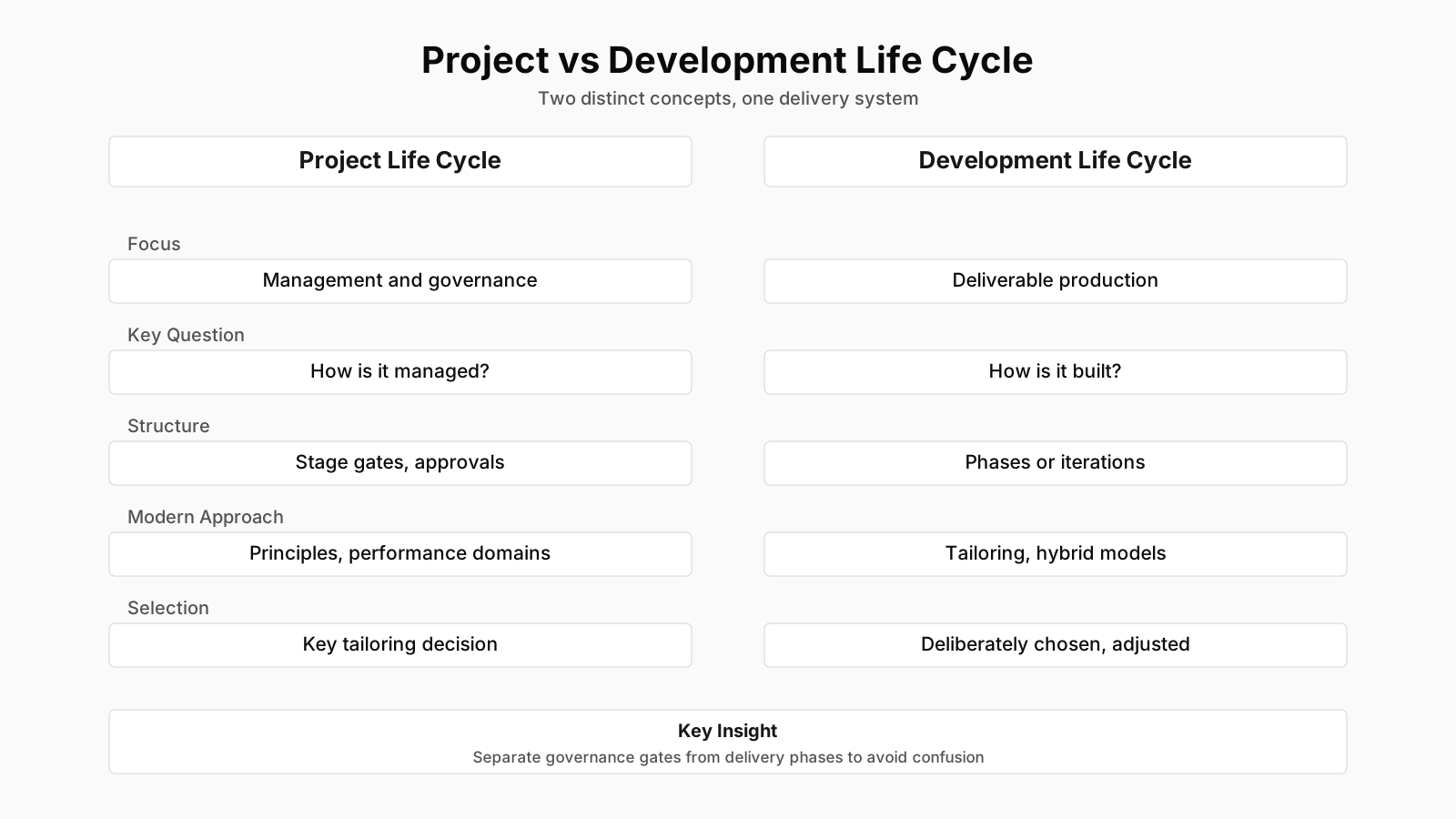
The concept is distinct from the project life cycle. A project life cycle covers the entire management journey from initial authorization to final closeout. The development life cycle, by contrast, focuses on the creation of the product itself. In a construction project the project life cycle includes financing, land acquisition, and commissioning, while the development life cycle covers design, site preparation, civil works, and finishing. This separation matters because a project may have one governance rhythm and a different delivery rhythm.
A useful way to understand this is to compare a bridge project with a mobile app project. The bridge requires most design decisions before construction begins because pouring concrete and then changing the span are prohibitively expensive. The app can be released in small usable pieces, so the development life cycle will deliberately repeat design, build, and test activities many times. The difference is not about discipline. It is about how much rework each environment can tolerate before the cost becomes unacceptable.
Core Insights on Development Life Cycle
- Decomposition and sequencing logic
- The development life cycle establishes the sequence and structure for decomposing work into manageable deliverables that build toward the final product.
- Distinct from project life cycle
- While the project life cycle covers the entire management arc from authorization through closure, the development life cycle narrows attention to the technical activities and interim outputs required to create the product.
- Linear logic in predictive projects
- Predictive projects advance through a sequential flow, locking in most design choices early because later modifications during construction carry substantial cost and rework penalties.
- Iterative cycles in adaptive projects
- Adaptive projects, including mobile app initiatives, intentionally cycle through design, build, and test activities so each iteration delivers a small, functional increment that users can validate.
Key Components of Development Life Cycle
The key components of development life cycle include phases or iterations, deliverables, review points, feedback loops, and cadence. Phases describe the major types of work, such as requirements, design, build, and test. Iterations describe repeated cycles of those activities. Deliverables mark the output that moves from one phase to another or from the team to the customer. Review points determine where decisions are made about continuing, adjusting, or stopping.
Feedback loops are especially important in adaptive life cycles. They may take the form of sprint reviews, customer demos, usability tests, or automated quality checks. Cadence refers to the rhythm of delivery and review, whether weekly, monthly, or at the end of a single long phase. These components are not always labeled the same way in every organization, but they are present in some form whenever a development life cycle is actually being managed.
Phase Definition and Delivery Cadence
Phase definition establishes what work belongs in a given stage and what conditions must be met before the next stage begins. In predictive delivery these conditions are often formal gate criteria. In iterative delivery they are more fluid, but still present as team definitions of done. Delivery cadence determines how frequently a usable version of the product is released. A project can have a fast cadence with small increments or a slow cadence with large batches. Cadence directly affects stakeholder feedback and the cost of correcting misunderstandings.
Types of Development Life Cycles
The main types of development life cycles are predictive, iterative, incremental, adaptive, and hybrid. These types exist on a spectrum from low to high change tolerance. They are not mutually exclusive in practice, and many projects combine elements from several categories. A project manager may describe the development life cycle as mostly adaptive with predictive elements for procurement or regulatory approval.
Predictive Development Life Cycle
In a predictive development life cycle, requirements are defined early, scope is baselined, and the product is delivered as a single result at the end of the sequence. The classic waterfall model is the most recognizable example. This approach works best when requirements are stable, the technology is well understood, and the cost of late changes is high. It offers strong control over scope and cost, but weak flexibility when stakeholders discover new needs.
Iterative and Incremental Development Life Cycles
Iterative and incremental life cycles are often confused. An iterative approach repeats the same development activities to refine the product through successive versions. Each iteration produces a more complete version of the same overall deliverable. An incremental approach produces the product in separate usable pieces, with each increment adding functionality that was not available before. Many teams blend both, refining existing work while adding new pieces.
Adaptive Development Life Cycle
The adaptive development life cycle combines iterative and incremental approaches and is closely associated with agile frameworks. Scope is deliberately flexible within time and cost constraints. Teams deliver working increments at a regular cadence and use feedback to adapt the next iteration. This approach accepts that requirements will evolve and treats change as a normal part of the work rather than as an exception to be managed through formal change control.
Hybrid Development Life Cycle
A hybrid development life cycle mixes predictive and adaptive elements. A project might use predictive planning for high-level design and regulatory approvals, then use iterative delivery for customer-facing features. Hybrid is common in large organizations and in industries with compliance requirements. It can create tension when governance expects fixed scope, while delivery teams need room to respond to feedback. Clear rules about which parts of the project are fixed and which are adaptable reduce that tension.
Core Summary of Life Cycle Types
- Five types on a change spectrum
- Predictive, iterative, incremental, adaptive, and hybrid life cycles form a continuum that reflects how much change a project can absorb, from minimal flexibility at one end to continuous adaptation at the other.
- Predictive favors upfront stability
- A predictive life cycle locks requirements and scope early to deliver a single fully realized product, which works best when requirements are stable and change would create significant risk.
- Iterative and incremental deliver differently
- Iterative approaches deepen quality by repeatedly refining the same product through feedback, whereas incremental approaches spread value by delivering usable portions sequentially, and many projects blend both with predictive planning to balance control and adaptability.
Development Life Cycle in PMBOK
The PMBOK definition of development life cycle focuses on the phases associated with developing a product, service, or result inside the wider project life cycle. The PMBOK Guide Sixth Edition distinguishes between the project life cycle and the development life cycle, noting that predictive and adaptive are common categories. The development life cycle PMBOK guidance also connects to the process groups, which are not phases but families of management activities applied as needed across the life cycle.
In the PMBOK Guide Seventh Edition, the term development approach appears more prominently as part of the Development Approach and Life Cycle performance domain. This shift reflects an emphasis on tailoring rather than prescribing a single model. The guide describes how delivery cadence, development approach, and life cycle should be selected based on the project's context. The underlying idea has not changed. The development life cycle is the product-focused delivery pattern, and the project manager must align it with governance, risk, and stakeholder expectations.
Tailoring the Development Life Cycle
Tailoring means selecting the life cycle characteristics that fit the work. Factors include requirements stability, delivery urgency, regulatory constraints, team distribution, and stakeholder availability. A medical device project with fixed compliance milestones will likely use a predictive sequence for validation. A digital service with evolving user needs will likely use short iterations. Tailoring is not a one-time choice. Teams can adjust the development life cycle at phase boundaries if the risk profile changes.
Development Life Cycle in PRINCE2
PRINCE2 does not mandate a specific development life cycle. The method separates the management of a project from the technical delivery approach. The development life cycle in PRINCE2 is therefore a delivery decision made within the framework's processes. PRINCE2's processes, themes, and management stages can accommodate predictive, iterative, or hybrid delivery. This design allows the method to govern projects in many industries.
The key interface is the work package. A work package defines a chunk of work assigned to a team manager. Inside that work package, the team may run sprints, iterations, or a linear sequence of tasks. PRINCE2 stays concerned with tolerances, stage boundaries, and product quality, not with how the team arranges its daily work. PRINCE2 Agile explicitly supports this integration by adding agile concepts to PRINCE2 governance without replacing it.
Management Stages and Delivery Cadence
Management stages in PRINCE2 are governance periods approved by the project board. They do not need to match development iterations. A single management stage may contain many sprints. Alternatively, a single phase of development may cross a management stage boundary if the board needs a decision point. This separation lets governance operate at a cadence appropriate to senior stakeholders, while delivery operates at a cadence appropriate to the work itself.
Core Insights on Delivery Flexibility
- No mandated delivery life cycle
- PRINCE2 deliberately avoids mandating any single development approach, allowing the project team to select predictive, iterative, or hybrid delivery based on context and product characteristics.
- Governance and delivery separation
- By separating management governance from technical delivery, the framework enables senior stakeholders and delivery teams to operate at distinct cadences without creating control gaps.
- Flexible delivery within work packages
- Within individual work packages, teams can run sprints, iterations, or linear task sequences while PRINCE2 preserves control over tolerances, stage boundaries, and product quality.
- PRINCE2 Agile integration support
- PRINCE2 Agile integrates agile techniques into the existing governance framework without displacing it, allowing controlled adoption of agile practices across projects.
Development Life Cycle in Agile and Hybrid Environments
In agile environments, the development life cycle is adaptive and delivery is organized around short feedback loops. Scrum uses fixed-length sprints that produce a potentially releasable increment. Kanban uses a continuous flow model with work-in-progress limits and frequent releases. The development life cycle in Agile is not a rigid phase sequence. It is a repeating loop of planning, execution, review, and adaptation. That loop continues until the product owner decides that enough value has been delivered or the project reaches its time boundary.
Hybrid environments introduce elements of predictive control around an adaptive core. A common pattern is a predictive feasibility phase followed by agile delivery sprints. Another pattern is an agile team working inside a fixed contract with defined milestones. These combinations often emerge from real organizational constraints rather than from a pure methodology preference. The challenge is to keep the adaptive feedback loop alive while satisfying the predictive governance gates.
Scrum, Kanban, and Continuous Delivery
Scrum formalizes the development life cycle through events such as sprint planning, daily scrums, sprint review, and sprint retrospective. Each sprint is both an iteration and a potential increment. Kanban does not prescribe iterations, but it still involves a development life cycle through the flow of work items from backlog to done. Continuous delivery extends the adaptive pattern by automating release steps so that increments can reach users with minimal delay. These approaches all share the assumption that short cycles reduce the risk of building the wrong product.
Purpose and Importance of Development Life Cycle
The purpose of development life cycle is to match the delivery model to the nature of the work and the acceptable level of uncertainty. When the life cycle fits, the project spends less effort on rework and more on value. When it does not fit, teams either freeze scope too early or iterate without enough structure. The development life cycle also shapes how estimates are produced, how quality is measured, and how stakeholders understand progress.
The life cycle is important because it sets expectations about when value will be delivered. A predictive life cycle tells stakeholders that the main benefits arrive at the end. An adaptive life cycle tells them that benefits will arrive progressively. That difference influences funding, resource planning, and the type of business case that can be approved. Projects that ignore this reality often face disappointed stakeholders even when the technical work is on track.
Impact on Risk and Change Control
A predictive development life cycle attempts to reduce uncertainty by locking down requirements early. That reduces the risk of scope creep but increases the risk of delivering an obsolete product. An adaptive development life cycle accepts higher levels of change and manages risk through short cycles and frequent inspection. Neither approach eliminates risk. Both simply place risk in different parts of the project. Change control is formal in predictive work and informal in adaptive work, but both require a mechanism for deciding what enters the next cycle of work.
Core Insights on Life Cycle Fit
- Matching model to uncertainty
- Selecting a life cycle is less about process preference and more about calibrating delivery to the actual uncertainty in the work; this alignment reduces costly rework and allows teams to direct their energy toward producing value.
- Shaping project practices
- The chosen life cycle establishes the cadence and methods for estimation, quality assurance, and progress reporting, shaping what stakeholders can reasonably expect to see at each stage.
- Setting value delivery expectations
- A predictive life cycle signals that the primary benefits are realized once the final deliverable is complete, whereas an adaptive life cycle releases value in frequent increments; this expectation influences how funding is staged, how resources are allocated, and the type of business case leadership will approve.
- Managing change and risk
- Predictive work relies on formal change control to protect the baseline, while adaptive work treats change as a normal part of each iteration; both still require a clear gate for deciding what enters the next cycle, and adaptive cycles use short feedback loops and frequent inspection to contain risk early.
Practical Application of Development Life Cycle
The practical application of development life cycle typically begins during project planning, after the business case and stakeholder needs are understood well enough to choose an approach. A construction manager will rarely choose an adaptive life cycle for structural steel. A digital product team will rarely choose a fully predictive life cycle for a new user-facing service. The application shapes the schedule, the work breakdown structure, the procurement documents, and the communication plan.
Organizations often apply a development life cycle differently depending on the contract type. Fixed-price contracts push teams toward predictive scope control. Time and materials contracts allow more adaptive behavior. Internal projects may choose a life cycle based on team capability and the maturity of the product area. In practice the decision is not purely technical. It is also commercial and political.
Business Value-Oriented Considerations
Business value-oriented project management methods add another layer to this decision. BVOPM treats scope change as user feedback rather than failure and uses a five-level scope scale from definite to unlikely. That perspective aligns naturally with adaptive life cycles, where evolving needs are expected. BVOPM also warns that work breakdown structures can carry inaccuracy when early planning is exploratory, which encourages teams to adjust plans as the development life cycle reveals better information.
Common Challenges, Pitfalls, and Misconceptions
One of the most common misconceptions about development life cycle is that it is the same as a project management methodology. A methodology such as PRINCE2 or PMBOK provides management processes, while the development life cycle describes the product creation pattern. Another misconception is that predictive means no feedback and adaptive means no planning. Predictive projects still use reviews and testing, and adaptive projects still require enough planning to coordinate teams and resources.
A frequent pitfall is selecting a life cycle because it is popular rather than because it fits the work. Some organizations impose agile terminology on highly regulated deliverables without adjusting their governance. Others insist on predictive documentation for exploratory product work. Both failures produce friction. Another pitfall is running iterations without producing usable increments. That creates the appearance of agility while delaying the feedback that adaptive life cycles exist to capture.
When a Chosen Life Cycle Creates Friction
Friction appears when the development life cycle fights the surrounding environment. A test team organized for one large release will struggle to support weekly increments. A procurement unit that needs fully specified contracts will not support an agile team that discovers requirements mid-project. These dependencies mean the life cycle cannot be chosen in isolation. Senior leadership may need to adjust adjacent processes, not just ask the project team to adopt a different rhythm.
Essential Insights on Life Cycle Pitfalls
- Life cycle vs methodology distinction
- A development life cycle defines the sequence and shape of product creation, whereas methodologies such as PRINCE2 and PMBOK provide the management processes, and conflating the two is a frequent source of project confusion.
- Predictive and adaptive myths
- Predictive life cycles still build in feedback through structured reviews and testing, and adaptive life cycles still rely on initial planning to align teams, resources, and delivery expectations.
- Fit over popularity
- The most effective teams choose a life cycle for its fit with the specific work, constraints, and risk profile rather than adopting a model simply because it is fashionable.
- Governance and adjacent processes
- Applying agile vocabulary to regulated projects without adjusting governance does not accelerate delivery; it simply delays feedback, and supporting functions such as testing, procurement, and senior leadership must recalibrate their own processes to match the chosen rhythm.
Development Life Cycle vs Project Life Cycle
The development life cycle vs project life cycle distinction is a recurring source of confusion in project management. The project life cycle is the full set of phases from project start to project closure. It typically includes phases such as initiation, planning, execution, monitoring, and closure, although organizations define their own phase names. The development life cycle is nested inside this larger structure and concentrates on the creation and refinement of the product.
A single project life cycle can contain more than one development life cycle. In a large program, one subproject may build a physical asset predictively, while another develops a customer portal adaptively. Both sit inside the same overall project governance. This nesting also appears in hybrid projects. The key point is not that one is superior. They answer different questions. The project life cycle answers when and how the project is controlled. The development life cycle answers how the deliverable is built.
How the Two Life Cycles Interact
The interaction appears most clearly at phase gates. A business case approved during project initiation may assume a predictive delivery with a fixed scope. If the development life cycle later evolves into an adaptive approach, that change may require revisiting the business case and risk register. Conversely, an adaptive development team may need to pause delivery at a management stage boundary so that a steering committee can approve continued funding. These points of contact are where many projects experience tension. Recognizing the two life cycles as separate but linked helps managers plan those interactions deliberately.
Relationships to Other Project Management Concepts
The development life cycle and other project management concepts interact through planning artifacts and control processes. The work breakdown structure, schedule, milestones, quality plan, and risk register all derive part of their structure from the chosen life cycle. In predictive work, the WBS is usually decomposed to low levels before build begins. In adaptive work, the WBS may remain high level for upcoming work and become detailed only for the current iteration.
Rolling wave planning is closely related. Predictive life cycles use rolling wave planning less often because the full plan is created early. Adaptive life cycles use rolling wave planning continuously, since details are known only for the near term. This means the development life cycle affects how much of the plan is committed and how much remains provisional.
Development Life Cycle and Milestones
Milestones mark significant events or decisions. In a predictive life cycle, milestones often align with phase exits. In an adaptive life cycle, milestones may align with release boundaries or increments. Either way, milestones provide the external visibility that stakeholders need. They are not a substitute for the life cycle itself. They are points of measurement on top of it.
Key Insights on Life Cycle Planning
- Life cycle shapes planning artifacts
- The selected development life cycle directly determines the structure and sequencing of the work breakdown structure, schedule, milestones, quality plan, and risk register.
- Predictive versus adaptive detail levels
- Predictive life cycles decompose the work breakdown structure into detailed lower-level components before the build phase starts, whereas adaptive life cycles keep future work at a high level and provide granular detail only for the current iteration.
- Rolling wave planning and milestones
- Predictive life cycles apply rolling wave planning selectively because the complete plan is established early, whereas adaptive life cycles apply it continuously because only near-term details are known at any point; in both cases, milestones give stakeholders the external visibility needed to track progress and align expectations.
Evolution and Current Thinking
The evolution of development life cycle thinking has moved from a preference for linear control toward context-driven selection. Early project management in construction and defense favored predictive models because the work was physical, sequential, and well understood. The software industry later challenged that assumption, showing that iterative and incremental delivery could reduce risk in environments with volatile requirements. Agile frameworks then popularized the adaptive life cycle beyond software.
Current thinking recognizes that most real projects are hybrids. The pressure for faster value delivery has pushed more organizations toward shorter cycles, but regulatory and contractual realities frequently require predictive artifacts. At the same time, product-oriented delivery blurs the boundaries between projects and ongoing product development. Teams may run continuous discovery and delivery cycles long after the initial project has closed. This evolution has led PMBOK and other standards to place more emphasis on tailoring and less on rigid life cycle categories.
Current Debates in Development Life Cycle Selection
There is no universal agreement on the best development life cycle. One school of thought argues that adaptive approaches are more honest about complexity and human learning. Another argues that predictive approaches remain necessary whenever safety, compliance, and fixed budgets dominate. The debate often comes down to where uncertainty lives. If uncertainty is primarily in requirements, feedback loops help. If uncertainty is primarily in execution risk, upfront engineering and sequencing may help more. Practitioners increasingly describe the choice as a portfolio of trade-offs rather than a battle between good and bad methods.