In project management, a cost baseline is the approved, time-phased project budget that excludes management reserves and serves as the reference point for measuring and controlling cost performance. It represents the cumulative expected cost of authorized work, distributed across the project calendar, and it is an essential input for earned value analysis and forecasting. The cost baseline is not a rough estimate, nor is it the total amount of money available to the project. It is a controlled artifact that can be changed only through formal change control.
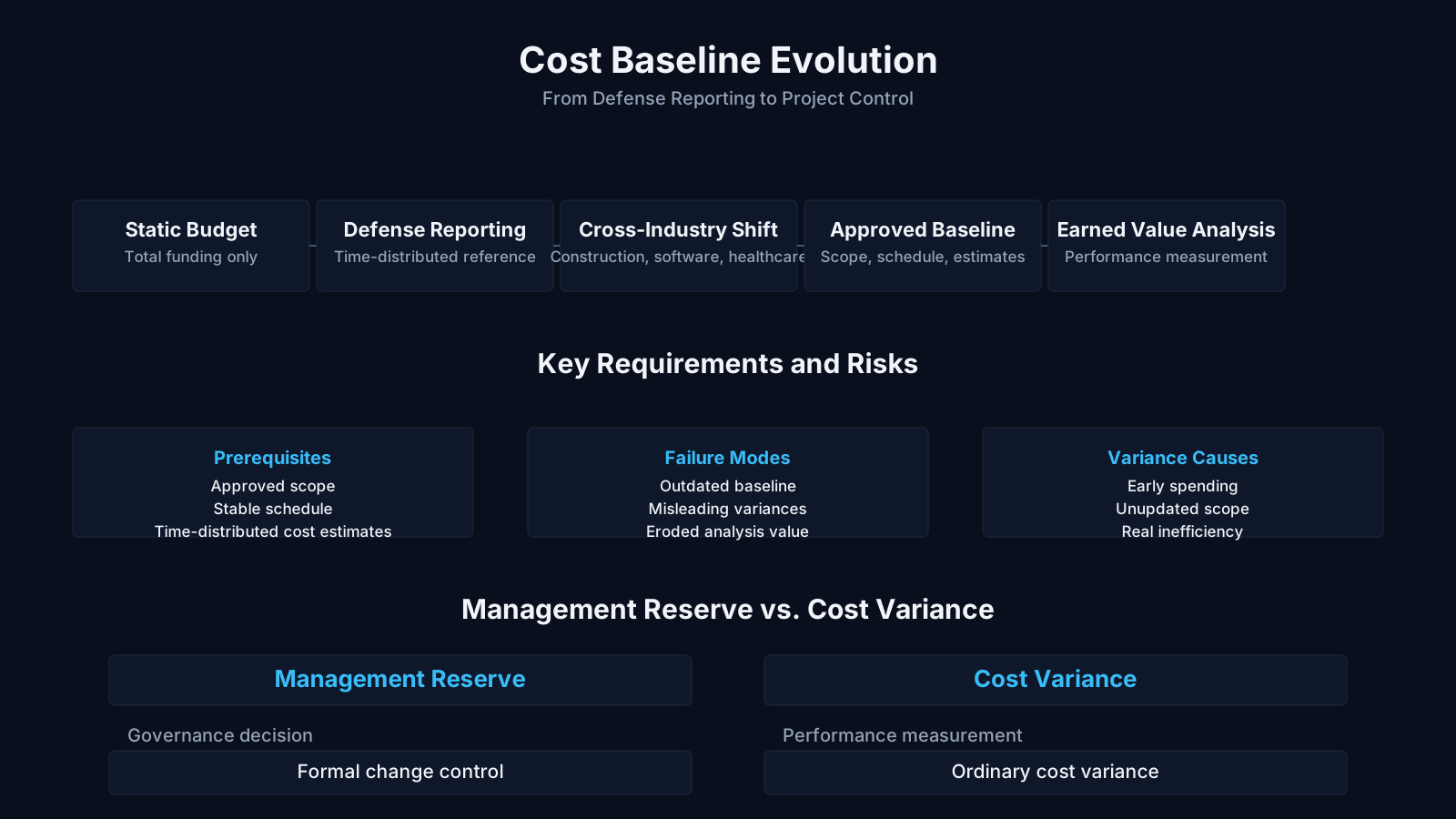
Cost Baseline: Key Topics at a Glance
| Key Concept | Summary |
|---|---|
| Cost Baseline | The cost baseline is the approved, time-phased project budget. It excludes management reserves and provides the authoritative reference for measuring, monitoring, and controlling cost performance. |
| Time-Phased Budget | By distributing cumulative expected costs across the project calendar, the baseline establishes clear spending targets for each period of authorized work and supports early detection of cost variances. |
| Primary Purpose | As a core input to earned value analysis and forecasting, the cost baseline enables objective performance measurement and gives early warning of accelerated budget consumption before it becomes critical. |
| Management Reserves | Management reserves cover unknown or unidentified risks. They remain outside the cost baseline and are governed separately, preserving the baseline as a stable measure of planned work. |
| Core Components | A cost baseline comprises approved cost accounts, their time-phased values, and contingency reserves tied to identified risks, providing a complete and traceable financial plan. |
| Variance Control | When actual costs in a control account exceed planned values, the project manager can examine the underlying work packages to identify root causes and take corrective action early. |
| Tolerance Management | Under PRINCE2, variances from the baseline are managed within predetermined tolerances, allowing controlled corrective action while preserving confidence in the overall plan. |
What Is Cost Baseline in Project Management?
The cost baseline definition centers on approval and timing. When a project schedule and budget have been integrated, the cost baseline becomes the time-phased statement of what the project expects to spend on authorized work periods. This baseline creates a clear dividing line between planned cost performance and actual cost performance. Without it, a project team can easily drift into spending money at a rate that looks acceptable month by month but is silently consuming the entire budget too early.
What does time-phased budget really mean? A conventional budget may say that a project will cost two million dollars, but it does not say when the money will be spent. A time-phased budget spreads that two million dollars across months or quarters according to the schedule. A construction project may expect to spend more during the structural phase than during permitting. The cost baseline captures that pattern, which is why it often appears as an S-curve when plotted cumulatively.
Cost Baseline Definition
Within formal project management standards, the cost baseline is defined as the approved version of the time-phased project budget, excluding any management reserves. It is used as the basis for comparing actual costs to planned costs. The definition is precise because the baseline is not simply an estimate. It has passed through review, negotiation, and approval. Once approved, it becomes a committed plan for the authorized scope.
The cost baseline includes all approved cost accounts for the project work. It also includes contingency reserves set aside for identified risks. Those reserves are part of the baseline because they are tied to known uncertainty within the approved work. Management reserves, which address unknown or unidentified risks, sit outside the baseline and are handled through a different governance mechanism.
Time Phasing and the S-Curve
Time phasing is what distinguishes a cost baseline from a static budget. The baseline assigns expected costs to specific time periods, usually months or quarters, based on the project schedule. When those cumulative amounts are plotted over time, the result is typically an S-curve. Spending starts slowly during mobilization, accelerates as execution peaks, and then tails off during closure.
The S-curve is useful because it gives a visual shape to cost expectations. A project that is spending far above the curve early on may be burning through contingency faster than anticipated. A project that stays below the curve is not automatically healthy, since it could also signal delayed work. The baseline therefore provides both a financial reference and a schedule-cued warning system.
Core Takeaways on Cost Baselines
- Time-phased approved budget
- The cost baseline translates the approved budget into time-phased spending, so stakeholders can see exactly when funds are expected to be consumed across authorized work periods.
- Planned versus actual comparison
- By establishing a clear reference point between planned and actual cost performance, the baseline helps teams detect early budget consumption and take corrective action before variances escalate.
- Excludes management reserves
- Management reserves for unidentified risks remain outside the cost baseline, so any use of these funds requires a separate governance approval rather than routine project spending.
Key Components of a Cost Baseline
The key components of a cost baseline are the approved cost accounts, their time-phased values, and the contingency reserves associated with identified risks. These components roll up from detailed work package estimates into control accounts. The baseline is not a single number. It is a structured aggregation of many cost elements distributed across the project timeline.
Each control account has a budget that can be tracked independently. The control account owner is responsible for delivering the work within that budget. When control account budgets are summed, they form the total cost baseline. This hierarchical structure means that cost performance can be examined at the work package level, the control account level, or the project level.
Control Accounts and Work Packages
A work package is the lowest level of the work breakdown structure where cost and schedule can be reliably estimated. Work packages are grouped into control accounts, which serve as management points for performance measurement. The cost baseline assigns budgets to these control accounts and spreads them over time according to when the work is planned.
This structure keeps cost control practical. A project manager does not need to review every expense line item every day. Instead, control accounts provide a sensible level of aggregation. If a control account starts to exceed its planned value, the project manager can investigate the work packages beneath it to understand what is happening.
Contingency Reserves and Management Reserves
Contingency reserves are funds set aside for known project risks, such as weather delays, supplier price changes, or rework on uncertain components. These reserves are included in the cost baseline because they belong to the approved scope of work under conditions of identified uncertainty. They are not extra profit or hidden padding. They are part of the realistic cost of delivering the project.
Management reserves are different. They are held outside the baseline for unidentified risks or broad management discretion. The project budget includes management reserves, but the cost baseline does not. If a manager decides to use management reserve for unforeseen work, that amount must be moved into the baseline through a formal change request. The baseline then expands, and the change is documented.
Cost Baseline in PMBOK and Other Frameworks
The cost baseline in PMBOK terms is an output of the Determine Budget process within the Project Cost Management knowledge area. It is created during the planning process group and becomes part of the project management plan. The baseline depends on the scope baseline and schedule baseline because cost, scope, and time must remain integrated.
PMBOK treats the cost baseline as one component of the performance measurement baseline. The other components are the scope baseline and the schedule baseline. Together, these three baselines give the project team a complete picture of what work should be done, when it should be done, and how much it should cost.
Cost Baseline in PMBOK
In the PMBOK framework, Determine Budget aggregates the estimated costs of individual activities or work packages to establish an authorized cost baseline. This process also considers funding limit reconciliation. If the natural spending pattern conflicts with available funding periods, the schedule or the spending profile may need adjustment before the baseline is approved.
The cost baseline is then used throughout monitoring and controlling. Earned value management relies on the baseline as the planned value curve. Cost variances, schedule variances, and performance indexes all derive meaning from their comparison to the baseline. Without an approved cost baseline, these measures have no reference point.
Cost Baseline in PRINCE2
PRINCE2 does not use the exact term cost baseline as frequently as PMBOK, but the concept is present in its baseline management product and its Plans theme. A PRINCE2 baseline is a snapshot of an approved plan that is retained for comparison with actual progress. Project plans and stage plans include cost information, and tolerance limits define how much cost deviation is acceptable before escalation.
In PRINCE2, the project board sets cost tolerances. If a stage or project is forecast to exceed its cost tolerance, an exception report is triggered. The baseline remains the approved reference, but PRINCE2 is explicit that deviations can be managed within predetermined tolerances without suggesting that the original plan was meaningless. This is a practical way to avoid overreacting to minor variances.
Agile and Hybrid Contexts
Key Takeaways on Cost Baselines
- PMBOK cost baseline definition
- Within PMBOK, the cost baseline is the approved output of the Determine Budget process and is incorporated into the project management plan as the authorized time-phased budget.
- Integrated with scope and schedule
- The cost baseline is derived from the scope and schedule baselines; together these three elements form the performance measurement baseline that links completed work, timing, and cost in a unified control framework.
- PRINCE2 tolerance-based approach
- PRINCE2 controls cost deviations through pre-agreed tolerance limits rather than continuous rebaselining, allowing controlled variance within defined boundaries and requiring escalation only when those limits are exceeded.
How a Cost Baseline Is Developed and Approved
Cost baseline development begins with the aggregation of detailed cost estimates. Each work package or activity estimate is rolled up into control accounts, and those control accounts are summed to create the total cost baseline. The estimates must be tied to the work breakdown structure and the project schedule so that costs can be distributed over time.
Development also requires reconciliation with funding limits. An organization may not be able to fund the project at the exact rate the schedule would naturally demand. If spending peaks too early, the project may need to be rescheduled or re-sequenced. The baseline must be both cost-realistic and financially feasible within the organization's funding constraints.
From Estimates to Baseline
Activity cost estimates are inputs, not the baseline itself. They become part of the baseline only after they are aggregated, time-phased, and approved. This step is significant because estimates often change during planning. Risks, resource availability, and schedule refinements all influence the final baseline.
The baseline is not simply the sum of initial estimates. It includes contingency reserves and reflects decisions about scheduling and procurement. A good baseline is built from the approved scope baseline and schedule baseline. Cost, scope, and schedule must align. If the schedule shifts, the time distribution of cost must shift as well.
Approval and Change Control
Once the cost baseline is approved, it becomes subject to integrated change control. Changes to the baseline require a formal change request. This does not mean the baseline can never change. It means changes are deliberate, documented, and approved by the appropriate authority. The baseline should be updated when approved scope or schedule changes affect cost.
Re-baselining is a specific type of change where the entire baseline is reset. This happens when the original baseline is no longer useful for performance measurement, often after a major scope change or a fundamental shift in project objectives. Re-baselining should not be used simply to hide poor performance. When done too often, it erodes confidence in project reporting.
Common Challenges and Misconceptions About Cost Baselines
Many cost baseline misconceptions come from treating the baseline as a forecast, a funding document, or a static number. In reality, the cost baseline is a controlled reference that can change through formal processes. It is not the same as the project budget, and it is not a guarantee that actual costs will match planned costs.
Another misconception is that staying under budget is always good. A project can be under the baseline because work is late or quality has been reduced. The baseline only measures cost performance when it is viewed alongside scope and schedule performance. Cost variance without schedule variance tells an incomplete story.
The Precision Illusion
Some organizations treat the cost baseline as if it were accurate to the dollar. This is a dangerous illusion. Every baseline is built on estimates, assumptions, and risk judgments. The apparent precision of a detailed baseline can hide the uncertainty underneath. A project manager should know which parts of the baseline are solid and which are soft.
The precision illusion often appears when teams spend too much effort refining minor line items while ignoring large uncertainties. A fifty-dollar travel estimate may be precise, but a one-million-dollar scope assumption may be fragile. The baseline is most useful when its major drivers are understood and monitored, not when every minor figure has been polished.
Baseline Discipline and Agile Tension
There is a natural tension between baseline discipline and agile responsiveness. Predictive environments value a stable baseline because it enables clear performance measurement. Agile environments value responding to change, which can make a fixed cost baseline feel restrictive. Neither view is universally correct. The challenge is to match the baseline approach to the project context.
In some agile projects, teams abandon the cost baseline entirely and rely on increment funding or run rate monitoring. That can work when scope is genuinely fluid and value delivery is tracked through product metrics. But even agile projects need some financial boundary. The most mature hybrid approaches keep a high-level cost baseline while allowing scope flexibility inside delivery cycles.
Key Insights on Baseline Misconceptions
- Baseline is not a forecast
- The cost baseline functions as a controlled reference that is updated only through formal change control, and it should not be treated as a forecast or a funding document.
- Separate from project budget
- The cost baseline establishes the approved cost expectation but offers no assurance that actual costs will remain aligned with planned amounts, since the project budget may include different assumptions and reserves.
- Under baseline signals trouble
- A favorable cost variance can result from delayed work or reduced quality, so spending under the baseline should be investigated rather than automatically treated as a positive signal.
- Contextualize with scope and schedule
- Cost performance becomes meaningful only when the baseline is analyzed together with scope and schedule performance, because cost alone cannot reveal whether the right work is being delivered on time.
- Precision illusion hides uncertainty
- Highly detailed estimates can create a misleading impression of precision, so project managers should identify which baseline components are well supported and which are uncertain, instead of investing excessive effort in refining minor line items.
Evolution and Current Thinking on Cost Baselines
Cost baseline best practices have evolved from static annual budgets toward more dynamic, integrated performance baselines. Modern project management tools allow baselines to be updated in near real time, with changes tracked and visualized. This does not mean the baseline loses its control function. It means the baseline can be maintained with less administrative burden.
Current thinking also emphasizes the baseline as part of a broader performance measurement baseline. Cost cannot be managed in isolation from scope and schedule. The most useful baselines are those that help teams understand trade-offs. A cost overrun may be acceptable if it buys schedule acceleration or higher value delivery, but that decision must be made consciously.
Performance Measurement Baseline and Digital Tools
The performance measurement baseline integrates scope, schedule, and cost into a single management framework. Digital project management tools have made it easier to maintain this integration. Changes to a schedule automatically update the time-phased cost profile. Dashboards show variances against the baseline in real time.
These tools also create a subtle risk. When the baseline is too easy to update, it can lose its role as a stable reference. Effective organizations still require approval before baseline changes, even when the software supports rapid updates. The baseline is meant to anchor performance measurement, not to shift with every minor fluctuation.
BVOP and Value-Oriented Baselines
BVOP, Business Value-Oriented Project Management, approaches baselines with a focus on value rather than pure cost control. It uses relational effort points in some planning contexts and warns against depending too heavily on a detailed work breakdown structure for baseline accuracy. BVOP also treats scope change as user feedback across a five-level scale, from Definite to Unlikely, rather than as an automatic failure of baseline discipline.
This perspective is useful in environments where business value shifts quickly. A cost baseline that is too rigid can block valuable changes simply because they were not in the original plan. BVOP does not discard the baseline, but it keeps the emphasis on outcomes. The cost baseline becomes one reference among several, not the sole judge of project health.
The cost baseline remains a foundational artifact in project cost management. It is the approved time-phased budget that gives meaning to cost performance, enables forecasting, and supports governance. Understanding what it includes, what it excludes, and how it interacts with other baselines is essential for anyone managing projects with financial accountability.
