A cross-cultural communication model is defined as a structured framework for understanding, predicting, and interpreting how cultural values and assumptions shape the way people exchange information, make decisions, and resolve disagreements in a project environment. In project management the term refers to a family of related models rather than one universal standard. Project managers, program managers, and team leaders use these models to adapt communication plans, stakeholder engagement approaches, and team collaboration practices when the work crosses national, regional, organizational, or professional boundaries.
The core idea behind these frameworks is that communication failure in projects is rarely just about language fluency. It is also about context, hierarchy, directness, time orientation, and the unspoken rules that govern trust and challenge. A project manager who understands these models can read weak signals more accurately, design safer feedback loops, and avoid interpreting culturally driven behavior as personal resistance or incompetence.
Cross-Cultural Communication Model: Key Topics Summary
| Key Concept | Summary |
|---|---|
| Model Definition | A cross-cultural communication model is a structured analytical framework for diagnosing how culturally embedded values and assumptions shape information exchange, decision authority, and conflict resolution within project environments. |
| Practitioner Usage | Project managers, program managers, and team leaders apply these models to refine communication plans, stakeholder engagement strategies, and collaboration protocols when teams operate across national, organizational, or professional cultures. |
| Practical Benefits | Leaders who apply these models are better equipped to detect subtle behavioral signals, design psychologically safe feedback loops, and avoid misreading culturally driven reserve as personal resistance or limited capability. |
| Plan Distinction | While a communication plan specifies channels, cadence, and audiences, a cross-cultural communication model clarifies the underlying expectations that determine whether those channels are trusted, whether feedback is direct or indirect, and whether silence signals agreement or unresolved concern. |
| Hall's Framework | Edward T. Hall introduced the distinction between high context and low context communication while working with the U.S. Foreign Service Institute in the mid twentieth century, establishing the basis for systematic cross-cultural analysis. |
| Field Applications | Diplomacy, international business, medicine, aviation, and military operations have operationalized cross-cultural communication concepts to reduce misunderstandings in high stakes, time sensitive environments. |
| Globalization Impact | The expansion of outsourcing, offshoring, and globally distributed program delivery made cross-cultural communication models central to interpreting schedule commitments, risk disclosures, requirements ambiguity, and stakeholder escalation patterns. |
| Power Distance | In low power distance cultures, team members are more likely to challenge a sponsor or project manager directly and expect that constructive dissent will be accepted as a routine part of decision making. |
What Is a Cross-Cultural Communication Model?
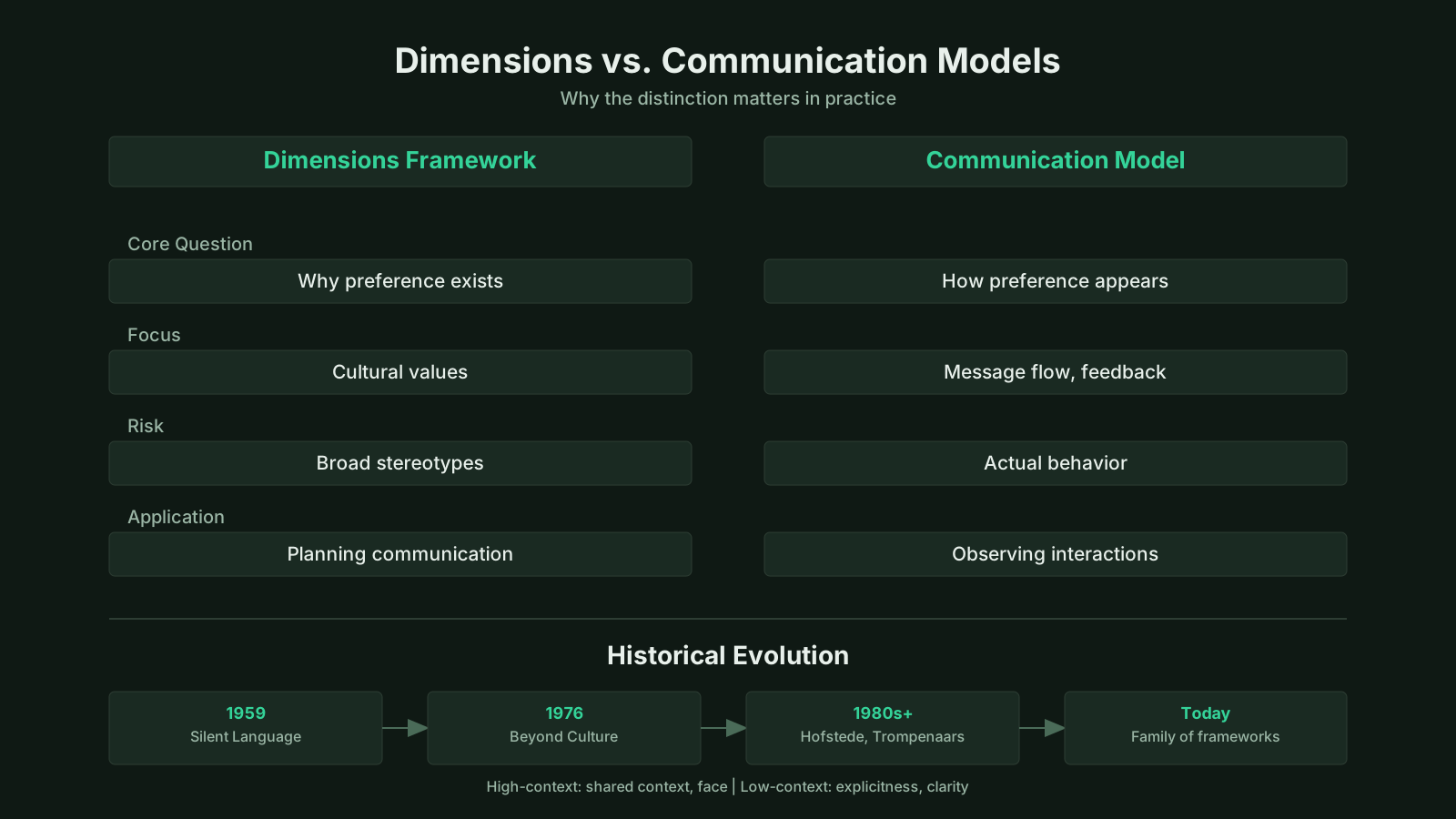
In project management, the cross-cultural communication model definition encompasses a set of analytical lenses that help practitioners recognize why the same message can land differently in different cultural settings. A model may map communication along dimensions such as context, hierarchy, directness, or attitudes toward time. Unlike a communication plan, which specifies channels and frequency, a cross-cultural communication model explains the underlying expectations that shape whether those channels will be trusted, whether feedback will be candid, and whether silence signals agreement or concern.
These models function as diagnostic tools rather than prescriptive formulas. They do not tell a project manager exactly what to say. Instead, they provide a structured way to notice patterns that might otherwise be invisible. For example, a project manager might observe that a team member from one culture frequently raises risks in private meetings but stays quiet in group settings. A cross-cultural communication model can help interpret that pattern without assuming the person lacks confidence or commitment.
The term is often used interchangeably with cultural dimensions frameworks, cultural communication theory, or intercultural competence models. That is not entirely accurate. A cross-cultural communication model concentrates specifically on communication behavior, although it draws heavily on broader cultural value research. In a project setting, the model sits between organizational culture and individual personality. It explains general tendencies within a cultural group, but it never replaces the need to understand the actual people on the team.
Key Insights on Cultural Models
- Analytical lenses for cultural differences
- A cross-cultural communication model provides analytical lenses that help project managers understand why the same message can take on different meanings depending on the cultural context.
- Diagnostic tools, not formulas
- These models function as diagnostic tools that surface underlying behavioral patterns, such as why a team member flags risks privately yet remains silent in group settings, rather than prescribing step-by-step solutions.
- Focus on communication behavior
- The model focuses specifically on communication behavior and draws on broader cultural value research, yet it cannot replace the need to understand the actual individuals on the team.
Origins and Cross-Industry Context
The origins of cross-cultural communication models lie primarily in anthropology, sociology, and cross-cultural psychology, not in project management itself. Edward T. Hall introduced the distinction between high-context and low-context communication while working with the United States Foreign Service Institute in the mid-twentieth century. His work showed that cultural groups differ in how much meaning is embedded in words versus the surrounding situation. Geert Hofstede later developed a set of cultural dimensions based on large survey data from IBM employees across many countries. Those dimensions became a common reference point for understanding power distance, individualism, uncertainty avoidance, and related values.
Other fields adopted these ideas long before project management did. Diplomacy, international business, medicine, aviation, and the military have used cross-cultural communication concepts to reduce misunderstandings in high-stakes environments. In aviation, for instance, researchers studied how cultural norms around authority affect cockpit communication and error reporting. In medicine, similar work explored how patients and providers from different backgrounds interpret symptoms, risk, and treatment instructions. These industries demonstrated that cultural communication patterns have direct operational consequences, not merely social ones.
Project management borrowed from this tradition as global delivery models became common. Software development, construction, engineering, and professional services began to rely on distributed teams and multinational stakeholders. The rise of outsourcing, offshoring, and global program delivery made cross-cultural communication models relevant for scheduling, risk reporting, requirements gathering, and stakeholder management. What started as an anthropological insight became a practical project governance concern.
Key Components of Cross-Cultural Communication Models
The key components of a cross-cultural communication model vary by framework, but most models address a recurring set of communication-related dimensions. These components help explain how people prefer to send messages, receive feedback, express disagreement, and interpret authority. They are not personality types. They are broad cultural tendencies that shape communication norms within a group.
High-Context and Low-Context Communication
High-context communication relies on shared understanding, implicit cues, relationships, and situational factors to carry meaning. Low-context communication places more weight on explicit words, written detail, and direct expression. In a project environment, a high-context stakeholder may express concern through hesitation, vague wording, or a question about timing rather than a direct objection. A low-context stakeholder may expect the same concern to be stated clearly in a risk register or issue log.
This distinction has practical implications for meeting management, status reporting, and requirements documentation. A project manager working with a mixed team may need to create multiple channels through which people can raise concerns. Some team members will feel comfortable speaking openly in a large meeting. Others will only raise serious issues in a private conversation or after a relationship has been established. A cross-cultural communication model helps the project manager recognize that both behaviors can represent genuine engagement.
Power Distance and Hierarchy
Power distance refers to the degree to which less powerful members of a group accept and expect unequal power distribution. In high power distance cultures, challenging a senior leader publicly may be seen as inappropriate, even if the project methodology encourages open escalation. In low power distance cultures, team members are more likely to question a sponsor or project manager directly and expect that challenge to be treated as normal.
This component affects decision making, risk escalation, and the design of governance forums. A project manager might assume that a quiet steering committee means approval, when in fact the silence reflects deference to a sponsor. In another setting, the same silence might mean disengagement. Reading the silence correctly requires understanding the power distance norms in the room.
Individualism and Collectivism
Individualist cultures tend to prioritize personal accountability, individual achievement, and direct responsibility. Collectivist cultures place greater weight on group harmony, loyalty, and shared identity. Communication in collectivist settings may be more indirect when it risks embarrassing a colleague or disrupting group cohesion. In individualist settings, calling out a specific owner for a missed deliverable may be expected.
These tendencies shape how project teams handle performance feedback, recognition, and conflict. A project manager who praises one person in a collectivist team may inadvertently create discomfort if the achievement is seen as shared. Conversely, a team from a highly individualist background may find collective recognition vague and unsatisfying. Neither reaction is wrong, but both require different communication choices.
Uncertainty Avoidance and Risk Communication
Uncertainty avoidance describes how comfortable a culture is with ambiguity, change, and unknown outcomes. High uncertainty avoidance cultures often prefer detailed plans, formal processes, and clearly defined acceptance criteria. Low uncertainty avoidance cultures may tolerate more experimentation, iterative discovery, and flexible scope. In project communication, this affects how risks are discussed and how much detail is needed before a decision feels legitimate.
A project manager may notice that stakeholders from a high uncertainty avoidance background ask for more documentation, more contingency plans, and more formal sign-offs. Stakeholders from a low uncertainty avoidance background may interpret those requests as bureaucratic resistance. A cross-cultural communication model can reframe the tension as a difference in comfort with ambiguity rather than a disagreement about project goals.
Time Orientation and Monochronic versus Polychronic Behavior
Monochronic cultures tend to treat time as linear and segmented, with a strong focus on schedules, deadlines, and one task at a time. Polychronic cultures treat time as more fluid and relational, where maintaining relationships may take priority over strict task sequencing. In global projects, this can create friction around meeting punctuality, agenda adherence, and responsiveness to messages.
Neither orientation is inherently better for project delivery, but each creates different expectations. A monochronic project manager may interpret a delayed response as disinterest. A polychronic stakeholder may interpret an overly rigid agenda as impersonal. The model helps both sides see that the behavior is not a signal of commitment level, but a reflection of how time and relationships are ordered.
Directness and Negative Feedback
Some cultural groups prefer direct negative feedback, delivered explicitly and without much softening. Others prefer indirect or diplomatically framed feedback, especially in public or hierarchical settings. Erin Meyer's Culture Map includes a scale for evaluating direct versus indirect feedback, distinguishing it from overall communication context. A team can be low-context in daily communication but still prefer indirect feedback when performance is being discussed.
This distinction matters in project retrospectives, performance reviews, and quality audits. A project manager who asks for candid feedback may receive only polite affirmations from some team members, even when issues exist. Creating anonymous channels, private conversations, or written feedback mechanisms can help gather useful information without forcing people to violate deeply held communication norms.
Key Insights on Cross-Cultural Communication
- High-context communication uses implicit shared cues
- In high-context communication, meaning depends on shared context, unspoken signals, and situational awareness, so stakeholders often reveal concerns through hesitation, tactful language, or indirect phrasing rather than stating objections directly.
- Low-context communication demands explicit direct wording
- Low-context communication requires precise wording, written documentation, and straightforward expression, meaning stakeholders expect concerns to be recorded clearly in risk registers or issue logs instead of being left to interpretation.
- Power distance governs authority and disagreement norms
- In high power distance cultures, openly challenging senior leaders is often viewed as disrespectful and is avoided, while in low power distance cultures team members are expected to question project managers or sponsors directly and treat such challenges as a normal part of collaboration.
Purpose and Importance of Cross-Cultural Communication Model
The purpose and importance of cross-cultural communication models in project management center on reducing misinterpretation and increasing the reliability of information flow. Projects depend on accurate status reports, early risk warnings, clear requirements, and timely decisions. When cultural communication patterns go unrecognized, these critical signals can be delayed, softened, or lost entirely.
These models also support stakeholder engagement. A project manager who understands that trust is built differently across cultures can adjust relationship-building activities. In some contexts, trust develops through task performance and reliable delivery. In others, trust develops through personal connection, shared meals, and informal conversation. A cross-cultural communication model helps the project manager avoid treating one path to trust as universally valid.
Beyond reducing friction, these models can improve decision quality. Diverse teams often hold different assumptions about what a deadline means, what an escalation requires, or what constitutes a commitment. Surfacing those assumptions through a shared model can turn cultural variation from a hidden risk into an explicit planning input. The model does not eliminate disagreement, but it gives the team language to discuss disagreement without blaming individuals.
Cross-Cultural Communication Model in PMBOK and PRINCE2
The cross-cultural communication model in PMBOK is not defined as a separate process, but it appears throughout the communication and stakeholder management areas. In the PMBOK Guide Sixth Edition, Plan Communications Management, Manage Communications, and Monitor Communications sit within the Project Communications Management knowledge area. Cultural diversity is treated as an enterprise environmental factor that influences communication planning. The basic sender-receiver model and interactive communication model are acknowledged, and cultural differences affect how messages are encoded, transmitted, decoded, and confirmed.
In practice this means a communications management plan should address more than distribution lists and meeting cadence. It should also consider how stakeholders prefer to receive, challenge, and confirm information. A project manager working within the PMBOK framework may use a cross-cultural communication model to tailor the communication plan for different stakeholder groups. The same report may need to be written with more explicit detail for some audiences and supported by direct conversation for others.
PMBOK Guide Seventh Edition shifts away from knowledge areas toward project management principles and performance domains. Communication remains embedded in the Team and Stakeholder performance domains. Tailoring is emphasized more strongly, which creates space for cross-cultural communication models as a tailoring consideration rather than a rigid procedure. The principle of effective stakeholder engagement requires understanding the cultural context in which stakeholders operate.
In PRINCE2, the Communication Management Approach is a management product that describes the means, frequency, and audiences for project communication. PRINCE2 explicitly expects this approach to be tailored to the project environment, which includes cultural factors. The project manager owns the Communication Management Approach, but the project board may need to approve it if communication controls are sensitive. A cross-cultural communication model can inform whether reporting lines should be direct, whether issues should be escalated through formal channels, and how much detail different governance layers require.
PRINCE2 also uses management by exception, which presumes that delegated authority will be exercised within agreed tolerances. This assumption may feel natural in some cultures and uncomfortable in others. High power distance or collectivist settings may require additional discussion before project board members feel safe acting autonomously. A cross-cultural communication model helps the project manager identify where management by exception needs more explicit reinforcement or where it may generate resistance.
Key Takeaways on PMBOK Cultural Communication
- Embedded in management areas
- Cross-cultural communication is embedded across the communication and stakeholder management knowledge areas rather than treated as a separate PMBOK process.
- Culture as environmental factor
- Cultural diversity functions as an enterprise environmental factor that shapes both the design and implementation of communication plans.
- Tailored stakeholder communication
- Project managers need to tailor communication plans to stakeholder preferences, ensuring the same information is delivered through explicit written detail for some audiences and through direct conversation for others.
- Seventh Edition cultural guidance
- The Seventh Edition reframes culture around principles and performance domains, influencing reporting lines, escalation channels, and governance expectations, while high power distance environments require additional discussion before board members exercise autonomous decision-making.
Cross-Cultural Communication in Agile and Hybrid Environments
Cross-cultural communication in Agile project management becomes particularly visible because Agile methods rely heavily on direct conversation, rapid feedback, and team self-organization. Daily stand-ups, sprint reviews, and retrospectives assume that team members will speak openly about progress, obstacles, and failures. Those assumptions are not culturally neutral. In a high power distance setting, a junior developer may not feel comfortable telling a senior product owner that a story is at risk. In a high-context setting, a team member may signal concern through hesitation rather than an explicit blocker.
Agile frameworks do not automatically solve these challenges. In fact, they can amplify them when the team mistakes silence for alignment. A scrum master or agile coach may need to adapt facilitation practices without abandoning transparency. This can include rotating meeting facilitation, using written check-ins before verbal discussions, creating smaller feedback groups, or holding private conversations after retrospectives. The goal is not to lower expectations for candor, but to create conditions where candor is culturally possible.
Hybrid environments add another layer of complexity. Predictive governance artifacts such as formal status reports, change requests, and stage gates coexist with iterative delivery rhythms. Different stakeholder groups may have different expectations about which communication channel carries authority. A cross-cultural communication model helps the project manager understand why a sponsor from one region expects a formal written decision while a team from another region treats a verbal agreement as binding. Both can be legitimate, but the project needs an explicit rule for what counts as an official commitment.
BVOP Perspective on Cross-Cultural Communication
The BVOP perspective on cross-cultural communication aligns with its broader emphasis on reducing ambiguity and making project information accessible to all stakeholders. BVOPM, or Business Value-Oriented Project Management, treats short, readable planning documents as a control mechanism. The idea is that communication artifacts should be understandable not only by senior stakeholders but also by new team members and people from different cultural and professional backgrounds.
This principle has direct relevance for cross-cultural communication. When planning documents are overlong or rely on implicit organizational shorthand, non-native speakers and people from different communication backgrounds are at a disadvantage. BVOPM also uses hiring-and-training-based dependency analysis, which recognizes that team capability depends on how people are onboarded and developed. From this perspective, cross-cultural communication is not a soft skill separate from project delivery. It is part of the dependency chain that determines whether instructions, risks, and commitments are actually understood.
Core Insights on BVOPM Communication
- Readable documents as control mechanism
- BVOPM uses concise, readable planning documents as a control mechanism to ensure that critical information remains accessible to senior stakeholders, new team members, and professionals from diverse cultural and linguistic backgrounds.
- Ambiguity disadvantages non-native speakers
- Overlong planning documents and implicit organizational shorthand systematically disadvantage non-native speakers and professionals from different communication backgrounds, creating avoidable barriers to accurate comprehension.
- Communication tied to delivery dependency
- Cross-cultural communication is a critical link in the dependency chain that determines whether instructions, risks, and commitments are genuinely understood, making it a delivery risk factor rather than a soft skill peripheral to project outcomes.
Practical Application in Project Management
The practical application of cross-cultural communication models occurs across the project life cycle, from initiation through closing. During initiation, a project manager can use these models to inform stakeholder analysis. Understanding whether a stakeholder group is likely to expect formal written communication, direct escalation, or relationship-based trust building shapes how the project charter and initial stakeholder engagement plan are developed.
During planning, the models feed into the communications management plan, risk management approach, and meeting design. A project manager may decide that certain stakeholder groups need visual summaries instead of dense text, or that some decisions require a pre-meeting before the formal steering committee. These are not superficial adjustments. They can determine whether critical risks surface early enough to be managed.
During execution, cross-cultural communication models guide daily interaction. A team leader may notice that a remote team member consistently says yes to commitments but misses deadlines. Instead of assuming a performance problem, the leader might recognize that in some communication cultures, saying no directly is difficult. The corrective action then focuses on creating alternative ways to surface capacity issues, such as written work-in-progress limits or private capacity checks.
During monitoring and controlling, the models help interpret status data. A green status report from a high-context team may not carry the same meaning as a green status report from a low-context team. The project manager may need to supplement formal reports with direct conversations or ask more specific questions about variance and confidence. At closing, lessons learned discussions can also be affected by cultural norms around blame, credit, and constructive criticism. Using a cross-cultural lens helps the facilitator gather insights without triggering defensiveness.
Common Challenges, Pitfalls, and Misconceptions
One of the most frequent common misconceptions about cross-cultural communication models is that they can be used to predict exactly how an individual will behave based on nationality. This is a serious mistake. Cultural dimensions describe group tendencies, not personal traits. A team member from a country that scores high on uncertainty avoidance may be highly tolerant of ambiguity because of professional background, personality, or experience. The model provides a starting hypothesis, not a conclusion.
Another pitfall is stereotyping. When cultural models become labels, they stop being analytical tools and start being biases. A project manager who assumes that all stakeholders from a particular region will avoid conflict may fail to invite open debate. Similarly, assuming that a low-context culture always values bluntness can cause unnecessary friction. The goal is to use the model to ask better questions, not to replace questions with assumptions.
There are also limitations in the models themselves. Many of the classic frameworks were built on national culture data, which can obscure variation by region, generation, profession, and organizational culture. A software engineer in one country may have more communication norms in common with a software engineer in another country than with a lawyer from the same country. Cross-cultural communication models do not always capture that layered reality. They are best used in combination with direct observation and individual discussion.
Practitioners sometimes apply these models too late, after conflict has already hardened into blame. The model works better as an early planning and team formation tool than as a rescue remedy. It is also less useful in small, highly cohesive teams that already share strong communication norms, although it can still help when new members or external stakeholders join. Lastly, language proficiency should not be confused with cultural communication competence. A fluent speaker can still misinterpret indirect signals, and a non-native speaker may be extremely skilled at reading cultural context.
Key Pitfalls in Cultural Frameworks
- Nationality cannot predict behavior
- Cultural dimensions capture broad group tendencies rather than individual traits, so no framework can reliably predict how a particular person will act solely on the basis of their nationality.
- Models are hypotheses, not conclusions
- Treating cultural frameworks as definitive labels rather than as analytical starting points turns them into biases that can suppress candid discussion and create unnecessary friction.
- National data hides subgroup variation
- National-level data conceals meaningful variation across regions, generations, professions, and organizational cultures, reducing the relevance of such frameworks in small teams that operate with their own communication norms.
- Fluency is not cultural skill
- Language proficiency does not automatically confer cultural competence because a fluent speaker can still misread indirect cues, while a non-native speaker may be highly skilled at interpreting the cultural context behind the words.
Relationships to Other Project Management Concepts
The cross-cultural communication model and stakeholder engagement are tightly linked because engagement effectiveness depends on understanding how stakeholders expect to be informed, consulted, and involved. Stakeholder registers and power-interest grids tell a project manager who matters and how formally they should be engaged. A cross-cultural communication model adds the next layer, determining whether a stakeholder will respond better to direct written communication, a personal phone call, or a formal meeting with a senior sponsor present.
These models also connect to the basic communication model used in project management, which includes sender, encoding, message, medium, decoding, receiver, feedback, and noise. Cultural differences can act as noise at every stage. A sender may encode a message with assumptions that do not transfer. A receiver may decode silence as agreement. Feedback may be constrained by hierarchy. Recognizing these cultural noise sources is part of managing communications effectively.
Conflict resolution and negotiation are other related areas. Thomas-Kilmann conflict modes, such as competing, collaborating, compromising, avoiding, and accommodating, are expressed differently across cultures. A preference for avoiding may be a cultural communication norm, not a lack of courage. Cross-cultural communication models help a project manager interpret conflict behavior without pathologizing it. The same applies to risk attitude. Some cultures communicate risk conservatively and escalate early; others communicate only certainty and may underreport ambiguous threats. Both have implications for risk registers and contingency planning.
The concept should not be confused with a communication plan, a team charter, or a stakeholder engagement plan. Those are project artifacts. A cross-cultural communication model is a conceptual lens that informs how those artifacts are written and used. Emotional intelligence and cultural intelligence are related but distinct. Emotional intelligence focuses on reading individual emotional states. Cultural intelligence focuses on reading group-level cultural patterns. The best project managers use both.
Evolution and Current Thinking
The evolution of cross-cultural communication models reflects a shift from static national culture categories toward more dynamic, context-sensitive approaches. Early models treated culture as a relatively stable set of national values. Later research emphasized organizational culture, professional culture, and the interaction between multiple cultural layers. Current thinking recognizes that a single person may operate with different communication norms depending on the setting, the audience, and the language being used.
Remote work and digital collaboration have changed the application of these models. Written communication now carries more weight, while body language and informal hallway conversations carry less. This affects high-context communicators disproportionately, because they rely on situational cues that are harder to transmit through messaging tools. Emoji, punctuation, response timing, and meeting camera use have become new cultural markers. A project manager in a distributed team needs to interpret digital communication patterns with the same care once reserved for face-to-face interactions.
There is also ongoing debate about the validity of some classic cultural dimension studies. Critics point out that Hofstede's data came from one organization and that later replications show variation. Supporters argue that the dimensions still provide useful heuristics when applied carefully. The current best practice is not to rely on any single model, but to combine multiple frameworks with direct conversation. Cultural intelligence, or CQ, has emerged as a practical complement to communication models. CQ emphasizes the ability to adapt behavior in real time, which matters more than memorizing cultural profiles.
In project management, the trend is toward treating cross-cultural communication as a governance issue rather than a soft skill. Global programs now include cultural considerations in communication plans, onboarding materials, risk workshops, and decision rights. That shift reflects a more honest view of project complexity. A model cannot guarantee understanding, but it can reduce the frequency of costly misunderstandings and surface assumptions that would otherwise remain hidden. In that sense, cross-cultural communication models are not a luxury for international projects. They are a core part of managing information, relationships, and delivery risk in a connected project environment.
Core Takeaways on Cultural Evolution
- Dynamic models replace static categories
- Cross-cultural communication has moved beyond fixed national value models toward adaptive, context-sensitive frameworks that capture the complexity of real-world interactions.
- Norms vary by setting and audience
- Individuals often adjust their communication style according to the setting, audience, and language in use, which makes broad cultural labels unreliable predictors of behavior.
- Digital signals become cultural markers
- Digital elements such as emoji, punctuation, response timing, and camera use now function as cultural signals, placing particular strain on high-context communicators who rely heavily on situational context.
- Real-time adaptation matters most
- Effective cultural intelligence depends on real-time behavioral adjustment rather than the memorization of static cultural profiles, which is why cultural considerations are now embedded in communication plans, onboarding, risk workshops, and decision rights frameworks.